

If you are searching for how to reconnect with your partner emotionally, you may already be feeling the kind of distance that is hard to explain. You still care about each other, but conversations feel more practical than personal, affection has become less natural, or daily stress has replaced the curiosity and warmth you once shared. Emotional disconnection usually does not appear in one dramatic moment. It often grows through missed conversations, unresolved hurts, routine, exhaustion, and small bids for connection that repeatedly go unanswered.
Reconnection usually does not require a perfect vacation or dramatic declaration. It is more often built through repeated actions: noticing the distance, listening carefully, restoring appreciation, repairing old tension, and making time for each other. The goal is to create conditions for closeness while watching whether both people participate.
Quick Takeaway: Do not wait until you “feel connected” before acting connected. Small moments of attention, honesty, affection, curiosity, and follow-through can help rebuild the emotional environment in which closeness is more likely to return.
How to Reconnect With Your Partner Emotionally Without Forcing Closeness
A useful starting point for how to reconnect with your partner emotionally is to stop treating emotional distance as proof that the relationship is already broken. The Gottman Institute notes that disconnection can build gradually through fading communication, reduced appreciation, less affection, fewer shared activities, and avoidance of meaningful conversations. It also emphasizes that trust, respect, empathy, communication, friendship, daily rituals, and vulnerability can support a stronger emotional bond.
Relationship research also shows why responsiveness matters. In a study of dating couples, concrete responsive behavior predicted feeling that a partner was responsive, and those perceptions were linked with greater intimacy for both partners. In practical terms, the small ways you listen, respond, remember, comfort, and acknowledge each other can shape whether the relationship feels emotionally alive.
1. Name the Distance Without Turning It Into an Accusation
The first step is to talk about the disconnection in a way that invites collaboration rather than defensiveness. “You never care about us anymore” may express real pain, but it also gives your partner a character judgment to defend against. A more workable opening is specific: “I feel like we have been talking mostly about schedules and responsibilities lately, and I miss feeling close to you.”
That statement does two important things. It describes the pattern and reveals the need underneath it. Instead of demanding an immediate solution, ask whether your partner has noticed the same shift. You may discover that both of you have felt lonely while each person assumed the other was simply too busy or uninterested.
This matters for how to reconnect with your partner emotionally because repair usually begins with a shared understanding of the problem. You do not need identical explanations, but both people need enough honesty to say, “Yes, something has changed, and it matters to me.” If one partner refuses to acknowledge obvious distance or mocks the concern, that response is important information too.
2. Rebuild the Small Bids for Connection You May Be Missing
Emotional reconnection often happens in moments that seem too small to count. Your partner sighs after reading an email, tells you a random story, asks what you think about something, reaches for your hand, or says, “Come look at this.” These are everyday attempts to connect. The Gottman Institute calls them bids for connection and describes “turning toward” those bids as a way to build trust and emotional connection.
You do not need to respond perfectly. Sometimes turning toward means a full conversation; sometimes it means saying, “I want to hear this, give me five minutes.” What matters is the pattern. Repeatedly missing each other’s bids can make a relationship feel lonely even when you spend plenty of time together.
For one week, notice a few small bids each day and respond intentionally when you can. Make bids of your own too by asking a question, sharing a thought, or initiating affection. The purpose is rebuilding the habit of reaching and responding, not keeping score.
3. Get Curious About Who Your Partner Is Now
Long-term partners often know each other deeply, but familiarity can quietly turn into assumption. You remember who your partner was five years ago and stop asking who they are becoming now. Work has changed, friendships have changed, worries have changed, goals have changed, and the things that make them feel hopeful or stressed may be different too.
One practical part of how to reconnect with your partner emotionally is updating your knowledge of each other. Ask questions beyond logistics: “What has been taking up the most mental space for you lately?” “What are you excited about that we haven’t really discussed?” Then listen without turning every answer into a solution.
Curiosity should move both ways. Share your own inner world too, so reconnection becomes mutual discovery rather than one partner doing all the asking.

4. Listen for the Emotion Before You Solve the Problem
When relationships become practical, conversations often become efficient. One partner reports a problem and the other immediately offers advice, a fix, a counterargument, or a reason it should not feel so serious. That may be useful sometimes, but emotional connection often requires understanding before problem-solving.
If your partner says, “I feel like I’m failing at work,” try staying with the feeling first. You might ask, “What part has been hardest?” or say, “That sounds exhausting.” If they want advice, they can ask for it or you can offer it after they feel heard. This kind of responsiveness can make emotional expression feel safer; research has found that perceiving a partner as responsive is associated with greater emotional expression toward that partner.
This is important when learning how to reconnect with your partner emotionally after months of feeling misunderstood. People often stop opening up when every vulnerable moment turns into correction, debate, or dismissal. A different response can slowly teach both partners that honesty is worth the risk again.
At this stage, some readers want more structured guidance. The official Make Him Worship You site currently lists the program for $37, membership-login access, and a 60-day satisfaction guarantee, and positions it around male psychology, communication, emotional openness, attraction, and relationship dynamics.
If you want structured male-perspective relationship guidance to compare with the healthy reconnection principles in this article, you can consider whether Make Him Worship You fits your needs and values.
5. Bring Appreciation Back Into the Relationship
Emotional distance makes it easy to notice everything that is missing. You see the dishes left behind, the distracted replies, the late arrival, the forgotten plan, and the habit that has irritated you for years. Those concerns may be legitimate, but if criticism becomes the dominant lens, both partners can begin feeling unseen for what they still contribute.
Reconnection needs accurate appreciation, not forced positivity. Notice specific things you genuinely value: “Thank you for handling dinner when I was exhausted,” or “I appreciated that you checked on me after that meeting.” Specific appreciation feels more believable because it points to something real.
The Gottman Institute’s guidance on emotional connection includes gratitude, friendship, empathy, and appreciation as ways partners can strengthen their bond. It also recommends daily rituals and intentional connection rather than relying only on occasional grand gestures.
Common Mistake: Do not use appreciation as a trick to get your partner to behave. If you praise every small effort while your own contributions remain invisible, resentment will return. Appreciation should become a two-way culture.
6. Create Small Rituals That Make Connection Predictable
Many couples wait for emotional closeness to happen spontaneously. Early in a relationship, that may work because novelty naturally creates conversation and attention. Later, work, children, errands, screens, fatigue, and routines compete for the same time. Connection often needs a place on the calendar before it disappears completely.
A ritual does not have to be elaborate. It might be coffee before work, a phone-free walk after dinner, a weekly check-in, or twenty minutes talking before turning on a show. Repeated rituals create dependable opportunities to notice each other.
For emotional reconnection to become practical rather than theoretical, choose one ritual small enough to keep during a busy week. Consistency matters more than ambition. A four-hour weekly “relationship meeting” that both people dread is less useful than a short ritual you genuinely enjoy.
Daily relationship habits → small rituals that help couples feel emotionally close
7. Bring Back Affection, Friendship, and Shared Enjoyment
Not every reconnection conversation should be serious. Couples can become so focused on solving the relationship that they stop doing the things that made them enjoy being together. Friendship matters because emotional closeness is not only built through vulnerability; it is also built through laughter, play, affection, shared memories, and the sense that your partner is still someone you like spending time with.
Create a new experience together without putting pressure on the outcome. Try a new restaurant, cook something unfamiliar, take a walk somewhere new, play a game, or revisit a favorite place. The goal is to give your relationship fresh material, not manufacture romance on command.
Affection can also become more natural when pressure decreases. A hug, hand on the shoulder, kiss goodbye, sitting closer, or affectionate touch can communicate warmth without demanding a deep conversation every time. Research has found that perceived partner responsiveness predicts affectionate touch, suggesting that emotional and physical closeness can reinforce each other in everyday couple life.
8. Repair the Hurt That Keeps Reopening the Distance
Sometimes emotional distance is protecting an unresolved injury such as betrayal, repeated broken promises, feeling dismissed, or a major conflict. More date nights may create temporary relief without repairing the underlying problem.
Name the unresolved issue clearly. The partner who caused harm should hear the impact without hiding behind intention, while the hurt partner explains what repair would look like now. That may include an apology, changed behavior, greater transparency, stronger boundaries, or couples support when the issue is too entrenched to navigate alone.
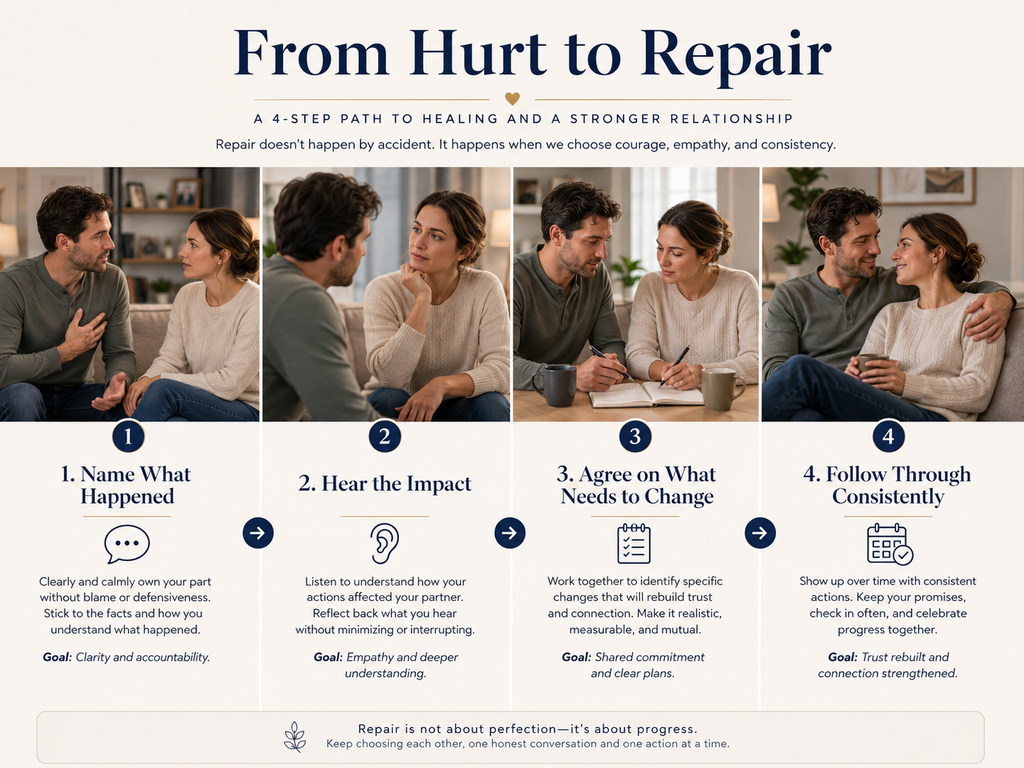
This is where how to reconnect with your partner emotionally becomes more than adding pleasant moments. Trust grows through repeated evidence that the problem is being handled differently. If the same injury keeps happening, reconnection cannot be sustained by better communication techniques alone.
Commercial relationship advice also deserves a careful filter here. The Make Him Worship You sales page includes material framed around communication, vulnerability, conflict, and male psychology, but it also uses strong promotional claims about making a man “worship,” become “addicted,” or become sexually “obsessed.” Those are seller marketing claims, not guaranteed relationship outcomes.
If unresolved communication patterns and emotional openness are where you feel most stuck, review Make Him Worship You critically and use only guidance that supports consent, honesty, mutual respect, and real repair.
9. Protect Time for the Relationship You Want to Rebuild
Reconnection requires enough contact for new patterns to become real. If every conversation happens while one person is multitasking, every date gets cancelled, or weeks pass without intentional time together, emotional closeness has very little room to grow. Saying the relationship matters and creating no space for it are contradictory messages.
Protect some time for the relationship, but keep it realistic. It could be a planned date, a weekly hour without screens, a daily check-in, or a recurring shared activity. The best structure is one both of you can sustain.
Also protect quality rather than only quantity. Three hours sitting beside each other while scrolling separately may feel less connecting than thirty attentive minutes. Put some boundaries around distractions and let your partner experience your presence.
Quality time in relationships → how to make time together feel emotionally meaningful again
How to Tell Whether Reconnection Is Actually Working
Reconnection should become visible in ordinary life. You may notice conversations becoming less forced, affection returning, more spontaneous humor, increased curiosity, and greater willingness to share stress before it turns into conflict. Small misunderstandings may also become easier to repair because there is more goodwill in the relationship.
Signs to Watch
- You both initiate conversations that are not only about logistics.
- Your partner responds to more of your bids for connection.
- Appreciation feels more natural and specific.
- You know more about what the other person is currently thinking and feeling.
- Affection and shared enjoyment are returning.
- Difficult conversations feel more honest and less threatening.
- Both people are contributing to repair rather than one partner doing all the work.
Do not expect constant closeness. Healthy relationships still include tired days, separate interests, and misunderstandings, so look for direction rather than perfection.
When Emotional Reconnection Cannot Be One-Sided
One of the hardest parts of how to reconnect with your partner emotionally is accepting that one person cannot create mutual intimacy alone. You can improve how you listen, initiate, appreciate, and communicate, but your partner still has to respond, reveal, repair, and participate.
If every attempt to connect is mocked, ignored, or treated as unreasonable, the issue may not be lack of technique. If a partner repeatedly refuses meaningful conversation, violates important boundaries, or expects you to carry all emotional work, consider what that pattern means for the relationship you want.
You can invite reconnection. You cannot perform both sides of it.
Where Make Him Worship You May Fit
The official Make Him Worship You offer currently lists the complete program at $37. The site says buyers receive a membership login for instant digital access and displays a 60-day satisfaction guarantee. The long-form sales page says the program can be accessed on a phone, tablet, or computer and currently lists three gifts: When To Sleep With A Man, Unstoppable Confidence, and The Good Girl’s Guide To Texting Dirty.
The program may appeal to an adult reader who prefers direct, gender-specific material about male psychology, attraction, and communication. It may be a weaker fit if you dislike promotional promises about controlling another person’s desire or attention. Evaluate any advice by whether it supports honesty, boundaries, reciprocity, and respect.
If you prefer structured male-perspective guidance and are comfortable applying that filter, Make Him Worship You can be considered as an optional supplement rather than a replacement for mutual effort, compatibility, or professional couples support when needed.
What Emotional Reconnection Really Looks Like
Ultimately, how to reconnect with your partner emotionally is less about recreating the exact relationship you had at the beginning and more about learning how to know each other again in the life you have now. People change. Stress changes. Responsibilities change. A strong relationship adapts by renewing curiosity, responsiveness, friendship, affection, appreciation, and trust.
The most useful reconnection work is surprisingly ordinary. You look up when your partner speaks. You ask the second question. You say thank you. You make time. You share what is actually happening inside you. You repair the hurt you used to avoid and protect small rituals that remind both of you that the relationship is still alive.
You cannot guarantee that emotional closeness will return simply because you follow a checklist. Both people have choices. But if mutual care is still present, these practices can create healthier conditions for intimacy to grow again. That is the deeper purpose of how to reconnect with your partner emotionally: not to force a feeling, but to rebuild the everyday patterns that allow two people to feel seen, safe, valued, and close.
How do you emotionally reconnect with a partner after growing apart?
Start by naming the distance calmly, creating more intentional time together, responding to small bids for connection, asking about each other’s inner world, and rebuilding appreciation. Focus on repeated daily connection rather than one dramatic romantic gesture.
Can emotional connection come back in a relationship?
It can improve when both partners still care and are willing to communicate, repair unresolved problems, and create new patterns of responsiveness and closeness. No method can guarantee reconnection if only one person is willing to participate.
What are signs of emotional disconnection in a relationship?
Common signs can include mostly logistical conversations, reduced affection, less curiosity, feeling unseen, fewer shared activities, avoiding deeper conversations, and spending time together without feeling emotionally present.
How can couples reconnect when they are both busy?
Choose small repeatable rituals rather than waiting for large blocks of free time. A short daily check-in, phone-free meal, weekly walk, or protected evening can create dependable opportunities for connection.
Should we talk about every unresolved problem before reconnecting?
Not every minor issue needs a major discussion, but recurring hurts that continue creating distance usually need to be addressed. Pleasant experiences alone may not repair trust when the same unresolved injury keeps returning.
What if my partner does not want to reconnect emotionally?
You can communicate your needs and invite healthier connection, but you cannot create mutual intimacy alone. If your partner consistently refuses to participate, consider whether that relationship pattern meets your emotional needs.