

If you are trying to understand how to change your money mindset, you may already know that simply telling yourself to “think positively about money” is not enough. You can want financial security while still avoiding your bank balance, feeling guilty when you spend, assuming you will never earn enough, or believing that other people are simply “better with money.” Those patterns can make financial decisions feel emotional long before they become practical.
A healthier money mindset is not about pretending every financial problem can be solved with optimism. It is about becoming more aware of the beliefs influencing your choices, questioning beliefs that no longer serve you, and building routines that support the financial life you actually want. That combination of reflection and practical action can help you move from vague anxiety toward greater clarity and control.
The Consumer Financial Protection Bureau describes financial well-being in terms that go beyond income alone, including control over everyday finances, the ability to handle financial shocks, progress toward goals, and freedom to make meaningful choices. In other words, improving your relationship with money is not simply about having more—it is also about developing greater security, direction, and confidence in how you manage what you have.
Why Your Money Mindset Matters
Your “money mindset” is a practical way of describing the assumptions, expectations, emotions, and beliefs you bring into financial decisions. Some beliefs may be useful, such as believing that planning ahead gives you more choices. Others may quietly work against you, such as “I always mess up with money,” “saving is impossible for people like me,” or “if I earn more, all my money problems will automatically disappear.”
Many of these ideas do not begin with a deliberate decision. The American Psychological Association notes that beliefs and attitudes about money can develop early and may operate without much conscious awareness. Looking critically at what you learned about money while growing up can therefore be useful when trying to understand present-day avoidance, shame, or financial habits.
That does not mean childhood determines your financial future. It means awareness gives you something specific to work with. Instead of labeling yourself as “bad with money,” you can identify the belief behind a behavior and decide whether it still makes sense in your current life.
Abundance mindset → how to develop an abundance mindset without ignoring reality
how to change your money mindset in 7 Grounded Steps
Changing your relationship with money is easier when you work on both sides of the equation: the story you tell yourself and the behavior that follows that story. Mindset without action can become wishful thinking, while action without examining your beliefs can feel like forcing yourself through the same stressful cycle.
The following seven shifts combine reflection with practical financial behavior. You do not need to master all seven immediately. Start with the belief or habit creating the most friction in your life and build from there.
1. Separate Your Financial Facts From Your Financial Story
Start by distinguishing what is objectively true from what you automatically conclude about it. Suppose your savings balance is lower than you want. “I currently have $600 saved” is information; “I will never be financially secure” is an interpretation.
Those two statements create very different emotional responses. The first gives you something measurable that can be changed over time, while the second can encourage helplessness. When you notice a stressful money thought, write down the factual situation first and then the story your mind is attaching to it.
Try a simple two-column journal exercise:
- Financial fact: What can I verify?
- Automatic story: What am I assuming this means?
- More useful interpretation: What could I believe that is realistic but less limiting?
- Next action: What is one step available to me now?
For example, “I spent more than planned this month” does not have to become “I have no self-control.” A more productive interpretation might be, “My current spending plan does not reflect what I actually spend, so I need better information and a more realistic system.”
This shift matters because facing your numbers becomes easier when financial information stops functioning as a verdict on your character.
2. Identify the Money Beliefs You Inherited
Think about the messages that surrounded money when you were younger. Was money discussed calmly or only during arguments? Were wealthy people described as selfish? Was spending associated with success? Did saving feel like security, deprivation, or something your family simply could not prioritize?
You may still be following rules that were never consciously chosen. A belief such as “money disappears as soon as you get it” can create urgency to spend, while “I must never spend on myself” can produce guilt even when a purchase fits comfortably within your budget.
Ask yourself:
- What did the adults around me believe about wealthy people?
- What did I learn about saving?
- Was discussing money considered normal, embarrassing, or stressful?
- What did success look like in my household?
- Which of those beliefs still help me?
- Which ones would I choose differently today?
The goal is not to blame your family. Financial circumstances, culture, employment experiences, and unexpected hardships can all shape the way people talk about money. The useful question is simply whether an inherited rule deserves to remain one of your rules today.
Quick reflection: Finish the sentence, “People like me can never ______ financially.” Then ask whether that statement is a proven fact or a belief you have repeated often enough that it feels like one.
3. Replace Extreme Money Thoughts With Useful Ones
Positive thinking becomes unhelpful when it requires you to deny reality. Repeating “I am wealthy” while feeling anxious about overdue expenses may create a bigger emotional disconnect instead of genuine confidence.
Use statements you can actually believe. Instead of “Money always comes easily to me,” try “I am learning to make more intentional decisions with the money available to me.” Instead of “I will never worry about money again,” try “I can improve my ability to plan for financial uncertainty.”
This is where affirmations can be useful as reflective prompts rather than guarantees. They can remind you of the attitude you want to practice, but they do not cause money to appear or replace budgeting, saving, earning, or professional financial guidance.
Possible grounded money affirmations include:
- I can learn financial skills I was never taught.
- My financial past does not have to dictate every future choice.
- I can make money decisions based on my priorities instead of panic.
- Small improvements still count.
- I am allowed to review a decision and change my approach.
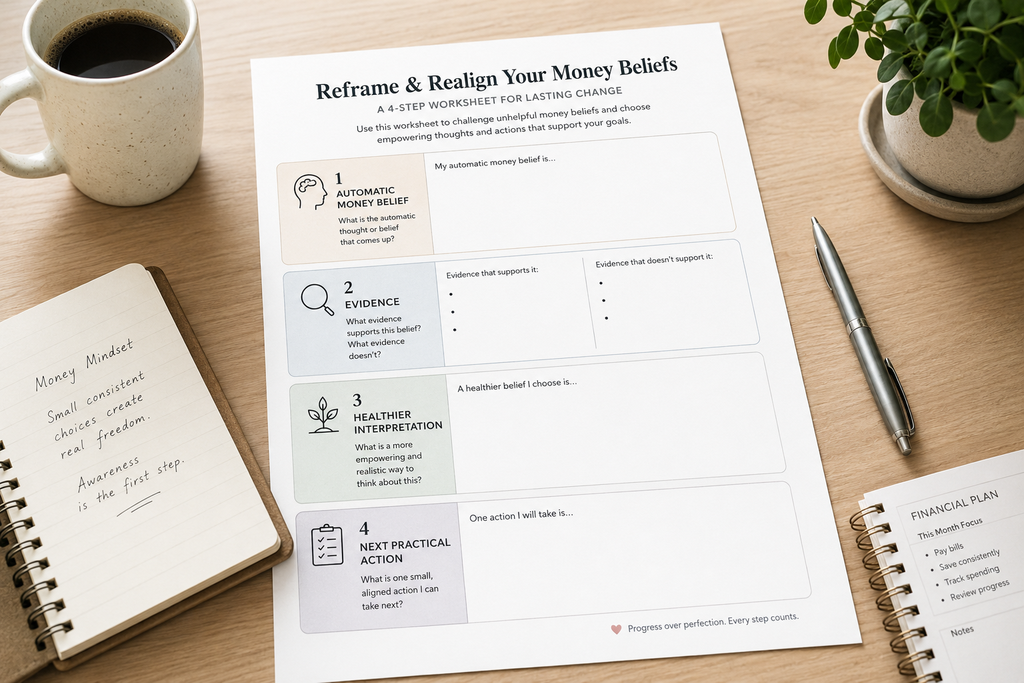
Once you understand this part of how to change your money mindset, the next step is turning those new thoughts into observable behavior.
4. Define What “Enough” Means for Your Own Life
An abundance mindset can become surprisingly stressful when abundance has no definition. If “more” is always the target, progress can remain invisible no matter how much your situation improves.
Instead, translate vague desires into meaningful financial priorities. You may want enough emergency savings to feel less vulnerable, enough flexibility to change jobs, money for travel without relying on debt, the ability to support your family, or simply greater control over everyday expenses.
The CFPB emphasizes that financial well-being involves both security and freedom of choice, including being on track toward financial goals. That is a useful reminder that a healthy financial life cannot be reduced to one universal income or savings number.
Try completing these statements:
- Financial security means ______ to me.
- I would feel more financially peaceful if ______.
- The three money goals that matter most in the next year are ______.
- I want money to give me more freedom to ______.
- One goal I am pursuing mainly because of comparison is ______.
This exercise can help separate genuine goals from pressure created by social media, friends, family, or lifestyle comparison.
If you want optional guided mindset support alongside these exercises, consider The Wealth Signal only if its current offer matches your goals and preferred learning style.
5. Build a Weekly Money Routine That Feels Manageable
Mindset becomes more powerful when a new belief has a matching behavior. If you want to believe “I am capable of handling my finances,” create recurring evidence for that belief.
A weekly money check-in can be simple. Choose one consistent time and spend 15–30 minutes reviewing recent spending, upcoming bills, savings progress, and one financial priority. The objective is not to criticize every purchase; it is to reduce avoidance and make your financial life more visible.
Consumer.gov recommends creating a written budget based on income and expenses, tracking spending during the month, and reviewing what actually happened so the next plan can be adjusted.
Your weekly routine might include:
- Review account balances.
- Look at recent transactions.
- Confirm upcoming bills.
- Check one savings or debt goal.
- Decide on one adjustment for the next seven days.
- Write down one financial win, however small.
A win might be declining an unnecessary subscription, transferring $20 to savings, opening a bill instead of avoiding it, or simply completing your weekly review. This creates a healthier definition of financial progress—one based on repeated actions rather than dramatic transformations.
Money manifestation routine → a grounded daily money manifestation routine
6. Use Visualization to Clarify Actions, Not Predict Outcomes
Visualization can fit into a spiritual money-mindset practice when it is treated as intentional reflection rather than proof that a desired outcome will occur. Imagine what greater financial stability would allow you to do differently, but then connect the picture to choices within your influence.
For example, instead of visualizing a large bank balance with no context, picture yourself opening your accounts without fear, paying expenses calmly, maintaining an emergency cushion, or making a planned purchase without financial panic. Then ask, “What behavior would make this scene more likely?”
That question converts visualization into planning. Your answer might involve increasing savings automatically, learning a new career skill, reducing one recurring expense, negotiating compensation, developing a realistic debt plan, or finally reviewing an area of your finances that you have been avoiding.
What this means: visualization can help define direction. The practical plan is what creates the bridge between today’s circumstances and that desired future.
7. Collect Evidence That Your Financial Identity Is Changing
People often overlook small improvements because they are waiting for a dramatic milestone. Yet your relationship with money may begin changing long before your income or net worth looks dramatically different.
Keep an “evidence list” for one month. Record actions showing that you are becoming more intentional with money: comparing prices before a purchase, asking a financial question you once avoided, saving automatically, sticking with a spending limit, researching a career opportunity, or recovering calmly after an unplanned expense.
CFPB resources emphasize that financial habits, attitudes, values, and routine practices influence day-to-day financial decisions. Its research also links financial skills and financial self-efficacy—confidence in the ability to achieve financial goals—with better financial behavior.
The goal is not to convince yourself that everything is perfect. It is to notice evidence that “I cannot handle money” is no longer an accurate description of how you behave.

If you have been wondering how to change your money mindset, this is one of the most important shifts: stop judging progress only by the final outcome. Notice the identity being built through repeated decisions.
Where The Wealth Signal May Fit Into a Money Mindset Practice
Some readers enjoy building mindset practices independently through journaling, budgeting, reflection, and habit tracking. Others prefer having an additional structured resource because it gives them a consistent framework or makes it easier to maintain a routine.
The Wealth Signal is the ClickBank product connected with this article, but its current official sales page could not be accessed during verification because the supplied website returned a 403 response. For that reason, this article does not claim specific current modules, audio components, creator credentials, bonuses, pricing, refund terms, scientific mechanisms, or promised outcomes.
That distinction matters. A spiritual or mindset-focused product can be considered an optional complement to practical work, but it should not be treated as evidence that wealth can be guaranteed through a particular frequency, signal, visualization, affirmation, or other metaphysical mechanism. Any seller claims should be evaluated according to what the current product page actually states and what evidence, if any, supports them.
A sensible fit would depend on questions such as whether the current product format suits how you prefer to learn, whether its actual content overlaps too heavily with what you can already do independently, whether the cost fits your circumstances, and whether any refund terms are clearly stated.
If you want a structured mindset resource to pair with your weekly money routine, The Wealth Signal may be worth evaluating against those practical fit criteria.
The free practices in this guide remain useful whether you use an additional resource or not. That is important because your long-term financial habits should not depend on continually buying new mindset material.
Limiting beliefs about money → common money blocks and how to challenge them
Make Your New Money Mindset Visible in Real Life
Changing beliefs becomes easier when you give yourself small, repeatable opportunities to act differently. A person who wants to become financially confident does not need to feel confident before reviewing a budget. Reviewing the budget despite discomfort can become evidence that confidence is developing.
Consider choosing one “minimum money action” you will complete every week. Make it small enough that you can still do it during a stressful week: reviewing transactions, transferring a predetermined amount to savings, updating your goal tracker, or planning the next seven days of discretionary spending.
The CFPB recommends goals that are specific and actionable, and its consumer guidance emphasizes planning systems that help turn intentions into behavior. Instead of saying “I need to become better with money,” define what better behavior would look like this week.
A useful money mindset should eventually make financial reality easier to face, not easier to avoid.
A 10-Minute Money Mindset Reset
When you feel stuck, use this short routine:
Minute 1–2: Name the emotion.
Write down whether you feel worried, ashamed, frustrated, impatient, hopeful, or overwhelmed.
Minute 3–4: Name the fact.
Describe the actual financial issue without predicting the future.
Minute 5–6: Identify the belief.
What are you assuming the situation says about you or your future?
Minute 7–8: Choose a better thought.
Create a statement that is realistic, useful, and within your ability to believe.
Minute 9–10: Choose one action.
Decide what you can actually do next.
This routine brings spiritual reflection and practical behavior into the same process. It keeps mindset work from becoming an escape from uncomfortable numbers while also keeping financial planning from becoming a source of unnecessary self-judgment.
Final Thoughts
Learning how to change your money mindset is less about forcing yourself to feel wealthy and more about becoming conscious of the beliefs, emotions, and habits influencing your financial decisions. You can question an inherited belief, define what financial security means to you, build a simple weekly routine, use visualization more intentionally, and track evidence that your behavior is changing.
Your circumstances may not transform overnight, and mindset alone cannot guarantee income, eliminate debt, or create wealth. What it can do is help you approach financial decisions with more awareness and less automatic fear, shame, or avoidance.
The most useful mindset is one that keeps you connected to reality while giving you enough hope and confidence to keep taking constructive action.
If The Wealth Signal fits your needs after you review its current details, you can choose it as optional support—not as a substitute for practical financial action.
Can you really change your money mindset?
Yes, beliefs and habits are not necessarily fixed. Becoming aware of automatic money beliefs, challenging unhelpful assumptions, and repeatedly practicing more constructive financial behaviors can gradually change how you respond to money-related situations. The APA specifically recommends examining and challenging existing beliefs when financial avoidance or denial is involved.
How long does it take to change a money mindset?
There is no universal timeline. A single insight may change how you view a particular belief, while established habits can require repeated practice. Focus on observable progress rather than expecting one dramatic mindset breakthrough.
What is the difference between an abundance mindset and unrealistic positive thinking?
A grounded abundance mindset focuses on possibilities, resourcefulness, growth, and intentional choices without denying genuine financial limitations. Unrealistic positive thinking ignores evidence or assumes that believing strongly enough guarantees a specific financial result.
Can affirmations improve my finances?
Affirmations may function as reminders of attitudes or behaviors you want to practice, but repeating a phrase does not guarantee additional income or wealth. They are most useful when connected to concrete actions such as budgeting, saving, learning, career development, or better financial decision-making.
What should I do if looking at my finances makes me anxious?
Start with a small, clearly defined task instead of trying to fix everything simultaneously. You might review only your recent transactions or one upcoming bill. If financial distress is severe or persistent, appropriate professional financial or mental-health support may be more useful than relying only on mindset exercises.
Is The Wealth Signal necessary for changing a money mindset?
No. The practices in this article can be used independently. The product should be considered optional, and because its official page was inaccessible during this article’s verification, specific claims about its current contents or benefits have intentionally not been made.