

If you keep repeating positive statements about money but still avoid checking your accounts, feel guilty when you spend, or assume financial security is always out of reach, money mindset exercises can help you look beneath those reactions. The most useful exercises do more than encourage positive thinking. They help you notice the beliefs influencing your behavior, question the stories that are no longer useful, and connect a healthier mindset with practical financial decisions.
Your mindset cannot guarantee wealth, erase debt, or change your income overnight. What it can influence is how you respond to financial information, setbacks, opportunities, goals, and everyday choices. That makes mindset work most useful when reflection and real-world action happen together.
Why Money Mindset Work Goes Beyond Positive Thinking
A money mindset is essentially the collection of assumptions, expectations, emotions, and habits you bring into financial situations. You might believe that saving always means deprivation, that having more money would make you a different kind of person, that one financial mistake proves you are irresponsible, or that there is no point planning because something unexpected will always ruin the plan.
Many of these beliefs can feel like facts simply because they have been repeated for years. The American Psychological Association notes that beliefs and attitudes about money can develop early in life and that people may not even be consciously aware of where those beliefs came from. It specifically suggests examining and challenging existing money beliefs when avoidance or denial is getting in the way of financial health.
A grounded mindset practice therefore does not ask you to ignore your current circumstances. It asks you to become more aware of the meaning you attach to those circumstances. That distinction matters because a bank balance is information; the thought “I will always fail financially” is an interpretation.
The Consumer Financial Protection Bureau describes financial well-being as having greater control over day-to-day finances, the ability to absorb financial shocks, progress toward goals, and freedom to make choices that allow you to enjoy life. That framework makes financial well-being broader than simply reaching a certain income or net-worth number.
Healthy money mindset → how to build a healthy money mindset
9 money mindset exercises You Can Actually Use
These practices combine self-reflection with practical action. You do not need to complete all nine in one day, and you do not need to believe every new thought immediately. Choose one or two exercises that address the area where you currently feel the most avoidance, frustration, or uncertainty.
The aim is not to manufacture constant optimism. It is to create enough awareness that your financial decisions become more intentional and less controlled by automatic beliefs.
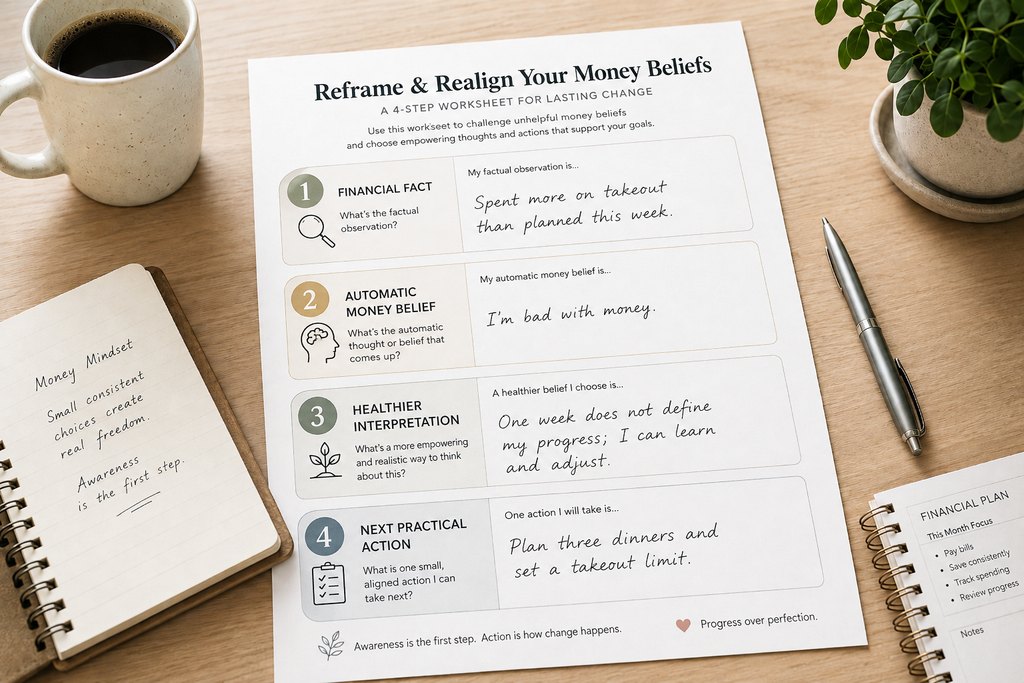
1. Separate the Financial Fact From the Story
Take one money situation that is bothering you and divide a page into two sections: What I know and What I am telling myself it means.
Imagine that you saved less this month than you planned. The factual statement might be, “I planned to save $300 and saved $125.” The story might be, “I never stick to anything, so I will never become financially secure.”
Those two statements are not the same. One identifies a measurable gap; the other turns one disappointing result into a permanent prediction about your future.
Use this four-part prompt:
- Fact: What can I objectively verify?
- Story: What conclusion am I automatically attaching to it?
- Alternative: What is a more balanced interpretation?
- Action: What is one useful thing I can do next?
Your alternative does not need to sound inspirational. “I missed my target, so I need to understand what changed this month” is far more useful than forcing yourself to believe that everything is perfect.
This exercise can be especially valuable when financial shame causes you to avoid information. APA guidance on money stress recommends moving beyond self-blame and taking concrete steps toward financial health rather than allowing embarrassment to keep financial issues unaddressed.
2. Complete a Money-Belief Inventory
Write down the first answer that comes to mind for each sentence:
- Money is ______.
- Rich people are ______.
- People who struggle financially are ______.
- Saving money means ______.
- Spending money makes me feel ______.
- Asking for more money is ______.
- Having enough money would allow me to ______.
- People like me usually ______ with money.
- The biggest reason I cannot reach my financial goals is ______.
Do not try to produce the “correct” answer. The value comes from noticing the assumptions that appear automatically.
Now place a mark beside each belief that came from family, past hardship, a previous relationship, workplace experiences, social comparison, or something you repeatedly heard growing up. Financial habits and norms can develop over time through values, attitudes, beliefs, and socialization, and these patterns can continue influencing adult financial behavior.
Choose one belief and ask three questions: Is this always true? What evidence contradicts it? What belief would help me act more constructively?
For example, “I am terrible with money” might become, “There are financial skills I have not practiced consistently yet.” The second version leaves room for responsibility without turning your current skill level into a permanent identity.
3. Create a More Believable Money Affirmation
Affirmations can become frustrating when there is a huge gap between the words you repeat and what you currently believe. If saying “I am completely wealthy and financially free” makes your mind immediately respond, “No, you’re not,” the statement may not be helping you build a more grounded perspective.
Try writing an affirmation that is both encouraging and believable:
- I am learning to make calmer financial decisions.
- I can improve financial skills I was never taught.
- I am becoming more consistent with money.
- I can make one useful financial decision today.
- My past money mistakes do not have to become permanent patterns.
- I can define financial success according to my own priorities.
Then add an action to the affirmation.
For example:
Mindset: “I am becoming someone who plans ahead.”
Action: Review upcoming expenses every Sunday.
This combination is important because a useful affirmation should support behavior rather than substitute for it.
Quick check: If your affirmation promises an outcome you cannot control, rewrite it around an attitude, decision, skill, or behavior that you can influence.
4. Define What “Enough” Means to You
One of the most useful money mindset exercises is surprisingly simple: stop using “more money” as the entire goal.
Take a blank page and write:
Money would help me feel more secure if…
Then finish the sentence five times.
Your answers might include having an emergency cushion, being able to cover monthly expenses without panic, paying down expensive debt, changing jobs without immediate financial pressure, traveling without putting the entire trip on credit, or helping family without damaging your own financial stability.
Next write:
Money would give me more freedom to…
Again, complete it five times.
The CFPB’s financial well-being framework emphasizes both security and freedom of choice rather than relying on income alone as the definition of financial wellness. That makes this exercise useful because it turns a vague desire for “abundance” into priorities you can recognize and plan around.
Once you have your answers, circle the three that matter most. Those become a more personal definition of financial progress.
5. Practice a Five-Minute Financial Check-In
Financial avoidance can make ordinary numbers feel more threatening because uncertainty grows when you do not look at them. A short, predictable check-in can reduce that uncertainty without turning your entire evening into a budgeting session.
Once or twice a week, spend five minutes answering:
- What money came in?
- What major expenses went out?
- Is anything due before my next check-in?
- Did I move toward one financial goal?
- What is one decision I need to make next?
Do not use the five minutes to criticize yourself. You are gathering information.
The CFPB’s research connects positive financial behaviors, financial skills, and financial self-efficacy—confidence in one’s ability to achieve financial goals—with better financial behavior and financial well-being. A routine that gives you regular evidence that you can face financial information may therefore be more useful than waiting until you feel completely confident.
After several weeks, you may notice that opening your accounts or reviewing expenses feels more ordinary. That change in emotional reaction is itself a form of progress.
If you prefer additional structure around mindset work, The Wealth Signal can be evaluated as optional support alongside—not instead of—your practical financial routine.
6. Visualize the Behavior, Not Just the Outcome
Financial visualization often focuses entirely on the finish line: a dream home, a large account balance, luxury travel, or complete freedom from financial stress.
Try a different approach. Visualize the behavior of the person capable of handling the outcome you want.
Picture yourself sitting down calmly to review money. Imagine receiving an unexpected expense and responding with a plan instead of immediate panic. Imagine discussing compensation confidently, saying no to a purchase that does not fit your priorities, or watching an emergency fund grow because you kept contributing to it.
Then ask:
What would that version of me do this week?
Your answer needs to be specific enough to act on.
Perhaps that person would:
- automate a small savings transfer;
- compare insurance or subscription costs;
- apply for a better-paying role;
- learn one new professional skill;
- schedule a weekly money review;
- create a realistic debt-payment plan;
- ask a qualified professional for help with a financial issue outside their expertise.
Visualization can then become a way of clarifying desired behavior rather than predicting that a specific financial outcome will magically occur.
Abundance mindset exercises → practical abundance mindset exercises for everyday life
7. Start a Financial Evidence Journal
Many people say things such as “I never make good money decisions” while overlooking dozens of small decisions that contradict that belief.
For 30 days, keep a running list titled:
Evidence That My Relationship With Money Is Improving
Add anything that demonstrates greater awareness or intentionality.
Examples include:
- I reviewed my statement instead of avoiding it.
- I waited before making an impulse purchase.
- I moved money into savings.
- I asked a question about my benefits at work.
- I canceled something I no longer use.
- I stayed calm after an unexpected expense.
- I talked openly about a money issue.
- I corrected a mistake instead of judging myself for making it.
- I made a purchase that genuinely aligned with my priorities.
This is not about pretending small actions make financial problems disappear. It is about collecting evidence that your financial identity is more flexible than an old statement such as “I am just bad with money.”
The CFPB notes that people’s financial well-being can differ even among people with similar income or financial circumstances because financial well-being also involves how much security, control, and freedom of choice their situation provides. Your evidence journal therefore gives you another way to notice progress beyond income alone.
8. Rewrite One Scarcity Decision
Think about a recent decision you made primarily from fear.
Maybe you avoided looking at a bill because you assumed it would be disastrous. Perhaps you bought something immediately because you feared missing out, stayed silent about compensation because you assumed asking would create conflict, or refused to spend on something genuinely important because any spending creates guilt.
Write down:
What was I afraid would happen?
Then:
What options did I ignore because I was afraid?
Finally:
What would a calm, informed decision have looked like?
A healthier mindset does not mean choosing the expensive option, taking bigger risks, or assuming unlimited resources. Sometimes the grounded decision is still “no.” The difference is that the decision comes from your priorities and available information rather than from an automatic scarcity reaction.
Use this exercise whenever you catch yourself thinking in absolutes: “I have to,” “I can never,” “There is no way,” or “People like me don’t.”
The goal is to create one extra moment between the emotional reaction and the financial decision.
9. Turn Gratitude Into Financial Stewardship
Gratitude practices often focus on appreciating what you already have. That can be meaningful, but you can make the practice more useful by connecting gratitude with stewardship.
Write down three financial resources currently available to you. They do not have to be impressive.
For example:
- income from your current job;
- a skill you could develop further;
- $100 already saved;
- access to free financial education;
- a supportive person you can talk to;
- time to apply for another opportunity;
- a debt balance that has already decreased;
- an expense you successfully reduced.
Beside each resource, write one way you can use it intentionally.
“I am grateful for my paycheck” becomes “I will direct part of this paycheck toward my emergency fund.”
“I am grateful for my design skills” becomes “I will update my portfolio this weekend.”
This keeps gratitude connected to agency. You are appreciating what exists while still acknowledging what needs improvement.

A Simple Weekly Routine Using These money mindset exercises
You do not need a complicated daily ritual. A realistic weekly practice may work better because it gives you enough repetition to notice patterns without creating another obligation you eventually abandon.
Try this 20-minute sequence once a week:
Minutes 1–5: Complete the financial check-in from Exercise 5.
Minutes 6–10: Choose one uncomfortable financial thought and separate the fact from the story.
Minutes 11–14: Add at least one entry to your financial evidence journal.
Minutes 15–17: Visualize one constructive financial behavior you want to practice during the coming week.
Minutes 18–20: Decide on one practical money action and schedule when it will happen.
The practical action is what closes the loop. Without it, mindset exercises can become endless reflection. With it, the exercise has an opportunity to influence something observable.
How The Wealth Signal May Fit Into This Practice
Some people are comfortable doing reflective exercises independently with a notebook, budgeting tools, educational resources, and their own weekly routine. Others prefer having an additional guided resource because they find external structure easier to follow consistently.
The Wealth Signal is the ClickBank product associated with this article. However, the supplied official sales page could not be successfully loaded during verification, so current details such as its creator, exact format, modules, bonuses, price, refund terms, audio components, or specific claimed mechanisms have not been stated here. The inability to verify the page should not be replaced with guesses.
That also means the product should not be presented as scientifically proven to attract wealth or guarantee a financial outcome. A sensible role for any spirituality-focused money resource is as optional mindset support while practical financial habits remain in place.
If structured guidance helps you stay consistent, The Wealth Signal may be worth comparing with the money mindset routine you want to build and the type of support you actually need.
Before making that decision, evaluate the current offer according to practical questions rather than excitement alone:
- Does the current format match how you prefer to learn?
- Does the material address a problem you still need help with?
- Is the current cost comfortable for your financial situation?
- Are the seller’s current terms clear?
- Does the material complement practical financial action?
- Would you realistically use it consistently?
That checklist prevents an abundance-focused product from becoming another impulsive financial decision.
Common Mistakes That Make Mindset Work Less Useful
The first mistake is using mindset work to avoid financial reality. If a practice leaves you feeling temporarily inspired but makes you less willing to look at balances, bills, spending, debt, or goals, the practice is moving in the wrong direction.
The second mistake is expecting yourself to eliminate every negative thought. Financial uncertainty can legitimately feel stressful. A healthier goal is learning to notice fear without automatically allowing it to dictate every decision.
The third mistake is measuring success only by how much money arrives. A useful shift may show up first as reduced avoidance, greater consistency, clearer goals, stronger boundaries, more informed decisions, or increased confidence in your ability to handle financial information.
Finally, avoid constantly changing techniques. Doing one short exercise consistently for several weeks can reveal more about your beliefs than collecting dozens of affirmations, journals, courses, or manifestation routines you rarely use.
Limiting beliefs about money → common limiting beliefs about money and how to challenge them
Measure Progress by What You Do Differently
You can assess whether these money mindset exercises are helping by looking for behavioral changes.
Ask yourself after four weeks:
- Am I checking my finances more consistently?
- Do I recover from money mistakes more quickly?
- Are my goals more specific?
- Do I recognize limiting thoughts earlier?
- Am I making fewer fear-driven decisions?
- Have I completed practical actions I previously avoided?
- Do I feel more capable of learning financial skills?
The CFPB’s financial well-being tools similarly emphasize that financial health involves control, resilience, goal progress, and freedom of choice rather than a single financial number.
You may still have significant financial goals ahead of you and be making genuine progress at the same time.
Final Thoughts
The best mindset practice is not the one that produces the most exciting affirmation. It is the one that helps you see your situation more clearly, challenge beliefs that keep you stuck, and make decisions that better reflect your priorities.
Use these exercises to examine the stories you tell yourself about money, create more believable thoughts, define what financial security means to you, notice evidence of progress, and connect reflection with action. You do not have to transform your entire financial life in one week; consistency with a few meaningful behaviors is a more grounded target.
A spiritual perspective and practical financial planning do not have to compete with each other. Reflection can help clarify what matters, while practical habits provide a way to act on that clarity.
If The Wealth Signal fits your goals after you assess its current details, it can remain an optional layer of support while the practical habits in this guide stay at the center of your money routine.
What are money mindset exercises?
They are reflective practices designed to help you identify beliefs, emotions, assumptions, and habits that influence financial decisions. Useful exercises connect that awareness with practical behavior rather than relying only on positive thinking.
How often should I do money mindset work?
A short weekly practice is enough to begin noticing patterns. Consistency is more important than completing a large number of exercises every day. Choose one or two practices and repeat them long enough to see whether your behavior is changing.
Can money affirmations make you wealthy?
Affirmations do not guarantee income, wealth, or a specific financial result. They can be used as reminders of attitudes or behaviors you want to strengthen, especially when paired with practical actions such as budgeting, saving, career development, or financial planning.
What is the best exercise for financial anxiety or avoidance?
Start by separating the objective financial fact from the story you are attaching to it. Then choose one small action, such as reviewing one account or one upcoming bill. If financial anxiety is severe or persistent, appropriate professional support may be more useful than relying on mindset practices alone.
Can I use manifestation with practical money planning?
Yes, if manifestation is treated as a personal or spiritual reflection practice rather than a guarantee of financial outcomes. Visualization, journaling, and intention setting can sit alongside budgeting, saving, career decisions, and other practical financial behaviors.
Do I need The Wealth Signal to do these exercises?
No. Every exercise in this guide can be practiced independently. The Wealth Signal is optional, and specific current product details have not been claimed because the supplied official sales page was unavailable during verification.