

Using daily abundance affirmations can be a simple way to interrupt discouraging thoughts, reconnect with what matters to you, and start the day with a more intentional perspective. The practice becomes more useful, however, when abundance means more than repeating that wealth is already yours. A grounded routine can combine positive self-talk with gratitude, realistic goals, awareness of opportunities, and practical actions that support the life you want to build.
Psychological research on self-affirmation provides a useful but narrower foundation than many manifestation claims suggest. A 2025 meta-analysis covering 129 independent tests found small positive effects of self-affirmation interventions on general well-being, social well-being, self-perception, and psychological barriers. These exercises generally centered on personal values, identity, strengths, and meaningful qualities—not on proving that repeating financial statements directly causes money to appear.
That distinction allows you to use affirmations without turning them into magical promises. You can appreciate spiritual or abundance-oriented language while still connecting your practice with real choices, habits, goals, relationships, learning, and financial decisions.
Abundance mindset exercises → practical exercises for developing a grounded abundance mindset
How daily abundance affirmations can fit into a grounded routine
An affirmation is most useful when it gives your attention a constructive direction. If your automatic thought is “There is never enough,” a grounded affirmation might remind you to notice available resources, make a thoughtful decision, or recognize that your current circumstances do not define every future possibility.
The goal does not have to be convincing yourself that everything is already perfect. In fact, an affirmation that feels completely unbelievable may create an internal argument rather than a helpful shift. A bridge statement such as “I am learning to create more financial stability one decision at a time” may be easier to connect with real behavior than “I have unlimited wealth right now.”
Research on self-affirmation is also more closely connected to values and identity than to material manifestation. The APA’s 2025 summary describes exercises in which people reflect on core values, identity, and positive traits, with modest benefits across several well-being outcomes. That evidence supports thoughtful self-reflection; it does not establish guaranteed wealth attraction.
A practical routine therefore asks two questions after every important affirmation:
What perspective do I want to reinforce?
What action would make that perspective visible today?
Before You Choose an Affirmation, Define Abundance
“Abundance” means different things to different people. For one person, it may mean enough savings to handle an emergency. For another, it may mean time freedom, supportive relationships, meaningful work, creative opportunity, better health habits, or the ability to make financial choices without constant fear.
Defining abundance prevents your practice from becoming vague. Instead of repeatedly saying “I attract abundance,” decide what greater abundance would actually change in your everyday life.
You might write:
- I want more financial breathing room.
- I want to feel calmer when making money decisions.
- I want to notice and pursue realistic opportunities.
- I want more consistency in saving.
- I want to appreciate what I already have without giving up on growth.
- I want to use money in ways that reflect my priorities.
The CFPB defines financial well-being around security and freedom of choice, including control over day-to-day finances, resilience to financial shocks, progress toward goals, and greater freedom to make meaningful life choices. That offers a useful practical interpretation of financial abundance without requiring an arbitrary wealth number.
Once your version of abundance is clear, your affirmations can reinforce something specific rather than an undefined promise.
25 Daily Abundance Affirmations That Stay Grounded
The following statements are designed to support reflection, agency, gratitude, and practical action. You do not need to use all 25 each day. Choose two or three that match what you are currently working on.
Abundance and self-belief
- “I can build a healthier relationship with money one decision at a time.”
- “My current circumstances do not define every future possibility.”
- “I am capable of learning skills that expand my options.”
- “I can make thoughtful choices even when I feel uncertain.”
- “I do not need perfect confidence before taking a useful next step.”
These statements focus on capability rather than guaranteed outcomes. They leave room for difficulty while reminding you that uncertainty does not automatically mean helplessness.
Gratitude and existing resources
- “I notice the resources, skills, and support already available to me.”
- “I can appreciate what I have while still working toward more.”
- “Small progress deserves to be recognized.”
- “I am becoming more aware of opportunities I may have overlooked.”
- “I can use today’s resources with greater intention.”
Gratitude does not require pretending that you have everything you need. A grounded gratitude practice helps you identify what is already usable—knowledge, time, relationships, experience, savings, skills, or another resource—and ask how you can strengthen it.
Financial confidence and action
- “I can face my finances with curiosity instead of avoidance.”
- “I am learning to make decisions that support greater financial stability.”
- “I can keep part of what I earn and build savings gradually.”
- “I can learn from financial mistakes without defining myself by them.”
- “I can create simple systems that make better money decisions easier.”
These affirmations become stronger when they lead to observable action. Statement 13 might be paired with a savings transfer. Statement 11 might be followed by opening a bill or reviewing an account instead of postponing it.

Opportunity and growth
- “I can notice realistic opportunities and evaluate them carefully.”
- “I can increase my options by learning, practicing, and taking action.”
- “Another person’s success does not reduce what I am capable of building.”
- “I can ask for information, negotiate, and make informed decisions.”
- “I am willing to grow beyond financial beliefs that no longer serve me.”
Abundance thinking is often described as believing there is enough opportunity for everyone. Real life is more complicated, because opportunities and resources are not unlimited or equally distributed. A grounded version simply prevents one setback or comparison from becoming proof that no worthwhile option can exist.
Calm, patience, and consistency
- “I do not need instant results for today’s effort to matter.”
- “Consistency can be more useful than intensity.”
- “I can pause before making a fear-driven financial decision.”
- “I can return to my plan after a setback.”
- “Today I will take one action that supports the future I want.”
The final group shifts attention away from dramatic transformation and toward consistency. For many goals, that is where an affirmation becomes practically valuable.
Turn One Affirmation Into Evidence
Reading an affirmation takes seconds. Building evidence for it is where the practice becomes more meaningful.
Suppose you choose:
“I am learning to make decisions that support greater financial stability.”
Ask:
What would count as evidence today?
Your answer might be reviewing an upcoming bill, transferring $10 to savings, researching one financial question, comparing two options before purchasing, or spending 20 minutes developing an income-related skill.
Now the process becomes:
Affirmation → intention → behavior → evidence.
The evidence does not have to be dramatic. Its purpose is to make the statement increasingly connected to reality.
If you repeatedly say, “I can face my finances with curiosity instead of avoidance,” and then complete a short money review every Friday, you begin accumulating examples that support the identity you are practicing.
Where The Wealth Signal May Fit
Some readers enjoy creating their own affirmation lists, journaling exercises, visualization routines, and reflection prompts. Others prefer a structured mindset resource because having a framework can make a routine easier to maintain.
That is the context in which The Wealth Signal may be relevant as optional mindset-oriented support. The supplied official sales-page URL could not be reliably fetched during research, so current claims about its creator, format, modules, audio content, bonuses, pricing, guarantee, or outcomes cannot be responsibly verified here.
For that reason, it should not be treated as proof that a specific mindset technique can scientifically attract money. Practical financial habits and decisions remain important whether you use a guided resource or create your own routine.
If structured mindset support appeals to you, consider whether The Wealth Signal fits alongside the practical abundance habits you are already building.
A Five-Minute Morning Abundance Routine
You do not need to repeat dozens of statements for an hour. A short practice that you actually maintain can be more useful than an elaborate ritual you quickly abandon.
Start with one minute of awareness. Notice the thought that is strongest this morning. Maybe you feel behind, worried, discouraged, grateful, hopeful, or uncertain.
Next, choose one of your daily abundance affirmations that responds to what you genuinely need.
For example:
Automatic thought: “I am so far behind financially.”
Affirmation: “My current circumstances do not define every future possibility.”
Then spend one minute identifying evidence. What is already true that supports a broader perspective? Perhaps you recently saved something, learned a new skill, solved a difficult problem, or made one better financial decision.
Use the fourth minute for gratitude. Write down one resource you appreciate—not necessarily money. It could be a skill, supportive person, useful information, available time, health, experience, or another meaningful resource.
Use the final minute to choose one action.
Your five-minute routine becomes:
- Notice the current thought.
- Choose one grounded affirmation.
- Identify supporting evidence.
- Name one genuine source of gratitude.
- Choose one practical action.
That is simple enough to use before work, after coffee, or while reviewing your planner.
Pair Affirmations With Financial Goals
Affirmations can support financial goals when they reinforce the behavior required by the goal.
Suppose your goal is to build an emergency fund.
Instead of using only:
“I attract financial abundance.”
Try:
“I am becoming someone who protects part of today’s money for tomorrow.”
Then choose a concrete saving amount or system that fits your real circumstances.
The CFPB’s financial well-being framework emphasizes progress toward financial goals alongside control over everyday finances and capacity to absorb financial shocks. This is a useful reminder that mindset becomes financially meaningful when it supports measurable behaviors and stronger options.
Another example:
Goal: Reduce impulsive spending.
Affirmation: “I can pause before making a fear-driven or emotional decision.”
Action: Create a 24-hour waiting period for nonessential purchases over a chosen amount.
Goal: Increase earning potential.
Affirmation: “I can expand my options by learning and practicing.”
Action: Schedule three focused skill-development sessions this week.
The affirmation keeps the intention visible. The system moves the intention into real life.
Financial abundance habits → practical money habits that support greater financial security
What If an Affirmation Feels Fake?
Do not force it.
If you repeat “I am completely financially secure” while feeling worried about bills, your mind may immediately respond, “No, I’m not.” Instead of fighting that reaction, use it as information.
Try moving the statement one step closer to something believable.
Instead of:
“I am wealthy.”
Try:
“I am learning to make choices that improve my financial future.”
Instead of:
“Money always comes easily.”
Try:
“I can notice realistic opportunities and evaluate them carefully.”
Instead of:
“I never worry about money.”
Try:
“I can feel worried and still make a thoughtful financial decision.”
A bridge affirmation does not have to sound spectacular. It needs to give you a healthier direction you can actually practice.
Use Visualization After the Affirmation
Visualization can help make an abundance routine more concrete when you visualize behavior rather than only the final reward.
If your affirmation is:
“I can build financial stability gradually,”
do not imagine only a large account balance. Picture yourself performing the ordinary actions associated with greater stability: reviewing expenses, transferring savings, finishing work, learning a skill, comparing options, or declining a purchase that does not fit your priorities.
Then ask:
“What behavior from that future can I practice today?”
This question protects visualization from becoming passive fantasy.
You can still imagine the larger future you want. The important addition is connecting that future with the ordinary behavior that could contribute to it.
A Daily Affirmation Journal Template
Use one page with five short sections:
AFFIRMATION:
Which statement am I practicing today?
WHY IT MATTERS:
What old thought or situation am I responding to?
EVIDENCE:
What already shows that this perspective is possible?
GRATITUDE:
Which current resource do I appreciate?
ACTION:
What will I do today?
Example:
Affirmation: “I can keep part of what I earn and build savings gradually.”
Why it matters: I tend to think small savings amounts are pointless.
Evidence: I already have $150 that I did not spend.
Gratitude: I have regular income this month.
Action: Transfer another manageable amount after payday.
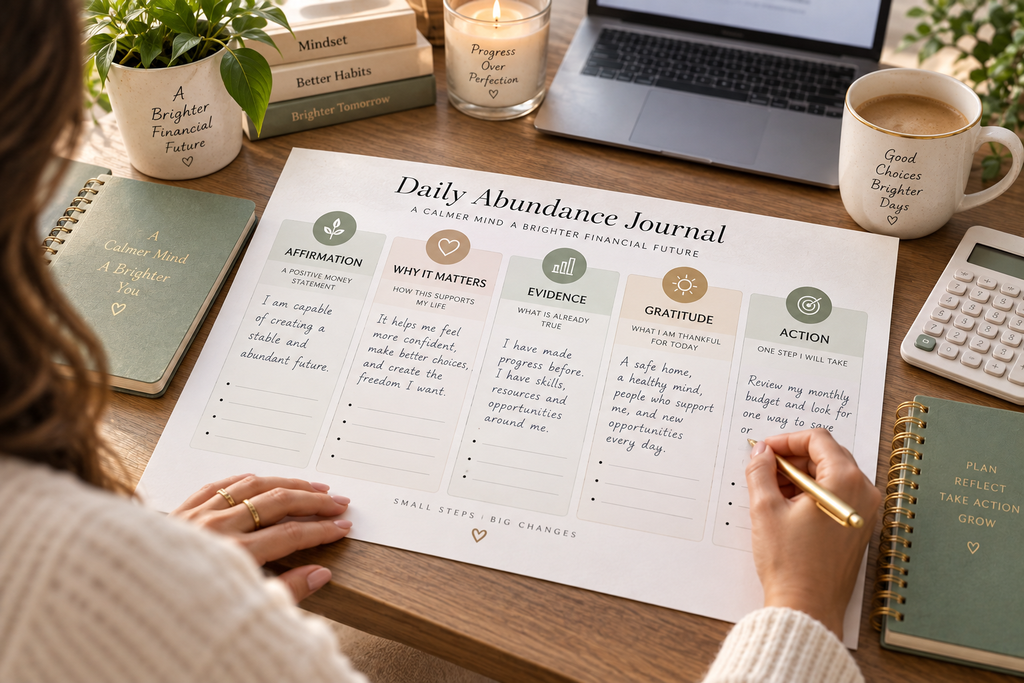
This format makes daily abundance affirmations less about repeating words and more about developing a consistent reflective practice.
Common Mistakes With Abundance Affirmations
One common mistake is choosing statements solely because they sound dramatic. “I receive millions effortlessly” may be emotionally exciting, but it gives you little guidance about today’s behavior.
Another mistake is using affirmations to avoid uncomfortable financial information. If you are worried about debt, repeating abundance statements while refusing to look at balances is unlikely to improve clarity. A healthier affirmation might help you face the information calmly.
A third mistake is treating every setback as proof that your mindset failed. Financial results are influenced by many factors beyond personal beliefs, including income, expenses, economic conditions, unexpected events, and access to opportunities.
A fourth mistake is repeating too many statements without remembering any of them. Two relevant affirmations connected to actions may be more useful than fifty statements repeated mechanically.
Finally, avoid turning abundance into self-blame. Financial hardship does not prove that you failed to “vibrate correctly” or believe strongly enough.
Build a Weekly Abundance Review
Daily practice gives you repetition. A weekly review gives you perspective.
At the end of the week, ask:
Which affirmation was most useful?
Which statement felt unrealistic or unhelpful?
What financial or personal action did I actually complete?
What opportunity did I notice?
Where did fear or scarcity thinking influence a decision?
What small win deserves recognition?
What is my most important next action?
This review helps you judge your routine by more than mood. You can look for changes in awareness, behavior, planning, and follow-through.
Weekly abundance routine → weekly money mindset and abundance reflection practice
Where Structured Guidance Can Add Value
The free routine in this article already gives you a complete foundation: choose a meaningful affirmation, connect it with evidence, practice gratitude, visualize relevant behavior, and take one real action.
For some people, that self-directed approach is enough. Others prefer an organized external framework because structure helps them maintain consistency or explore mindset work more deeply.
The key is to judge a resource by whether it supports a useful process for you rather than assuming that buying something guarantees a financial result.
If a guided abundance routine would help you practice more consistently, The Wealth Signal may be worth evaluating as optional support alongside your real-world financial goals.
A 30-Day Daily Abundance Practice
If you want to use affirmations consistently, try a 30-day practice without treating 30 days as a guaranteed transformation deadline.
Choose three affirmations that match your current priorities.
For example:
“I can face my finances with curiosity instead of avoidance.”
“I can keep part of what I earn and build savings gradually.”
“Today I will take one action that supports the future I want.”
Each morning, choose one statement and write one supporting action.
Each evening, ask whether you completed it.
At the end of each week, review which statements influenced behavior and which ones need to be adjusted.
After 30 days, evaluate the practice through questions such as:
Am I noticing negative money thoughts sooner?
Do my affirmations feel more believable?
Have I followed through on more financial actions?
Am I more aware of useful resources or opportunities?
Which new habit should I continue?
Do not judge the experiment solely by whether your income changed. Mindset work can support behavior, but financial outcomes depend on many additional factors.
Final Thoughts
The most useful daily abundance affirmations are not necessarily the boldest or most mystical ones. They are the statements that help you relate to your circumstances with more perspective, recognize your resources, remember your values, and take a constructive next step.
Choose language you can actually work with. Pair it with evidence instead of forcing belief. Add gratitude without using gratitude to deny real problems, and connect every important affirmation with a behavior that supports the future you want.
You can appreciate abundance, visualization, spirituality, and positive self-talk without turning them into guarantees about money.
A five-minute practice can be enough: notice, affirm, find evidence, appreciate something real, and act.
When repeated consistently, the value of the routine comes not only from what you say but from what those words help you notice and do.
If The Wealth Signal matches the kind of structured abundance practice you prefer, decide whether it belongs alongside—not instead of—the practical habits supporting your goals.
Do daily abundance affirmations really work?
Self-affirmation research has found small positive effects on several aspects of psychological well-being, but these studies generally involve reflection on values, identity, and positive qualities. They do not establish that repeating abundance or wealth statements directly causes financial outcomes.
How many abundance affirmations should I say each day?
There is no evidence-based requirement for a specific number. Using two or three relevant statements thoughtfully and connecting them with reflection or action may be more useful than rapidly repeating a long list without engagement.
Should I say abundance affirmations in the morning or at night?
Either can work as a personal routine. Morning practice can help set an intention for the day, while evening practice can support reflection. Consistency and relevance matter more than choosing a supposedly perfect hour.
What should I do if an abundance affirmation feels unbelievable?
Create a bridge statement that feels more grounded. Instead of “I have unlimited wealth,” try “I can develop habits and skills that strengthen my financial options.”
Can abundance affirmations attract money?
There is no established scientific evidence that repeating affirmations directly attracts money. Affirmations can instead be used to reinforce values, constructive self-talk, financial intentions, and behaviors that you can actually influence.
Should affirmations replace financial planning?
No. Financial well-being also depends on practical factors such as income, spending, savings, resilience to financial shocks, and progress toward goals. Affirmations are best used as a supportive mindset practice rather than a substitute for financial planning.