

A money meditation for abundance can be a calming way to examine your relationship with money, clarify what financial abundance means to you, and begin the day with more intention. The most useful version does not ask you to ignore bills, financial stress, or real-world constraints. Instead, it combines focused attention, visualization, gratitude, grounded affirmations, and one practical action that supports the financial future you want to build.
Meditation itself is a broad category of mind-body practices. The National Center for Complementary and Integrative Health explains that some forms use attention on the breath, a sound, a visual image, or a repeated word or phrase, while mindfulness involves maintaining present-moment awareness without judgment. Research suggests meditation and mindfulness may help with areas such as stress, anxiety, and sleep, although study quality and results vary across specific practices and outcomes.
That evidence should not be stretched into a claim that meditation directly creates financial wealth. A grounded abundance practice uses meditation to create mental space for reflection and better choices, while financial progress still depends on factors such as income, expenses, savings, opportunities, skills, unexpected events, and decisions.
How to practice money meditation for abundance without losing touch with reality
A useful meditation begins by deciding what you want the practice to do. If the goal is simply “make money appear,” there is no reliable scientific basis for that promise. If the goal is to become calmer around financial thoughts, identify unhelpful beliefs, clarify priorities, visualize better behavior, and choose an intentional next step, the practice becomes much more practical.
This distinction also protects you from turning spirituality into self-blame. Financial well-being is influenced by multiple factors, some within personal control and some outside it. The CFPB describes financial well-being in terms of everyday financial control, resilience to financial shocks, progress toward goals, and freedom of choice.
The seven steps below create a meditation routine that moves from inner reflection toward something concrete.
1. Define What “Abundance” Means Before You Meditate
Abundance is easier to visualize when it means something specific.
Perhaps you want enough emergency savings to feel safer. Maybe you want to reduce debt, develop more income options, stop avoiding your finances, save consistently, or create enough financial flexibility to make different career or lifestyle choices.
Before closing your eyes, write:
“Greater financial abundance would mean __________ in my real life.”
Then make the answer more practical.
Instead of:
“I want unlimited wealth.”
Try:
“I want enough emergency savings to handle an unexpected expense without immediately relying on credit.”
Instead of:
“I want more money.”
Try:
“I want to develop an additional income skill and consistently save part of what I earn.”
The CFPB’s framework is useful here because it defines financial well-being by what money allows you to handle and choose, not simply by one income or net-worth number.
Quick reflection
Ask:
- Which financial situation currently creates the most pressure?
- What would greater stability change?
- Which goal matters most during the next few months?
- What part of that goal can I influence?
One meaningful intention gives the meditation a direction.
2. Spend Two Minutes Settling Your Attention
Sit comfortably and allow your breathing to return to a natural rhythm. You do not need a special posture, soundtrack, or spiritual object.
For the first two minutes, focus on the physical sensation of breathing. When thoughts appear, notice them and return attention to the breath rather than arguing with them.
NCCIH describes focused attention and present-moment awareness as common features of meditation and mindfulness practices. It also notes that research on meditation has found potential benefits for some stress-related and psychological outcomes while warning that evidence varies by condition and study quality.
The purpose of this stage is simple: create a little distance from mental noise before thinking about money.
If a financial worry appears immediately, do not suppress it.
Notice:
“A money worry is here.”
Then return to breathing.
This creates a calmer starting point for the next step.
3. Notice the Money Belief That Shows Up
Once your attention feels steadier, bring your financial intention to mind.
Notice the first automatic thought.
Maybe it is:
“I never have enough.”
“I am terrible with money.”
“I am too far behind.”
“I will never earn more.”
“Everyone else knows what they are doing except me.”
Do not immediately replace the thought with a positive sentence. First, examine it.
Ask:
What part is fact?
What part is interpretation or prediction?
For example:
Thought: “I will always struggle financially.”
Fact: “My finances are difficult right now.”
Prediction: “Nothing can ever improve.”
Grounded perspective: “My current situation is difficult, but I can still improve specific skills, systems, and decisions.”
This is not pretending the problem does not exist. It is separating the financial problem from the permanent identity you may have attached to it.

4. Choose One Grounded Abundance Affirmation
After identifying the old thought, choose a statement that provides a healthier direction.
Avoid forcing yourself to repeat something you immediately reject.
Instead of:
“I am infinitely wealthy.”
Try:
“I can build a healthier relationship with money one decision at a time.”
Instead of:
“Money comes to me effortlessly.”
Try:
“I can notice realistic opportunities and evaluate them thoughtfully.”
Instead of:
“I am already completely financially free.”
Try:
“I can take steps that move me toward greater financial security.”
Instead of:
“I never worry about money.”
Try:
“I can feel financial concern and still make a careful decision.”
A 2025 meta-analysis summarized by the American Psychological Association reviewed 129 studies involving 17,748 participants and found positive, generally modest effects of self-affirmation exercises on several aspects of well-being. Those exercises centered on values, identity, strengths, and positive qualities; that evidence does not establish that repeating wealth claims directly produces money.
Hold your chosen affirmation quietly for several breaths.
Then ask:
“What action would make this statement more true today?”
Where The Wealth Signal May Fit
Some people prefer creating their own meditation prompts, affirmations, visualization exercises, and journal routines. Others find structured mindset material easier to follow because it reduces the work of deciding what to practice each day.
That is the most reasonable context for The Wealth Signal within this article. The supplied official sales page could not be reliably fetched during research, so current details about the product’s creator, exact format, modules, bonuses, price, guarantee, delivery method, or financial outcome claims cannot be responsibly verified here.
The product is therefore best treated as optional mindset-oriented support rather than evidence that a particular meditation or manifestation mechanism can scientifically produce wealth.
If structured abundance-focused guidance would help you stay consistent, consider whether The Wealth Signal fits alongside the practical financial habits you are already building.
5. Visualize the Behavior Behind the Financial Goal
Now bring your financial goal to mind.
You can picture the result you want, but do not stop there.
If you want an emergency fund, visualize yourself making the recurring transfer, reviewing progress, and leaving the money alone when an unnecessary purchase appears.
If you want higher income, picture the behaviors that may contribute: learning a valuable skill, completing focused work, communicating with clients, preparing for an interview, asking for feedback, or evaluating opportunities.
If you want better financial organization, visualize yourself calmly reviewing upcoming expenses instead of postponing the task.
Then ask:
“What behavior from this future can I practice today?”
That question transforms visualization from passive fantasy into rehearsal for a real choice.
This is an especially important part of money meditation for abundance because the visualized outcome becomes connected to something within your influence.
6. Practice Gratitude as Resource Awareness
Gratitude does not require you to pretend your finances are perfect.
Instead, use this part of the meditation to identify resources that already exist.
You might think:
“I am grateful for the professional skill I already have.”
“I am grateful that I started saving, even if the amount is still small.”
“I am grateful for access to useful information.”
“I am grateful for the person who supports me.”
“I am grateful that I can correct yesterday’s mistake with today’s decision.”
After each expression of gratitude, ask:
“How could I use or strengthen this resource?”
For example:
Gratitude: “I appreciate the skill I already have.”
Action possibility: “Spend 30 minutes improving that skill.”
Gratitude: “I appreciate that I have some savings.”
Action possibility: “Protect the habit by scheduling another realistic transfer.”
Gratitude becomes useful because it shifts attention from “I have nothing” toward “What is available, and what can I do with it?”
That is different from denying hardship.
7. End With One Practical Financial Action
Before finishing the meditation, choose one specific action.
It might be:
- review upcoming bills;
- transfer an affordable amount to savings;
- cancel an unused recurring expense;
- compare two financial options;
- spend 20 minutes on an income-related skill;
- update a résumé or portfolio;
- follow up on a realistic work opportunity;
- organize one financial document;
- create a waiting period before an unnecessary purchase.
The action should be small enough to complete.
A grounded money meditation for abundance ends with:
INTENTION → CALM → REFLECTION → AFFIRMATION → VISUALIZATION → GRATITUDE → ACTION
The meditation helps organize attention. The action brings the practice into your financial life.
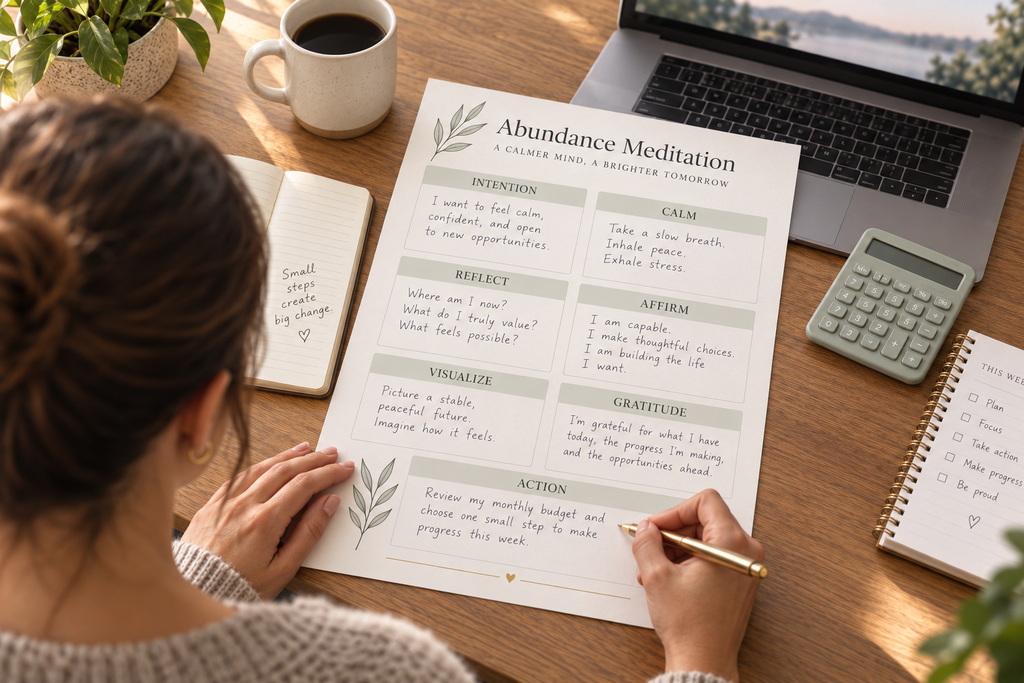
A Complete 10-Minute Money Meditation
You can combine the seven stages into a short morning or evening routine.
Minutes 1–2: Breathe and settle
Sit comfortably and focus on breathing. Allow thoughts to appear without immediately following them.
Minute 3: Name the intention
Write or mentally state one financial goal.
Example:
“I want to become more consistent about building emergency savings.”
Minute 4: Notice the belief
Ask what thought appears when you imagine that goal.
Example:
“Small savings amounts will never matter.”
Minute 5: Create the grounded statement
Try:
“Small amounts can matter when they become part of a repeatable habit.”
Minutes 6–7: Visualize the process
Picture yourself completing the next savings transfer and continuing the habit on future paydays.
Minute 8: Practice gratitude
Identify one real resource.
“I am grateful that I have income I can plan with this month.”
Minutes 9–10: Choose the action
Decide:
“After payday, I will transfer the amount I already determined is affordable.”
The exercise is complete when you know what happens next.
Can Meditation Help With Financial Stress?
Meditation cannot remove a bill or change an account balance by itself, but it may help some people manage stress or anxiety more effectively.
NCCIH summarizes research suggesting mindfulness-based practices can help with some symptoms of anxiety and depression, although outcomes vary and some evidence is limited by study quality. Meditation is generally considered low risk for many healthy people, but negative experiences have also been reported, so it should not be treated as universally beneficial for everyone.
For money-related stress, that means meditation can be viewed as a way to create space before responding.
You might move from:
“I’m panicking, so I don’t want to look.”
to:
“I am uncomfortable, but I can look at one piece of information.”
That shift does not solve the financial issue. It can make the next useful action easier.
Money anxiety and financial wellness → practical ways to approach money stress with greater clarity
Add Journaling After Meditation
Meditation can reveal thoughts quickly. Journaling gives you somewhere to put them.
Use five sections:
FINANCIAL INTENTION
What am I working toward?
MONEY THOUGHT
What fear, assumption, or belief appeared?
GROUNDED AFFIRMATION
What healthier perspective will I practice?
RESOURCE / GRATITUDE
What do I already have that could help?
NEXT FINANCIAL ACTION
What will I do?
Example:
Financial intention: Build a stronger emergency fund.
Money thought: “I can never save consistently.”
Grounded affirmation: “I can practice saving an amount that fits my current situation.”
Resource/gratitude: “I have predictable income this month.”
Next financial action: “Choose a realistic automatic transfer.”
Using a journal makes money meditation for abundance easier to evaluate because you can later see whether your reflections actually influenced behavior.
Avoid Meditation as Financial Avoidance
One of the biggest mistakes is using a calming practice instead of facing information.
Meditating for 20 minutes and then refusing to open a bill is not financial progress.
If the meditation makes you calmer, use that calmer state to take one step toward the issue.
For example:
Meditation → review the balance.
Meditation → make a payment plan.
Meditation → organize the next seven days of expenses.
Meditation → ask a qualified professional for help when the issue is beyond what you can manage alone.
The practice should make reality easier to face, not easier to avoid.
Be Careful With “Manifestation” Overconfidence
Spiritual optimism and financial caution can coexist.
A study published in Personality and Social Psychology Bulletin examined manifestation beliefs across three studies with a combined 1,023 participants. Stronger manifestation belief was associated with higher perceived success and stronger expectations of future success, but also with greater attraction to risky investments, prior bankruptcy, and belief in achieving unlikely success more quickly. Because the study was correlational, it does not establish that manifestation beliefs caused those outcomes.
The practical lesson is simple: meditation should not make evidence irrelevant.
Before putting money into an opportunity, ask:
- What exactly is being offered?
- What evidence supports the claim?
- How much could I lose?
- Does the decision fit my actual finances?
- Am I reacting to excitement or evaluating the details?
- Would I make this decision if the promised outcome sounded less dramatic?
Positive thinking is not a substitute for due diligence.
How Structured Guidance Can Fit Into the Practice
This article already gives you a complete free framework: define abundance, settle your attention, notice money beliefs, choose a grounded affirmation, visualize useful behavior, practice gratitude, and take one financial action.
For some people, that is enough.
Others may prefer external structure because a guided framework can make regular practice easier to organize. Because the official The Wealth Signal page was not reliably accessible, it would be inappropriate to assume what specific meditation, audio, lesson, or exercise formats it currently contains.
If a structured mindset resource would help you maintain the routine more consistently, The Wealth Signal may be worth evaluating as optional support alongside your financial goals.
A Weekly Abundance-Meditation Review
Once a week, review what happened after your meditation sessions.
Ask:
Which money thought appeared most often?
Which affirmation felt believable and useful?
Which affirmation felt forced?
Which financial actions did I actually complete?
What resource did I notice that I had previously overlooked?
Which action repeatedly got postponed?
What should I simplify next week?
This review prevents the practice from becoming repetitive.
If the same intention appears every morning but nothing changes afterward, your next step may not be “meditate harder.” The action may need to be smaller, clearer, or better suited to your circumstances.
Weekly abundance routine → a weekly abundance, gratitude, mindset, and financial-action review
Try It as a 30-Day Experiment
You can use the meditation for 30 days as an experiment, not as a guaranteed transformation timeline.
Each day, record:
- Financial intention.
- Money thought.
- Grounded affirmation.
- Visualization focus.
- Gratitude/resource.
- Next financial action.
- Whether you completed the action.
At the end of 30 days, evaluate the practice with practical questions.
Are you noticing money-related thoughts sooner?
Are you avoiding financial tasks less often?
Are your affirmations becoming more believable?
Have you completed more small financial actions?
Do you have greater clarity about your priorities?
Which part of the practice should continue?
The result does not need to be a dramatic increase in income. Greater awareness, reduced avoidance, better organization, improved follow-through, or clearer financial goals can all make the exercise useful.
What Money Meditation Can—and Cannot—Do
Meditation can provide a structured moment for reflection. It may help you settle attention, notice an automatic thought, reconnect with a value, and choose a deliberate response.
It cannot guarantee wealth.
It cannot control economic conditions, eliminate unexpected expenses, ensure business success, or make every investment profitable.
The CFPB’s financial-well-being model recognizes both practical behaviors and broader circumstances. Financial well-being includes control over everyday finances, ability to handle shocks, progress toward goals, and freedom of choice, while multiple factors influencing those outcomes are not fully under individual control.
That gives abundance work a realistic role.
Use your mindset practice to influence the part you can influence—your awareness, preparation, learning, decisions, habits, and next actions—without assuming that thoughts control every outcome.
Final Thoughts
A grounded money meditation for abundance is less about convincing yourself that wealth is already guaranteed and more about creating a thoughtful bridge between intention and behavior.
Begin by defining what abundance means in your actual life. Settle your attention, notice the money belief that appears, choose a believable affirmation, visualize useful behavior, identify a resource you appreciate, and finish with one concrete financial action.
You can keep the spiritual meaning that makes meditation personally valuable while still respecting evidence and financial reality.
The practice becomes strongest when the final question is not only “What do I want?”
It is also:
“What can I do today that supports it?”
If The Wealth Signal matches the kind of structured abundance practice you prefer, decide whether it belongs alongside—not instead of—the practical financial habits supporting your goals.
What is money meditation for abundance?
It is a meditation or reflection practice focused on financial intentions, money beliefs, gratitude, visualization, and abundance-oriented thinking. A grounded version finishes with a practical financial action instead of assuming meditation alone will create money.
Can meditation attract money?
There is no established scientific evidence that meditation directly attracts financial wealth. Meditation may support attention, stress management, or reflection for some people, but financial outcomes still depend on real-world circumstances and behavior.
How long should an abundance meditation take?
There is no scientifically established perfect length. A focused 5–10 minute routine can be enough to settle your attention, reflect on one financial intention, and identify a next action.
Should I use affirmations during money meditation?
You can if they feel useful. Self-affirmation research has found modest benefits in areas such as well-being and self-perception, particularly when exercises involve values, identity, and strengths; this is different from proving that wealth statements produce money.
Can I meditate if thinking about money makes me anxious?
A short mindfulness practice may help some people with anxiety or stress, but responses vary. If meditation increases distress, it is reasonable to stop or use another supportive approach.
Should meditation replace budgeting or financial planning?
No. Meditation can support reflection, but practical financial well-being also involves everyday control, resilience to shocks, progress toward goals, and financial freedom of choice.