

If you are trying to understand how to clear subconscious money blocks, you may already notice patterns that seem to happen automatically: avoiding your bank account, feeling guilty when you spend, assuming you will never earn enough, or believing that wanting more money makes you selfish. These patterns can feel deeply rooted, but you do not need to treat them as mysterious forces. A more useful approach is to identify the belief, understand where it may have come from, test it against reality, and practice a different financial response.
“Subconscious money blocks” is popular personal-growth language, not a formal psychological diagnosis. Still, research gives us grounded concepts that overlap with what people usually mean by the phrase. The APA defines automatic thoughts as habitual thoughts that can occur with little conscious effort and influence mood and behavior, while financial-socialization research shows that beliefs, attitudes, habits, and money-management patterns can develop through family modeling, discussion, and lived experience.
The CFPB similarly explains that financial habits and norms are influenced by attitudes, values, emotions, social expectations, and contextual cues, with many of these patterns beginning to develop in childhood and continuing into adulthood.
So instead of thinking, “Something invisible is blocking wealth from reaching me,” try a more actionable question:
“Which automatic belief or learned money rule keeps influencing my decisions—and what can I practice instead?”
How to clear subconscious money blocks without forcing positive thinking
Learning how to clear subconscious money blocks does not require replacing every uncomfortable thought with “I am rich” or pretending your current financial situation is better than it is. The goal is to make automatic patterns more visible so you can decide whether they still deserve to guide your behavior.
This approach resembles a basic principle used in cognitive behavioral therapy: becoming aware of automatic or unhelpful ways of thinking, questioning them, noticing how they affect emotions and behavior, and replacing self-defeating patterns with more useful responses. That does not mean a money-journaling exercise is therapy, but the general idea—identify, evaluate, and respond differently—is well established.
Financial research also supports looking beyond knowledge alone. The CFPB notes that effective financial education needs to bridge the gap between what people know, what they intend to do, and what they actually do. Personal circumstances, goals, environment, motivation, confidence, and follow-through all matter.
The seven steps below use that same practical logic.
1. Catch the Automatic Money Thought
A money belief is difficult to change while it remains vague.
Start by paying attention to the sentence that appears automatically when a financial situation triggers you. Do not clean it up or make it sound reasonable. Write it exactly as it comes.
Examples might include:
- “I never have enough.”
- “People like me don’t become wealthy.”
- “Money always disappears.”
- “If I earn more, people will expect more from me.”
- “Wanting money makes me greedy.”
- “I am terrible with finances.”
- “Investing is only for rich people.”
- “If I look at my finances, I will feel worse.”
- “I have already made too many mistakes.”
These are more useful than the broad statement “I have a money block,” because now you have something specific to examine.
The CFPB describes money-related values, attitudes, emotions, norms, and contextual cues as influences on everyday financial decisions. In other words, not every financial choice starts with a conscious spreadsheet calculation.
Quick exercise
For one week, keep a short Money Thought Log with three columns:
Situation: What happened?
Automatic Thought: What did I immediately tell myself?
Behavior: What did I do next?
You may begin noticing patterns surprisingly quickly.
2. Ask Where the Rule May Have Come From
Once you identify a recurring belief, become curious about its history.
You may have heard direct statements growing up:
“Money doesn’t grow on trees.”
“Rich people are selfish.”
“We can’t afford anything.”
“You should never talk about money.”
“You have to work yourself to exhaustion to earn.”
Or perhaps nobody said these things directly. You may have learned through observation: seeing adults panic over bills, hide purchases, argue about spending, avoid financial discussions, or treat money as a source of shame.
A review of financial-socialization research describes parental modeling, parent-child financial discussion, and experiential learning as major pathways through which financial attitudes, knowledge, behavior, and well-being can develop.
Research on “money scripts” also examines core beliefs about money such as money avoidance, money worship, money status, and money vigilance. These concepts are not proof of a literal subconscious barrier, but they offer a useful framework for recognizing persistent money attitudes.
The goal is not to blame your family. Most people absorb financial lessons from environments that were themselves shaped by stress, culture, income, opportunity, and previous generations.
Ask:
“Was this rule created for my current life—or did I inherit it from an earlier environment?”

3. Separate the Financial Fact From the Belief
This step is where many “money block” exercises become more useful.
Take the automatic thought:
“I will never be financially secure.”
Now separate it.
Current fact:
“My emergency savings are lower than I want.”
Belief or prediction:
“I will never become financially secure.”
Those are not the same statement.
Another example:
Automatic thought:
“I am bad with money.”
Current fact:
“I have made several financial decisions I regret.”
Belief:
“Those mistakes prove that I cannot learn.”
Again, the fact may be real while the conclusion is unnecessarily permanent.
A central element of cognitive approaches is learning to identify automatic ways of thinking, evaluate their accuracy, and understand how those thoughts influence behavior.
This does not mean arguing yourself into unrealistic optimism. It means refusing to let a difficult fact automatically become a lifelong identity.
A practical way to think about how to clear subconscious money blocks is to replace vague emotional certainty with a more precise question:
“What is actually true right now?”
Where The Wealth Signal May Fit
Some people are comfortable doing belief work independently with a journal, structured questions, and financial habit tracking. Others prefer having an external framework that gives their mindset practice more structure.
That is the reasonable context for mentioning The Wealth Signal here. The supplied official website could not be reliably fetched during research, so current details about its creator, delivery format, modules, exercises, pricing, bonuses, guarantee, or specific outcome claims cannot be responsibly verified.
Because those specifics are unavailable, it is better to think of the product only as optional mindset-oriented support rather than assume it provides any particular technique or scientifically established method for creating wealth.
If structured money-mindset guidance would make reflection easier to maintain, consider whether The Wealth Signal fits alongside the practical financial work you are already doing.
4. Create a Grounded Replacement Belief
Once you identify the old rule, do not jump immediately to its most extreme opposite.
Old belief:
“I will always struggle with money.”
Extreme replacement:
“I effortlessly attract unlimited wealth.”
If that statement feels unbelievable, your mind may reject it before it becomes useful.
Try a bridge belief:
“I can learn financial habits that improve my options over time.”
Other examples:
Old: “Money always disappears.”
Grounded: “I can create systems that help me decide where part of my money goes.”
Old: “I am terrible with money.”
Grounded: “I have financial skills I still need to develop.”
Old: “Rich people are selfish.”
Grounded: “Money can be used in ways that reflect many different values.”
Old: “I must earn more before I can manage money well.”
Grounded: “I can practice better money management with the resources I have now.”
Old: “One mistake means I failed.”
Grounded: “A financial mistake can give me information for my next decision.”
Self-affirmation research should also be interpreted carefully. A 2025 meta-analysis reported generally modest positive effects from exercises focused on values, identity, and positive qualities, but this evidence does not show that repeating wealth claims directly produces financial outcomes.
Your replacement belief should therefore support a healthier perspective, not promise an outcome you cannot control.
5. Test the New Belief With One Small Behavior
Beliefs become more convincing when you build evidence for them.
Suppose the new belief is:
“I can become more intentional with money.”
Ask:
“What action would provide evidence for that today?”
Perhaps you:
- review one account instead of avoiding it;
- transfer a manageable amount to savings;
- compare prices before purchasing;
- cancel one unused subscription;
- spend 20 minutes learning a financial concept;
- organize upcoming bills;
- update a résumé or portfolio;
- delay an emotional purchase;
- ask a useful financial question.
The action should be small enough to complete.
This matters because knowing what to do is not always enough. The CFPB’s work on financial education emphasizes bridging knowledge and intention with actual action and follow-through.
You are creating a new loop:
Old belief → automatic behavior
becomes:
New perspective → intentional behavior → new evidence
That evidence is often more persuasive than repeating a statement hundreds of times.
Money mindset exercises → practical money mindset exercises that connect beliefs with behavior
6. Change the Environment That Reinforces the Old Pattern
Sometimes the problem is not only what you think. Your environment may keep triggering the same response.
Imagine that your belief is:
“I cannot stop impulsively spending.”
You could repeat affirmations every morning, but if shopping notifications constantly appear on your phone, saved payment information removes friction, and you browse online stores whenever you feel stressed, the environment keeps supporting the old habit.
Instead, change something around the behavior.
You might:
- turn off unnecessary shopping notifications;
- remove saved payment information;
- create a 24-hour waiting period for discretionary purchases;
- schedule a weekly money review;
- automatically move a realistic amount into savings;
- place an important financial goal where you will see it;
- schedule time for income-building work;
- create calendar reminders for bills.
The CFPB describes financial habits and norms as routine practices and rules people rely on in day-to-day financial life, and its financial-education guidance emphasizes considering the person’s environment as well as goals and motivation.
This is an important shift.
You do not have to depend entirely on willpower.
Design the environment so the healthier financial behavior becomes easier to repeat.
7. Build a Record of Evidence for the New Pattern
A deeply familiar belief rarely disappears because you challenged it once.
Instead, create evidence over time.
Keep a simple weekly record with four questions:
What old money thought appeared?
What did I do differently?
What happened?
What does this teach me?
Suppose your old belief is:
“I cannot save.”
Week one: You save $10.
Week two: You save another small amount.
Week three: An unexpected expense prevents you from saving.
The old belief may immediately return:
“See? I knew I couldn’t do this.”
But your evidence says something more accurate:
“I saved twice. This week an unexpected expense changed the plan. I can adjust and continue.”
That is a much healthier interpretation.
The CFPB notes that positive financial behaviors may contribute to improved financial situations and that financial self-efficacy—confidence in one’s ability to achieve financial goals—can support financial behavior.
Your goal is not to prove that nothing difficult will ever happen. It is to collect evidence that your response can change.
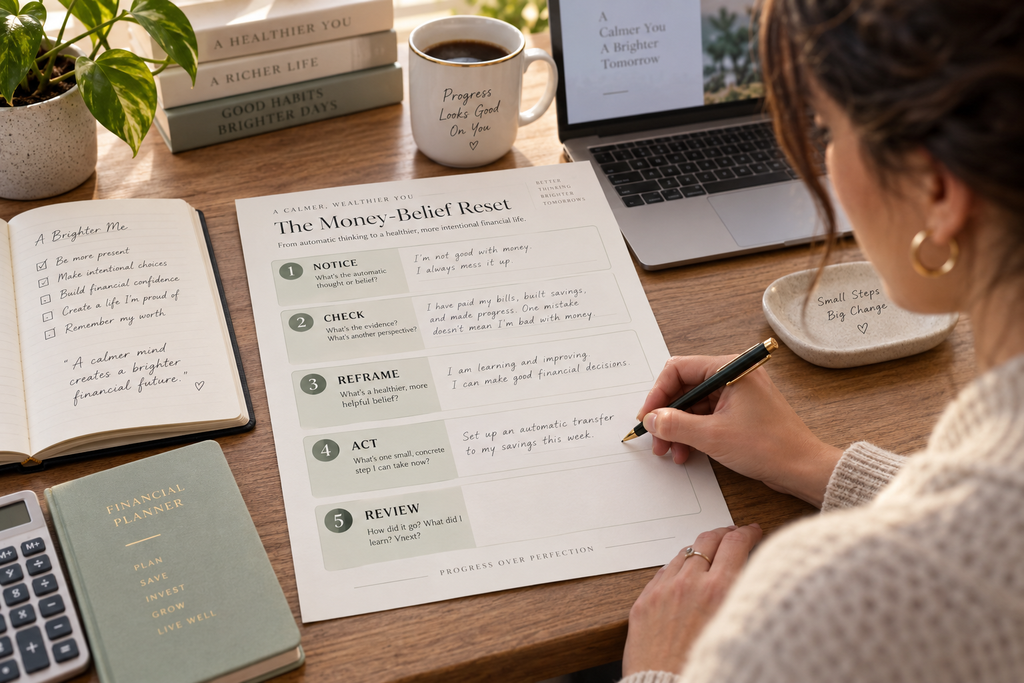
A Five-Step Reset for a Money Trigger
Once you understand the seven-step process, you can use a shorter reset whenever a money trigger appears.
NOTICE
What did I just tell myself?
Example:
“I can’t afford anything, so there is no point planning.”
CHECK
What is objectively true?
“My finances are tight this month.”
REFRAME
What is a more accurate perspective?
“Limited money makes planning more important, not less.”
ACT
What is one useful action?
“Review the next seven days of expenses.”
REVIEW
What did I learn?
“I felt less overwhelmed once I knew what was actually due.”
This short exercise can be repeated whenever a familiar belief returns.
Do Money Affirmations Help?
Affirmations can be useful when they support reflection and behavior rather than demanding that you believe something obviously untrue.
Try:
“I can learn.”
“I can make one thoughtful financial choice today.”
“I can recover from financial mistakes.”
“I can build systems that support my goals.”
“I can evaluate opportunities without panic or desperation.”
“I can appreciate progress without pretending everything is perfect.”
These are different from claiming that repeating a sentence will directly attract money.
Values-based self-affirmation research suggests small psychological benefits in several areas, but those findings should not be interpreted as evidence for guaranteed wealth manifestation.
Stop Using “Money Blocks” as a Reason for Self-Blame
Mindset matters, but it is not the only thing affecting your finances.
Income, housing costs, caregiving responsibilities, health expenses, debt, labor-market conditions, education, opportunity, family obligations, unexpected emergencies, and many other factors can affect financial outcomes.
The CFPB explicitly recognizes that financial well-being is shaped by multiple factors, some within an individual’s control and some outside it.
This is why “I am struggling because my subconscious is blocking abundance” can become harmful if taken too literally.
Your financial situation is not a morality test.
Mindset work is useful when it helps you influence the things you actually can influence: awareness, decisions, preparation, learning, boundaries, habits, and next actions.
How Structured Mindset Support Can Fit
At this point, you already have a complete process you can use without purchasing anything. You can identify an automatic money thought, explore where it came from, separate fact from prediction, create a grounded replacement, test it through behavior, change your environment, and collect evidence over time.
Some readers prefer doing all of that independently. Others appreciate an organized external structure because having a defined mindset routine can make consistency easier.
Because the official The Wealth Signal page was not reliably accessible, specific claims about how its current material works should not be assumed.
If an organized mindset framework would help you practice these ideas consistently, The Wealth Signal may be worth evaluating as optional support alongside your financial habits and goals.
A 30-Day Money-Belief Practice
If you want a simple experiment for how to clear subconscious money blocks, choose one recurring belief instead of trying to change your entire financial mindset at once.
For 30 days, track:
- The triggering situation.
- The automatic money thought.
- What is objectively true.
- Your grounded replacement belief.
- One action.
- What happened afterward.
For example:
Trigger: Checking savings.
Automatic thought: “I will never have enough.”
Reality: “My savings are lower than my target.”
Replacement: “I can improve this gradually through decisions and systems.”
Action: Transfer a realistic amount after payday.
Evidence: “I followed the plan once this week.”
Do not treat 30 days as a guaranteed psychological transformation deadline. It is simply long enough to gather useful observations and begin seeing patterns.
At the end, ask:
Which belief appeared most often?
Which situations triggered it?
Which replacement belief felt believable?
Which actions became easier?
What kept getting avoided?
What system should I keep?
The purpose is evidence, not perfection.
When the Pattern Feels Bigger Than a Money Exercise
Some financial thoughts are part of ordinary habit patterns. Others may connect with deeper anxiety, shame, trauma, compulsive behavior, relationship conflict, or severe avoidance.
If your money-related distress is intense or significantly interferes with daily life, a qualified mental-health professional may provide more appropriate support than an online mindset exercise alone. NIMH describes psychotherapy as helping people identify and change troubling thoughts, emotions, and behaviors, with approaches such as CBT addressing automatic thinking and self-defeating patterns.
Likewise, complex financial problems may require qualified financial, legal, tax, or debt advice depending on the situation.
Recognizing that additional expertise would help is not a failure of mindset work. It is another practical decision.
Build a Weekly Money-Mindset Review
Daily awareness is useful, but a weekly review helps you see the pattern.
Set aside 15–20 minutes and answer:
Which money belief showed up most often?
What triggered it?
Did I treat a fact as a permanent prediction?
Which new action did I practice?
What evidence supports my new belief?
What financial task did I avoid?
What environmental change could make next week’s action easier?
What is my most important next financial step?
You can also track one small win.
Maybe you looked at a bill without postponing it. Maybe you saved $20. Maybe you asked a question you usually avoid. Maybe you did not buy something automatically.
These wins matter because they show behavior changing in real life.
Final Thoughts
Understanding how to clear subconscious money blocks becomes much less mysterious when you stop treating every financial struggle as evidence of an invisible force working against you.
Learn to notice the automatic thought. Explore the context that shaped it. Separate present facts from old predictions. Create a grounded replacement belief, test it through one useful behavior, redesign the environment that keeps reinforcing the old pattern, and collect evidence that a different response is possible.
You do not have to pretend that every circumstance is under your control.
You only need to become more intentional about the part that is.
That creates a practical sequence:
NOTICE → QUESTION → REFRAME → ACT → REVIEW
Over time, the goal is not to never have an old money thought again. It is to recognize it sooner and give it less authority over your next decision.
If The Wealth Signal matches the structured mindset approach you prefer, decide whether it belongs alongside—not instead of—the practical financial work supporting your goals.
What are subconscious money blocks?
“Subconscious money blocks” is a popular personal-development term rather than a formal diagnosis. In practical terms, it can refer to automatic money thoughts, learned beliefs, attitudes, emotional associations, and habits that influence financial behavior without much deliberate reflection.
Where do money blocks come from?
Money beliefs can be influenced by many experiences. Financial-socialization research identifies family modeling, conversations about money, and experiential learning as important influences on later financial attitudes and behaviors.
Can I completely eliminate an old money belief?
An old thought may still appear occasionally. A more realistic goal is to recognize it sooner, question whether it fits the current situation, and practice a more useful response until the new pattern becomes easier to access.
Do money affirmations clear subconscious blocks?
Affirmations may support reflection and self-perception, particularly when they focus on values, identity, or meaningful qualities. Research does not establish that repeating wealth statements automatically removes financial problems or creates money.
How long does it take to change a money belief?
There is no universal evidence-based timeline. How quickly a pattern changes can depend on how established it is, how often it is triggered, your circumstances, and whether you repeatedly practice different behaviors.
Can changing my mindset make me wealthy?
Mindset alone cannot guarantee wealth. Financial outcomes are influenced by behavior, skills, resources, opportunities, economic circumstances, and other factors, some of which are outside individual control.