

If you are looking for abundance visualization techniques, you may want more than simply picturing a larger bank balance or an ideal lifestyle. A useful visualization practice can help you define what abundance means, mentally rehearse constructive behavior, notice obstacles, and choose a practical next step. You can keep the spiritual or motivational meaning that makes visualization personally valuable while avoiding the assumption that imagination alone guarantees money or financial success.
Visualization is often discussed in manifestation communities as a way to “attract” desired outcomes. Research on mental imagery supports a more grounded interpretation: imagining a desired future can be combined with reflection on present obstacles and concrete planning to support goal pursuit. A meta-analysis of 21 studies involving 15,907 participants found that mental contrasting combined with implementation intentions had a small-to-medium positive effect on goal attainment, although the research was not specifically about manifesting financial wealth.
That distinction gives visualization a practical role. Instead of asking an imagined future to replace action, use it to clarify the future, reveal the gap between today and that future, and rehearse what you can do next.
How to use abundance visualization techniques in a grounded way
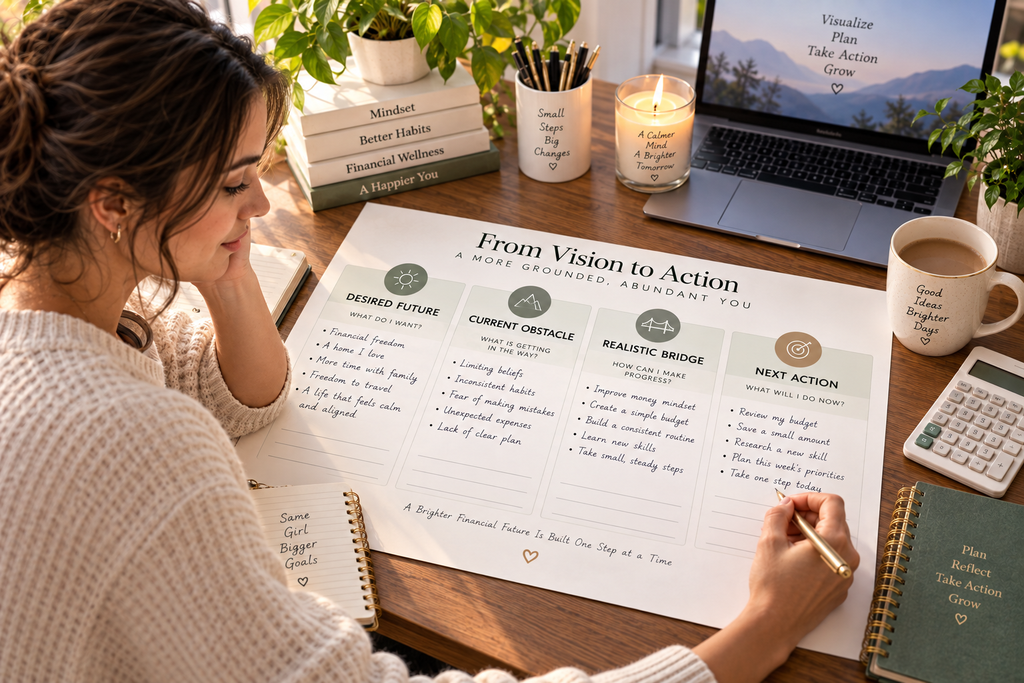
The strongest abundance visualization techniques do more than create a pleasant mental picture. They connect three things: a future you value, the present reality you are working from, and behavior that can help bridge the two. This makes visualization useful even if you do not believe thoughts literally attract external financial events.
A helpful research-based concept is mental contrasting. Rather than imagining only the desired outcome, you picture the future and then deliberately consider the obstacle currently standing in the way. Research has found that mental contrasting, especially when paired with specific implementation plans, can support goal attainment across different behavioral settings.
For financial goals, that might mean visualizing a stronger emergency fund and then acknowledging that inconsistent saving is the obstacle. The next step is not another fantasy scene; it is deciding what behavior would make progress more likely.
The seven exercises below follow that principle.
1. Define Abundance in Real-Life Terms
Before visualizing anything, decide what “abundance” means to you.
For one person, abundance might mean having an emergency cushion. For another, it might mean reducing debt, increasing income options, having enough flexibility to change careers, or feeling more in control of monthly expenses.
Write:
“Financial abundance would give me more ability to __________.”
Try to describe the experience rather than choosing an arbitrary wealth symbol.
For example:
“I want enough emergency savings to handle an unexpected expense without panic.”
“I want enough financial flexibility to take a thoughtful career opportunity.”
“I want to develop skills that expand my earning options.”
The Consumer Financial Protection Bureau defines financial well-being in terms of security and freedom of choice, including control over everyday finances, capacity to absorb financial shocks, progress toward goals, and the ability to make choices that support quality of life.
That framework can make your visualization more personally meaningful than simply picturing piles of money.
2. Visualize the Process, Not Only the Result
Outcome visualization is attractive because it feels good.
You might imagine checking a large savings balance, living without debt, running a successful business, or having greater financial freedom. Keep that scene if it motivates you, but then rewind the mental movie and visualize the behaviors that would come before it.
If your goal is savings, picture yourself reviewing your finances and completing a realistic transfer each payday. If your goal is greater earning potential, picture yourself practicing a skill, completing high-quality work, preparing for an interview, or communicating with potential clients.
If your goal is financial organization, imagine calmly opening your accounts and understanding what is happening rather than postponing the task.
Then ask:
“Which part of this process can I practice today?”
That question turns a desired future into a behavioral cue.
3. Use Mental Contrasting: Future + Present Obstacle
Now take the visualization one step further.
First, picture the future you want. Allow yourself to experience why it matters emotionally: perhaps stability would give you relief, greater flexibility would create freedom, or stronger savings would make emergencies less frightening.
Then deliberately bring your attention back to the present.
Ask:
“What is the main obstacle between me and this particular goal?”
The obstacle might be:
- inconsistent saving;
- avoiding account balances;
- impulsive spending;
- unclear priorities;
- lack of a specific plan;
- procrastinating on career development;
- fear of asking for better compensation;
- unrealistic expectations about how quickly progress should happen.
This is different from negative thinking. Mental contrasting is designed to connect the desired future with the reality that must be addressed rather than allowing fantasy to stand alone. Meta-analytic research has found modest positive effects of mental contrasting on behavior, while work combining it with implementation intentions also supports goal pursuit.
4. Turn the Visualization Into an If-Then Plan
Once you recognize the obstacle, create a response in advance.
Use:
“If X happens, then I will do Y.”
For example:
If I feel tempted to make an unplanned purchase over my personal limit, then I will wait 24 hours.
If payday arrives, then I will complete the savings transfer I planned.
If I start avoiding my financial review because I feel anxious, then I will spend only 10 minutes reviewing the next seven days of expenses.
If I have 30 minutes after dinner on Tuesday, then I will practice the income-related skill I am developing.
Implementation intentions are specific if-then plans linking a situation with a predetermined response. They are commonly studied as a way to help close the gap between intentions and behavior, and they are an important part of the mental-contrasting framework.
Your visualization now has a practical bridge.
Where The Wealth Signal May Fit
You can practice these exercises independently with a notebook and a few minutes of focused reflection. Some readers, however, prefer organized mindset material because having an external framework may make a routine easier to maintain consistently.
That is the appropriate role for The Wealth Signal within this article. The supplied official sales page could not be reliably accessed during research, so current details about its creator, exact format, exercises, modules, audio content, bonuses, pricing, guarantee, or claimed outcomes cannot be responsibly verified.
It is therefore better to treat the product as optional mindset-oriented support rather than assume it contains any particular visualization method or proven wealth-attraction mechanism.
If structured abundance-focused guidance would help you maintain a consistent mindset practice, consider whether The Wealth Signal fits alongside the practical financial habits you already use.
5. Visualize Your Financial Identity Through Behavior
Another useful exercise is to visualize the kind of person you want to become around money.
Avoid vague identity statements such as “I am wealthy” if they feel disconnected from reality. Instead, focus on observable behavior.
Picture yourself as someone who:
- checks financial information without unnecessary avoidance;
- pauses before emotional purchases;
- saves consistently when circumstances allow;
- asks questions before making important decisions;
- continues learning;
- evaluates opportunities carefully;
- returns to a plan after setbacks.
Then write:
“A financially intentional version of me would __________ today.”
Perhaps the answer is:
“Review the upcoming bills.”
“Send the application.”
“Spend 20 minutes updating my portfolio.”
“Transfer a realistic amount into savings.”
“Ask for clarification before agreeing to the financial decision.”
Identity visualization becomes useful when it ends with a behavior you can practice now.
6. Use Gratitude Visualization to Notice Existing Resources
Abundance practices often emphasize gratitude. You can make this more concrete by visualizing a resource you already possess and how you might use it.
Close your eyes and bring one real resource to mind:
a professional skill, an existing income source, a supportive relationship, access to useful information, available time, previous experience, a small savings habit, or something you learned from a mistake.
Rather than simply saying, “I am grateful,” visualize yourself putting that resource to work.
For example:
“I appreciate the skill I already have.”
Then picture yourself improving or applying it.
“I appreciate the small amount I have already saved.”
Then visualize protecting and continuing the habit.
“I appreciate that I recognized an expensive pattern.”
Then picture yourself responding differently the next time the trigger appears.
This allows gratitude to coexist with ambition. You can value what is already available without pretending every part of your financial situation is ideal.
7. End Every Visualization With One Real Action
The final stage is the most important.
Ask:
“What is one action I can complete within the next 24 hours?”
Choose something specific and proportionate.
Examples include:
- review the next seven days of expenses;
- transfer an affordable amount to savings;
- cancel an unused subscription;
- create a realistic debt-payment step;
- research one job opportunity;
- practice an income-related skill;
- update a résumé or portfolio;
- compare two financial options;
- schedule a financial-planning session.
The CFPB notes that financial well-being is influenced by multiple factors, some within personal control and some outside it, while positive financial behavior, skills, and financial self-efficacy can support better outcomes.
That makes action a healthier place to focus than trying to control every outcome through thought alone.
A grounded sequence is:
SEE THE FUTURE → NOTICE THE OBSTACLE → CHOOSE THE BRIDGE → ACT

A 10-Minute Abundance Visualization Routine
These abundance visualization techniques can be combined into one short practice.
Minutes 1–2: Settle and choose one goal
Sit comfortably and allow your breathing to become natural. Choose one financial priority instead of trying to visualize your entire future.
Example:
“I want to become more consistent about emergency savings.”
Minutes 3–4: Visualize the desired future
Picture what greater financial stability would make possible. Imagine handling an unexpected expense with less disruption and seeing steady progress toward your goal.
Focus on why the goal matters.
Minutes 5–6: Visualize the process
Now picture the ordinary behavior behind that future.
See yourself reviewing your plan, receiving income, completing your savings transfer, and continuing the habit over time.
Minute 7: Contrast with reality
Ask:
“What is currently making this difficult?”
Perhaps your obstacle is forgetting to transfer money or spending the available amount first.
Minute 8: Create an if-then plan
“If payday arrives, then I will transfer my planned savings amount before discretionary spending.”
Minute 9: Notice a resource
Identify one thing you already have that can support the goal.
For example:
“I have predictable income this month that I can plan with.”
Minute 10: Schedule the next action
Write down exactly when you will act.
The visualization is finished when the next behavior is clear.
Use a Visualization Journal
A journal prevents abundance visualization from becoming disconnected from reality.
Create five sections:
DESIRED FUTURE
What am I picturing?
WHY IT MATTERS
What would this change in my life?
CURRENT OBSTACLE
What stands between the present and that future?
IF-THEN PLAN
How will I respond when the obstacle appears?
NEXT ACTION
What will I do within 24 hours?
Example:
Desired future: Reliable emergency savings.
Why it matters: Greater ability to handle unexpected expenses.
Current obstacle: I often spend first and plan later.
If-then plan: If payday arrives, then I will make my planned transfer first.
Next action: Decide on a realistic transfer amount tonight.
This gives your visualization a beginning, middle, and end.
Avoid Visualizing Only Luxury Symbols
Luxury cars, mansions, designer purchases, and enormous account balances may feel exciting, but they do not automatically tell you what financial well-being actually means to you.
Try visualizing experiences instead.
Imagine paying your regular expenses without panic. Picture having an emergency cushion. Imagine having the flexibility to decline work that conflicts with your priorities or take time for something meaningful.
The CFPB’s financial well-being framework is useful because it emphasizes security and freedom of choice rather than defining success through one number.
This approach can make visualization more emotionally relevant and less dependent on comparison.
Financial abundance goals → turning broad abundance intentions into specific financial goals
Do Not Confuse a Strong Feeling With Financial Evidence
Visualization can make an imagined future feel vivid. That emotional intensity does not prove that a financial opportunity is good.
If you visualize becoming successful with an investment, business idea, or product, you still need to examine the actual information.
Ask:
- What does this cost?
- What evidence supports the expected outcome?
- What could go wrong?
- How much can I afford to lose?
- Is the opportunity consistent with my financial plan?
- Am I evaluating the facts or reacting to how exciting the future feels?
Visualization can clarify what you want. Due diligence helps you judge whether a specific path makes sense.
Where Structured Mindset Guidance Can Add Value
By this point, the article already provides a complete free visualization system. You can define abundance, imagine the process, contrast the future with present obstacles, create if-then plans, rehearse financially intentional behavior, practice gratitude, and select a concrete action.
Some people are comfortable guiding themselves through that process. Others find routines easier to maintain when they have an organized mindset framework to follow.
Because the supplied official The Wealth Signal page was not reliably available, it would be inappropriate to claim that the product currently includes specific visualization exercises or other particular features.
If you prefer an organized abundance-mindset framework instead of designing every exercise yourself, The Wealth Signal may be worth evaluating as optional support alongside your financial goals.
Try a “Future, Obstacle, Bridge” Exercise
When you do not have time for a longer routine, use three prompts.
FUTURE
What do I want?
“Build a stronger emergency cushion.”
OBSTACLE
What is currently getting in the way?
“I wait until the end of the month and save whatever happens to remain.”
BRIDGE
What action can connect the two?
“Decide on an affordable amount and transfer it shortly after income arrives.”
This compact format captures the main advantage of mental contrasting: the future is not viewed separately from the obstacle. Instead, the obstacle helps determine the plan.
You can use the same method for career growth, spending habits, debt reduction, financial organization, or other realistic goals.
Common Abundance Visualization Mistakes
One mistake is making the image so unrealistic that it provides no useful direction. If your scene jumps from today’s situation directly to extreme wealth, ask what realistic intermediate stage is missing.
Another mistake is visualizing only outcomes. Add the repeated behaviors, decisions, and obstacles that would exist on the path.
A third mistake is changing the visualization every day. If your main priority is emergency savings, you do not necessarily need a new dream each morning. Repeatedly reconnecting with the same meaningful goal may be more useful.
A fourth mistake is using visualization instead of financial information. Imagining debt freedom does not replace knowing the balance, interest terms, required payments, or available options.
A fifth mistake is treating setbacks as evidence that you “visualized incorrectly.” Financial outcomes are shaped by circumstances as well as behavior, and not every factor is personally controllable.
Review Your Practice Weekly
Set aside 10 minutes once a week and review what happened after your visualization sessions.
Ask:
Which future did I visualize most often?
Did it represent something I genuinely value?
Which obstacle kept appearing?
Which if-then plan worked?
Which planned action did I avoid?
What practical progress occurred?
What should I change next week?
Do not judge the practice only by whether you “felt abundant.” Look for observable changes such as clearer priorities, improved follow-through, better financial organization, or greater willingness to face a money task.
That gives your visualization feedback.
A 30-Day Visualization Experiment
If the practice resonates with you, use it for 30 days as an experiment rather than a promise that your financial life will transform on a fixed schedule.
Choose one primary goal.
Each day, record:
- the future you visualized;
- why it matters;
- the obstacle you noticed;
- your if-then plan;
- one existing resource;
- your next financial action;
- whether you completed it.
At the end of the month, ask whether the practice improved how you relate to the goal.
Are your priorities clearer?
Are you recognizing obstacles sooner?
Are you taking more specific actions?
Have you stopped relying as heavily on vague wishes?
Do you know what part of your plan needs adjustment?
Those are useful outcomes even if your ultimate financial goal takes much longer to reach.
Final Thoughts
The most practical abundance visualization techniques do not require choosing between imagination and reality. You can picture a future that inspires you while also acknowledging present circumstances, obstacles, uncertainty, and the work involved in moving forward.
Define what abundance means in your life. Visualize the process, not only the reward. Contrast your desired future with the obstacle in front of you, create an if-then response, notice the resources you already have, and finish with one specific action.
A useful visualization sequence is:
FUTURE → OBSTACLE → PLAN → ACTION → REVIEW
That keeps the practice hopeful without asking visualization to do the job of financial behavior.
If The Wealth Signal matches the structured abundance approach you prefer, decide whether it belongs alongside—not instead of—the practical financial actions supporting your goals.
What are abundance visualization techniques?
They are exercises that use mental imagery to picture desired goals, experiences, or behaviors. A grounded approach also examines present obstacles and identifies practical actions rather than assuming visualization itself guarantees an external outcome.
Can visualization attract money?
There is no established scientific evidence that imagining wealth directly attracts money. Research does support some imagery-based self-regulation strategies, such as mental contrasting combined with implementation intentions, for helping people pursue goals.
Should I visualize the outcome or the process?
You can visualize both, but process visualization is especially useful because it helps you mentally rehearse the behaviors associated with the goal. Mental contrasting goes further by comparing the desired future with the present obstacle.
What is mental contrasting?
Mental contrasting involves imagining a desired future and then reflecting on the present reality or obstacle standing in the way. Research has examined it as a self-regulation strategy for goal pursuit.
How long should an abundance visualization session last?
There is no required duration. A focused 5–10 minute practice can be enough to visualize one meaningful goal, identify an obstacle, create a plan, and choose a next action.
Should visualization replace financial planning?
No. Financial well-being also involves practical money management, resilience to financial shocks, progress toward financial goals, and freedom of choice.