

If you are searching for signs your ex is open to reconciliation, you are probably trying to answer a more careful question than “Does my ex still care?” You may already see warmth, contact, curiosity, or regret, but you want to know whether your ex is actually becoming receptive to rebuilding the relationship. That distinction matters because lingering feelings can exist without readiness, and one emotional conversation can create hope before anything has truly changed.
The biggest mistake is treating openness as a promise. An ex can be willing to talk, meet, apologize, or explore what happened without being ready to restart the relationship. This guide shows you nine stronger clues, weaker signals that are easy to overread, and how to respond in a way that protects your self-respect while leaving room for mutual reconciliation if it genuinely develops.
Quick Takeaway: Openness means the door is no longer completely closed. Readiness means both people can walk through it with enough clarity, change, trust, and willingness to build something different.
Signs Your Ex Is Open to Reconciliation: Look for Openness, Not Certainty
When evaluating signs your ex is open to reconciliation, focus on progression. Passive behavior such as watching stories, liking posts, or sending one nostalgic message requires almost no vulnerability. More meaningful evidence appears when your ex willingly communicates, stays present after you respond, discusses the breakup, makes real plans, and becomes more curious about what a healthier future might require.
Research on on-again/off-again relationships shows why this distinction matters. In a study of 274 people who had experienced cyclical relationships, lingering feelings were a predominant reason for relationship renewals, while uncertainty about the preceding breakup also mattered. In other words, renewed contact can be emotionally real while uncertainty remains unresolved, so it is wiser to judge the developing pattern than one hopeful moment.
Decision Rule: Do not ask only, “Is my ex giving me signs?” Ask, “Is my ex becoming more willing to communicate, take responsibility, tolerate difficult conversations, and make mutual choices?”
1. They Communicate More Willingly Instead of Keeping the Door Shut
One of the earliest signs your ex is open to reconciliation is a clear reduction in resistance to contact. Your ex may respond more fully, initiate a conversation, stop ending every interaction quickly, or become comfortable discussing topics that go beyond practical logistics. The important change is not simply that they answer; it is that communication feels less guarded and more voluntary than it did immediately after the breakup.
Look for a pattern across several interactions. One warm reply can happen because of politeness, nostalgia, or loneliness, while increasing willingness to talk suggests that your ex is at least open to emotional contact again. You do not need to force the conversation toward reconciliation immediately. Let the communication become stable enough that you can see whether your ex is choosing it rather than merely tolerating it.
Practical Example: If your ex once replied with short, delayed answers but now asks questions back, stays in the conversation, and occasionally starts one themselves, that shift tells you more than one dramatic “I miss you” message.
2. They Ask About Your Present Life, Not Only Shared Memories
An ex who is emotionally open to rebuilding usually becomes curious about who you are now. They may ask about work, family, goals, routines, friendships, or changes you have made since the breakup. Present-focused curiosity matters because reconciliation would involve the people you are today, not simply the version of the relationship that existed before.
Notice whether the questions feel respectful and reciprocal. Do they remember what you tell them, ask thoughtful follow-ups, and share honestly about their own life? That is more meaningful than repeatedly bringing up old memories without showing interest in your present reality.
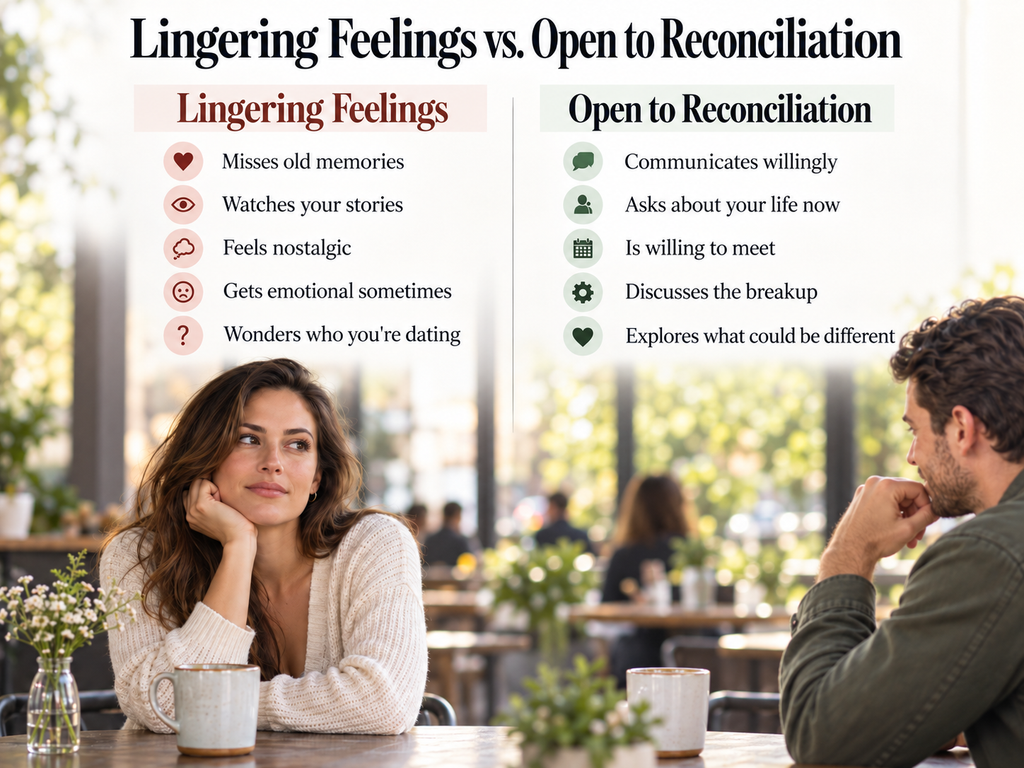
If most of the questions are only about whether you are dating someone else, jealousy may be driving the interaction more than reconciliation readiness. Curiosity becomes more useful when it expands beyond competition and into compatibility.
3. They Are Willing to Meet Without Turning It Into an Instant Reunion
Moving from texting to an in-person conversation can be another meaningful clue. Your ex may suggest coffee, a walk, lunch, or another low-pressure meeting and then follow through without making the situation overly romantic. A person who is open to reconciliation often wants more information about how it feels to be around you again before making a bigger decision.
The healthier version of this meeting does not demand immediate answers. You should be able to talk, observe the new dynamic, and leave without deciding the relationship that same day. If chemistry returns, treat it as one part of the experience rather than proof that old problems disappeared.
Some readers prefer structured guidance once renewed contact starts becoming more serious. The current women’s order page for The Ex Factor 2.0 lists a 163-page interactive e-book, a 20-part video course, a three-part bonus video series, three additional e-books, immediate digital access, a $47 price, and a 60-day money-back guarantee.
If you want a structured breakup-and-reconnection framework to compare with the independent guidance here, you can consider whether The Ex Factor 2.0 fits your situation and boundaries.
4. They Can Discuss the Breakup Without Immediately Shutting Down
A major sign of openness is the ability to revisit what happened without ending the conversation, becoming completely defensive, or pretending the breakup never occurred. Your ex may acknowledge that the relationship had real problems while still being willing to hear your perspective. That willingness does not mean they agree with every detail, but it shows that the past is becoming discussable rather than untouchable.
This is important because signs your ex is open to reconciliation should eventually include tolerance for uncomfortable truth. A second chance cannot be built only on pleasant memories and renewed attraction. If your ex wants contact but refuses every conversation about what went wrong, they may be open to closeness without being open to repair.
Research on breakup remorse in cyclical relationships highlights intentionality, communication, identity, and power or control dynamics as important themes when people are deciding whether to renew or end a recurring relationship. The study involved 21 young adults and was qualitative, so it cannot predict your situation, but it supports treating reconciliation as a deliberate decision rather than an emotional reflex.
5. They Take Specific Responsibility for Their Part
An apology becomes more meaningful when it is specific. Your ex may say they now understand that they avoided commitment, withdrew during conflict, dismissed your concerns, communicated poorly, or failed to follow through. Specific responsibility shows more reflection than a vague “I’m sorry for everything” and gives you something concrete to compare with future behavior.
Here, accountability matters because openness is not only emotional. It includes the willingness to look at why the previous relationship failed and what each person would need to do differently. You can own your contribution without accepting blame for choices that were not yours.
Common Mistake: Do not treat an apology as a completed repair. An apology opens the possibility of change; consistent behavior shows whether the understanding lasts.
6. They Stay Engaged After They Know You Are Receptive
Some exes become attentive until they receive reassurance that you still care, then disappear once the uncertainty is gone. That pattern can be driven by loneliness, ego, fear of loss, or a need to know the door is still open. It may feel like reconciliation is beginning, but the behavior often resets once your availability is confirmed.
A stronger clue appears when your ex remains engaged after reassurance. They continue initiating, follow through on plans, ask meaningful questions, and communicate with similar effort even though they already know you are open to talking. That suggests the connection itself matters, not just the relief of knowing they still have access to you.
This is useful because stable effort is harder to confuse with a temporary emotional spike. You are looking for a trend that becomes calmer and clearer, not unpredictable.
7. Their Behavior Changes in the Area That Caused the Breakup
Words such as “I’ve changed” become useful only when you can see the change in the place where the old relationship repeatedly broke down. If unreliability was the issue, does your ex become more dependable? If conflict avoidance was the problem, do they stay present for difficult conversations? If commitment was unclear, are they now more honest about what they can offer?
Relevant behavioral change is stronger evidence than romantic gestures. Flowers, long messages, or emotional declarations can be sincere while leaving the original problem untouched. A second chance becomes more realistic when new behavior gives you a different experience where the old pattern hurt the relationship.
What This Means: Do not ask only whether your ex feels differently. Ask whether they now behave differently where it matters most.
8. They Respect Your Boundaries and Your Pace
Healthy openness to reconciliation should leave room for your choice. Your ex may want more contact while accepting that you need time, may ask to meet without pressuring you, or may hear “I’m not ready to decide yet” without becoming cold, angry, or punitive. Interest plus restraint is usually a better sign than urgency plus pressure.
This matters because rebuilding trust requires emotional safety. A person who genuinely wants another chance should tolerate that you may need evidence before offering more closeness. If your boundaries are treated as obstacles, the process is recreating a problem rather than solving one.
The seller behind The Ex Factor 2.0 describes a “3R” framework of recovery, rekindling, and reattraction and includes material for the stage when an ex starts contacting you again. Its sales presentation also promotes ignoring an ex and what it calls “covert jealousy,” along with strong claims about influencing another person’s emotions; those are seller marketing claims rather than guarantees and are best filtered through consent, healthy boundaries, and mutual choice.
If your ex is communicating again but knowing how to move from cautious contact into a clear, respectful reconciliation conversation is where you feel stuck, you can review The Ex Factor 2.0’s structured communication material while keeping only guidance that supports honesty, consent, boundaries, and two-way choice.
9. They Start Talking About What a Different Relationship Would Require
The clearest signal appears when the conversation becomes future-focused. Your ex may ask what would need to change, whether you think trust could be rebuilt, how you would handle old conflicts differently, or whether you could imagine trying again under better conditions. They are no longer only reacting to the loss; they are considering the structure of another relationship.
You still do not need to say yes immediately. Ask whether the changes being discussed are realistic, whether both people are willing to contribute, and whether enough evidence already exists to support another step. Openness is valuable because it creates a real conversation, but the final decision should still depend on trust, compatibility, consistency, and mutual desire.
Weak Signs That Do Not Prove Your Ex Is Open to Reconciliation
Story views, likes, old-photo reactions, vague posts, mutual-friend questions, or one jealous comment can reflect curiosity, nostalgia, or lingering feelings without proving a serious interest in rebuilding. When looking for signs your ex is open to reconciliation, use passive signals only as background context and give more weight to direct communication, accountability, plans, boundaries, and future-focused discussion.
Decision Check: If the digital signal disappeared tomorrow, would the real-world behavior still suggest openness? If not, wait for stronger evidence.
Does Being Open to Reconciliation Mean Your Ex Wants You Back?
Not necessarily. An ex can be willing to talk or explore what happened without having decided to reunite. Openness is permission to explore; wanting you back is a stronger intention; reconciliation is a mutual decision. Let clearer behavior develop before restoring daily relationship routines, exclusivity, or future plans.
What Should You Do if Your Ex Seems Open to Reconciliation?
If contact is welcome and there is no no-contact or safety issue, respond naturally and keep effort reciprocal. Avoid doing all the initiating because you are afraid the opportunity will disappear; you need enough space to observe whether your ex continues choosing communication voluntarily.
For signs your ex is open to reconciliation, the healthiest next step is a calm conversation once the pattern becomes consistent. Ask what your ex hopes for, what they understand differently now, and what would need to change. If they explicitly requested no contact or made clear they do not want communication, respect that boundary.
Open to Reconciliation vs. Ready to Reconcile
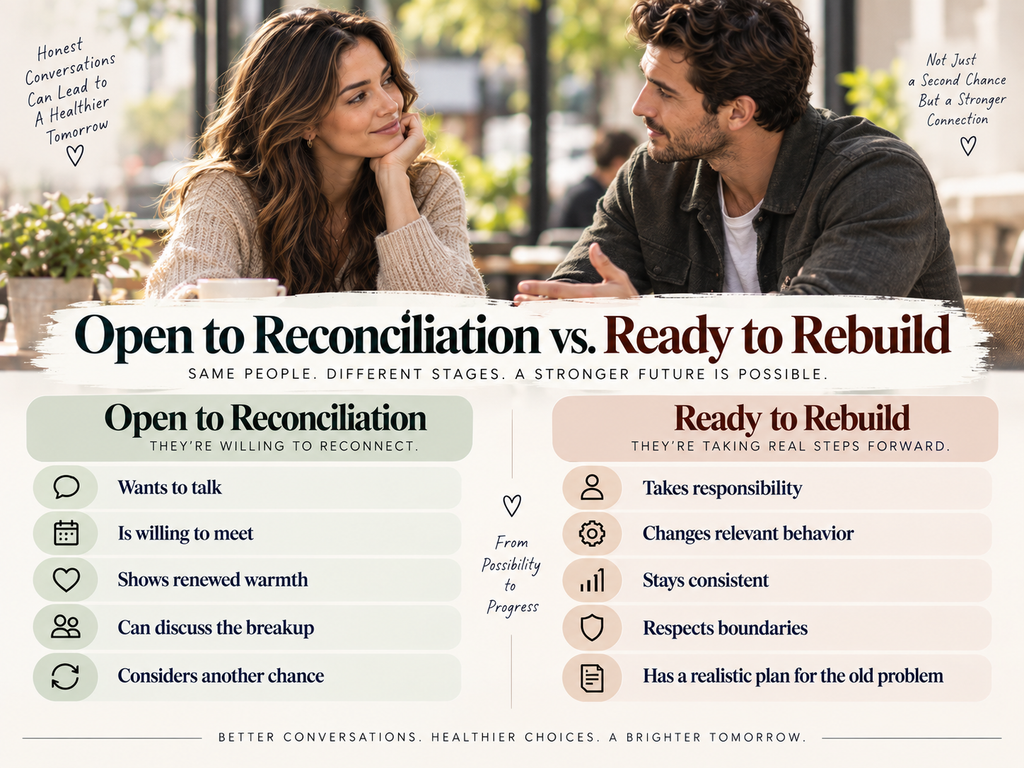
Being open means your ex is willing to communicate and consider the possibility. Being ready means both of you have enough clarity and evidence to begin rebuilding deliberately.
Open to Reconciliation May Look Like:
- warmer voluntary communication;
- willingness to meet;
- curiosity about your present life;
- ability to discuss the breakup.
Reconciliation Readiness Is Stronger When:
- accountability is specific;
- relevant behavior has changed;
- trust is returning;
- boundaries are respected;
- both people clearly want another relationship;
- there is a realistic plan for the original problem.
Do not rush from the first list to the second. Let uncertainty become clearer through behavior.
When Reconciliation May Still Be the Wrong Choice
Your ex can be open to reconciliation while the relationship is still a poor fit. Major incompatibilities around commitment, children, lifestyle, location, trust, or core values may remain.
If the prior relationship involved coercion, stalking, threats, violence, or serious boundary violations, do not treat renewed openness as a reason to restore access. Prioritize safety and appropriate support.
Where The Ex Factor 2.0 May Fit
The current women’s order page lists The Ex Factor 2.0 with a 163-page interactive e-book, a 20-part video course, a three-part bonus video series, three additional e-books, a $47 price, immediate access, ClickBank processing, and a 60-day money-back guarantee.
The program may appeal to readers who prefer a structured framework after communication has reopened. Its sales presentation makes stronger claims about influencing an ex’s emotions than this article endorses, so filter any advice through consent, boundaries, mutual willingness, and realistic expectations.
If you prefer a structured ebook-and-video reconciliation framework and are comfortable applying that filter, you can consider The Ex Factor 2.0 as optional support rather than a substitute for direct communication, mutual effort, or your own judgment.
Signs Your Ex Is Open to Reconciliation: The Bottom Line
The strongest signs your ex is open to reconciliation are progressive. Your ex communicates more willingly, becomes curious about your present life, agrees to low-pressure meetings, discusses the breakup honestly, takes responsibility, stays engaged after reassurance, changes relevant behavior, respects boundaries, and starts discussing what a different relationship would require.
That pattern still does not guarantee that getting back together is right. Openness creates an opportunity to evaluate the relationship; trust, consistency, compatibility, communication, and two willing choices should determine what happens next.
The goal is not merely to prove the door is open, but to see whether both people can build something healthier on the other side.
What are the strongest signs your ex is open to reconciliation?
Stronger clues include voluntary communication, curiosity about your present life, willingness to meet, honest breakup discussions, specific accountability, consistent effort, changed behavior, respected boundaries, and future-focused conversations.
Does being open to reconciliation mean my ex wants me back?
Not automatically. Your ex may be willing to explore the possibility without having decided to reunite. Wanting another chance usually becomes clearer through consistent behavior and direct communication.
Does an apology mean my ex is ready to reconcile?
An apology can be meaningful, especially when it is specific, but readiness requires more. Look for behavior that addresses the problem that caused the breakup and remains consistent over time.
Should I bring up reconciliation if my ex seems open?
If several stronger signs are present and communication feels safe and mutual, a calm conversation can be reasonable. Ask what they are hoping for rather than assuming the outcome.
What if my ex is warm but still uncertain?
Believe both parts. Warmth may show openness, while uncertainty means they may not be ready. Avoid restoring the entire relationship before clarity and consistency develop.
How do I know whether reconciliation is actually becoming healthy?
Look for specific accountability, reliable behavior, rebuilding trust, respected boundaries, compatible future expectations, and a mutual plan for handling the issue that ended the first relationship.