

If you are asking should i take my ex back, you are probably dealing with more than a simple yes-or-no decision. Your ex may have returned, apologized, said they miss you, or asked for another chance, and part of you may still care deeply. At the same time, you may remember exactly why the relationship ended and fear repeating the same pain.
The biggest mistake is deciding from the emotion of the reunion instead of the quality of the relationship being offered now. Missing someone can make old problems feel smaller for a moment. This guide gives you eight practical questions to evaluate change, trust, compatibility, boundaries, and mutual effort before you say yes.
Quick Takeaway: Do not ask only whether you still love your ex. Ask whether the relationship would be meaningfully different this time.
Should I Take My Ex Back? Start With the Reason You Broke Up
Before you evaluate chemistry or apologies, identify the actual reason the relationship ended. Was it a temporary circumstance, broken trust, incompatible goals, repeated inconsistency, emotional withdrawal, or something more serious? A second chance makes more sense when the problem is specific enough to examine and both people can describe what would need to change.
Research on on-again/off-again relationships shows why feelings alone are not enough. In a study of 274 people with cyclical relationship experience, lingering feelings were a predominant reason for renewals, while breakup uncertainty also mattered. A reunion can therefore be emotionally genuine while old uncertainty remains.
Decision Rule: If you cannot clearly name what ended the relationship and what is different now, you probably do not yet have enough information to restart it.
1. Has the Problem That Ended the Relationship Actually Changed?
Start with the issue that made the relationship unsustainable. If your ex was unreliable, are they now consistently dependable? If commitment was the problem, are they clearer about what they want? If communication broke down, can both of you now stay present during difficult conversations instead of withdrawing, attacking, or avoiding the subject?
For should i take my ex back, this question matters more than romantic gestures. A long apology, flowers, emotional messages, or intense chemistry can feel powerful while leaving the actual breakup problem untouched. Look for relevant change in ordinary behavior over enough time to judge it. Change is more credible when you can describe what you have observed rather than only what your ex has promised.
Practical Example: “I have changed” is a claim. “I used to disappear during conflict, but over the last several weeks I have stayed in difficult conversations, followed through, and communicated when I needed space” is behavior you can evaluate.
2. Is Your Ex Taking Responsibility Without Blaming You for Everything?
A healthy second chance usually requires both people to understand their contribution to the breakup. Your ex does not need to accept your version of every event, but they should be able to acknowledge specific choices they regret and listen to how those choices affected you. Vague remorse can be sincere, yet specific accountability gives you much better information about whether reflection has happened.
Listen for language that includes responsibility rather than excuses. “I know I hurt you when I kept cancelling plans and then told you that you were too demanding” is more useful than “We both made mistakes” when one particular behavior repeatedly caused harm. You should be able to own your part too without accepting blame for behavior that was not yours.
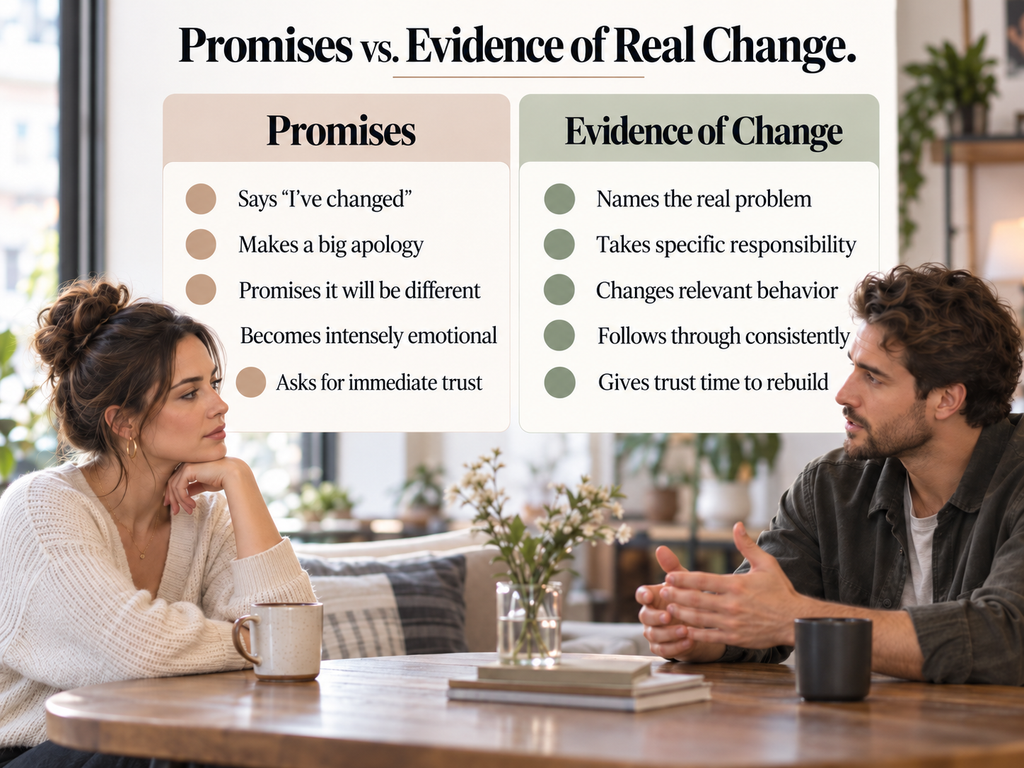
Research on breakup remorse in cyclical relationships emphasizes intentional decision-making, communication, identity, and power or control dynamics when people consider whether to renew or end an on-again/off-again pattern. The study was qualitative and involved 21 young adults, so it cannot predict your relationship, but it supports approaching reconciliation as a deliberate decision rather than an emotional reflex.
3. Do You Trust Their Behavior More Than Their Words?
Trust after a breakup rarely returns because of one conversation. It rebuilds when words and behavior match repeatedly: plans are kept, communication is reasonably consistent, and promises become observable action. You do not need perfect certainty, but trusting again should rest on more than hope.
If you are wondering should i take my ex back, notice what happens when the emotional reunion settles down. Does your ex remain engaged after they know you still care, or does the effort drop once they receive reassurance? Does their behavior stay respectful when you ask for time, or do they pressure you to decide quickly? These moments often reveal more than romantic declarations.
Some readers prefer a structured framework while evaluating renewed contact. The current women’s order page for The Ex Factor 2.0 lists a 163-page interactive e-book, a 20-part video course, a three-part bonus video series, three additional e-books, immediate digital access, a $47 price, and a 60-day money-back guarantee.
If you want a structured breakup-and-reconnection framework to compare with the independent decision process here, you can consider whether The Ex Factor 2.0 fits your situation and boundaries.
4. Are You Compatible With the Future You Both Want?
Love does not solve every incompatibility. Two people can care deeply and still want different futures around marriage, children, location, lifestyle, finances, monogamy, religion, or the amount of closeness and independence each person needs. If a major incompatibility ended the relationship, a reunion will not fix it unless something material has genuinely changed.
Ask direct questions instead of assuming that missing each other created alignment. What does commitment mean now? Which issues are negotiable and which are not? A second chance is safer when both people understand the future they are agreeing to explore.
Common Mistake: Do not confuse stronger feelings with stronger compatibility. Feelings can intensify during separation even when the practical problem remains exactly the same.
5. Can You Talk About the Breakup Without Recreating the Same Fight?
A useful reconciliation conversation includes enough emotional safety for both people to discuss the past. You should be able to explain what hurt, what you needed, and what you would need now without the conversation immediately becoming contemptuous, threatening, manipulative, or impossible to finish. Disagreement is normal; repeating the same destructive pattern is the warning sign.
For should i take my ex back, pay attention to how your ex handles information they do not like. Can they hear that you need more time? Can they disagree without punishing you? Can both of you discuss the breakup without using the conversation to win, shame, or extract an immediate commitment? Communication under pressure predicts the quality of the new relationship better than how affectionate you are during the reunion.
6. Are You Choosing Them—or Choosing Relief From Missing Them?
Reuniting can produce an enormous sense of relief. The person you missed is suddenly available again, uncertainty drops, and the painful finality of the breakup disappears. That relief can be mistaken for evidence that getting back together is automatically the right decision.
Ask yourself what you would think if the emotional urgency disappeared for a week. Would you still believe this person is a good partner for the life you want? Are you excited about the relationship they can realistically offer now, or mainly grateful that the loss no longer feels permanent? The answer can help you separate attachment from judgment.
Decision Check: Imagine your ex had never left, but all of the old relationship problems were still present today. Would you actively choose that relationship? If the answer is no, the reunion itself is not enough.
7. Is the Effort Mutual, or Are You Already Carrying the Reconciliation?
A healthy second chance cannot depend on one person doing all the emotional work. Both people should initiate conversations, ask questions, make plans, repair misunderstandings, and follow through. If you are already monitoring every message, creating every opportunity to meet, explaining every conflict, and keeping the reconnection alive, the old imbalance may already be returning.
This is especially important when the decision feels urgent because your ex has finally shown interest. You do not need to prove that you deserve the second chance. Let your ex contribute enough effort that you can observe what they actually want and what they are willing to do.
The seller behind The Ex Factor 2.0 describes a “3R” framework of recovery, rekindling, and reattraction and includes material for the stage when an ex starts contacting you again. That is the seller’s description of its program, not independent evidence that a tactic can determine another person’s choice.
If mutual interest exists but knowing how to move from renewed contact into a clear reconciliation conversation is where you feel stuck, you can review The Ex Factor 2.0’s structured communication material while keeping only guidance that supports consent, accountability, boundaries, and voluntary two-way choices.
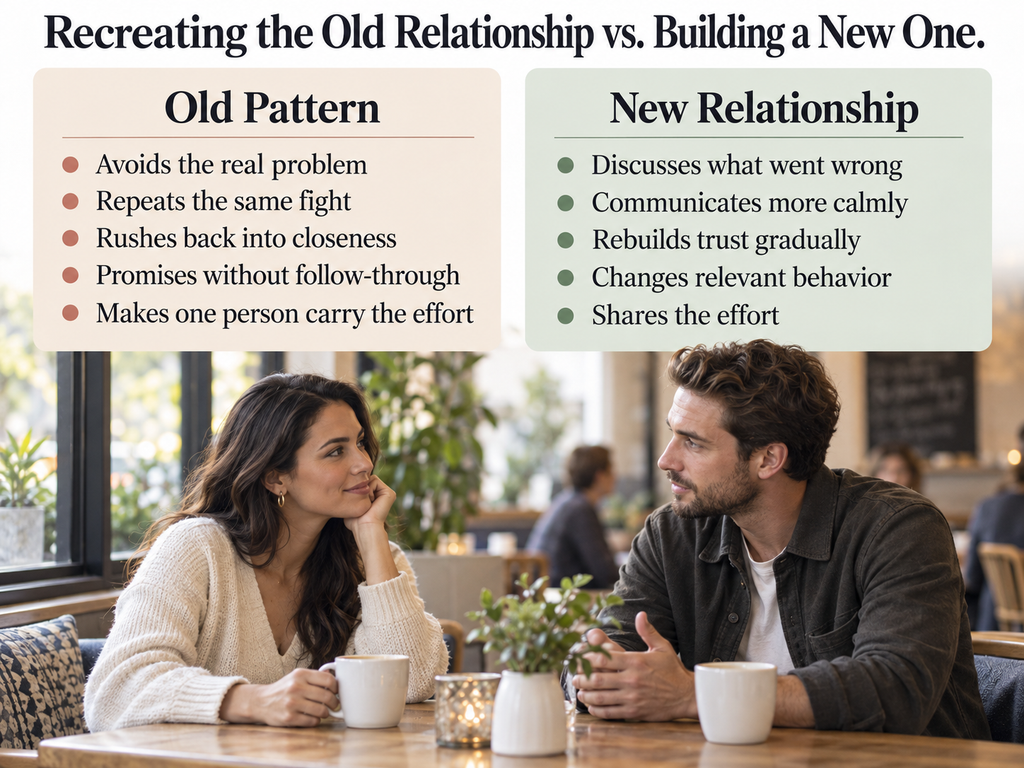
8. Can You Build a New Relationship Instead of Recreating the Old One?
The best case for reconciliation is not that the old relationship was secretly perfect. It is that both people understand why it failed and are prepared to build a different pattern. That can mean slower pacing, clearer expectations, better conflict habits, more honest boundaries, or specific agreements around trust, commitment, money, family, or communication.
Look for evidence that both of you can tolerate a gradual rebuild. You do not have to return immediately to daily contact, exclusivity, physical intimacy, or future planning. A healthier second chance can begin with conversations and low-pressure time together while you see whether the new behavior holds.
Signs Taking Your Ex Back May Be Worth Exploring
You do not need every possible sign, but a healthy case for reconciliation usually contains several forms of evidence at the same time:
- the breakup reason is clearly understood;
- accountability is specific rather than vague;
- relevant behavior has changed;
- communication is calmer and more honest;
- trust is rebuilding through consistency;
- future goals are compatible;
- both people contribute effort;
- boundaries are respected;
- neither person is demanding an immediate reunion;
- both people can explain what would be different this time.
This checklist does not guarantee success. It helps distinguish a thoughtful second chance from a reunion driven mainly by loneliness or chemistry.
Signs You Probably Should Not Take Your Ex Back Yet
Be cautious if your ex wants immediate access but cannot explain what changed, repeatedly blames you for the entire breakup, disappears and returns when convenient, refuses to discuss the original problem, or pressures you to make a decision before trust has had time to rebuild. Strong feelings do not cancel these patterns.
Also pay attention to your own state. If you feel afraid to say no or are ignoring your values because the reunion feels exciting, slow the process down. Decisions made under emotional pressure are harder to evaluate clearly.
If the previous relationship involved coercion, stalking, threats, violence, or serious repeated boundary violations, reconciliation should not be treated as a normal “second chance” decision. Prioritize safety and appropriate support rather than reopening access.
Should I Take My Ex Back if They Say They Have Changed?
Do not decide from the sentence alone. Ask what changed, how it changed, how long the new behavior has been present, and whether the change connects directly to the breakup problem. Real change is easier to describe through examples than through promises.
You can also allow time to do some of the verification. If your ex becomes angry because you will not trust them instantly, that reaction is information. A person who understands damaged trust should be able to tolerate a slower rebuild.
Should I Take My Ex Back if I Still Love Them?
Love matters, but it is not a complete decision framework. You can love someone who is incompatible with your future, unable to offer stability, or unwilling to repair the problem that ended the relationship. You can also love someone and decide that the healthiest choice is to stay apart.
Treat love as one important input alongside trust, compatibility, safety, communication, accountability, and mutual effort. The goal is not to deny your feelings. It is to make sure your feelings are not being asked to carry the entire relationship.
Should I Take My Ex Back After They Cheated?
Infidelity does not create one universal answer. Some couples attempt repair, while others decide the breach is incompatible with what they need. If you are considering reconciliation, focus on responsibility, the end of deceptive behavior, honest answers, and acceptance that trust may take substantial time to rebuild.
You are not obligated to reconcile because they are remorseful. You also do not need to prove that you are “over it” quickly. If repeated infidelity, coercion, abuse, or ongoing dishonesty is present, protecting yourself may be more important than preserving the relationship.
A Simple Decision Test Before You Say Yes
If you feel overwhelmed, write down your answers to five questions without your ex present: What ended the relationship? What evidence shows that problem has changed? What would I need to feel safe and respected? Are our future goals compatible? If nothing changed from today onward, would I still choose this relationship?
Then compare your answers with what your ex is actually offering. This creates a useful separation between hope and evidence. If your answer depends mostly on what you imagine they might become, you may need more time before deciding.
Where The Ex Factor 2.0 May Fit
The current women’s order page for The Ex Factor 2.0 lists a 163-page interactive e-book, a 20-part video course, a three-part bonus video series, How To Read A Man, Why Men Pull Away, and Flawless Fat Loss Guide. The listed price is $47, access is described as immediate, payments are processed through ClickBank, and the seller provides a 60-day money-back guarantee.
The program may appeal to readers who prefer a structured breakup-and-reconnection framework once mutual communication has resumed. Its promotional presentation also makes strong claims about influencing an ex’s emotions and promotes tactics including ignoring an ex and what the seller calls “covert jealousy.” Those are seller marketing claims rather than dependable predictions, so manipulation-based material is better filtered out in favor of consent, accountability, boundaries, honest communication, and mutual choice.
If you prefer a structured ebook-and-video reconciliation framework and are comfortable applying that filter, you can consider The Ex Factor 2.0 as optional support rather than a substitute for compatibility, trust, healthy communication, mutual effort, or your own judgment.
Should I Take My Ex Back? The Bottom Line
The answer to should i take my ex back should come from more than love, loneliness, or the excitement of being wanted again. Look at why you broke up, whether the relevant problem has changed, whether accountability is real, whether trust is rebuilding, whether your future goals fit, and whether both people are contributing to a different relationship.
You do not have to decide the moment your ex returns. A careful “maybe” can give you time to observe behavior without promising a reunion. If the relationship becomes clearer, safer, more consistent, and more compatible as you slow it down, another chance may be worth exploring.
The goal is not to recreate the relationship you lost. It is to decide whether the relationship available now is one you would knowingly choose.
Should I take my ex back if I still love them?
Love is important, but it should not be the only reason. Consider trust, compatibility, changed behavior, communication, boundaries, and whether both people want the same future.
How do I know if my ex has really changed?
Look for behavior connected directly to the issue that ended the relationship. Reliable follow-through over time is stronger evidence than apologies, promises, or romantic gestures alone.
Should I take my ex back if they cheated?
There is no universal answer. If you are considering reconciliation, look for full responsibility, an end to deceptive behavior, patience with rebuilding trust, and behavior that makes future honesty more credible.
Is it a bad idea to get back together with an ex?
Not automatically. Some former partners rebuild successfully, while others repeat the same cycle. What matters is whether the original problem is understood and meaningfully different now.
How long should I wait before deciding?
There is no fixed timeline. Give yourself enough time to observe whether changed behavior, mutual effort, trust, and respectful communication remain consistent beyond the emotional reunion.
What are the biggest signs I should not take my ex back?
Major warning signs include pressure for an immediate reunion, blame without accountability, repeated disappearing, unchanged harmful behavior, ignored boundaries, or an inability to discuss why the relationship ended.