

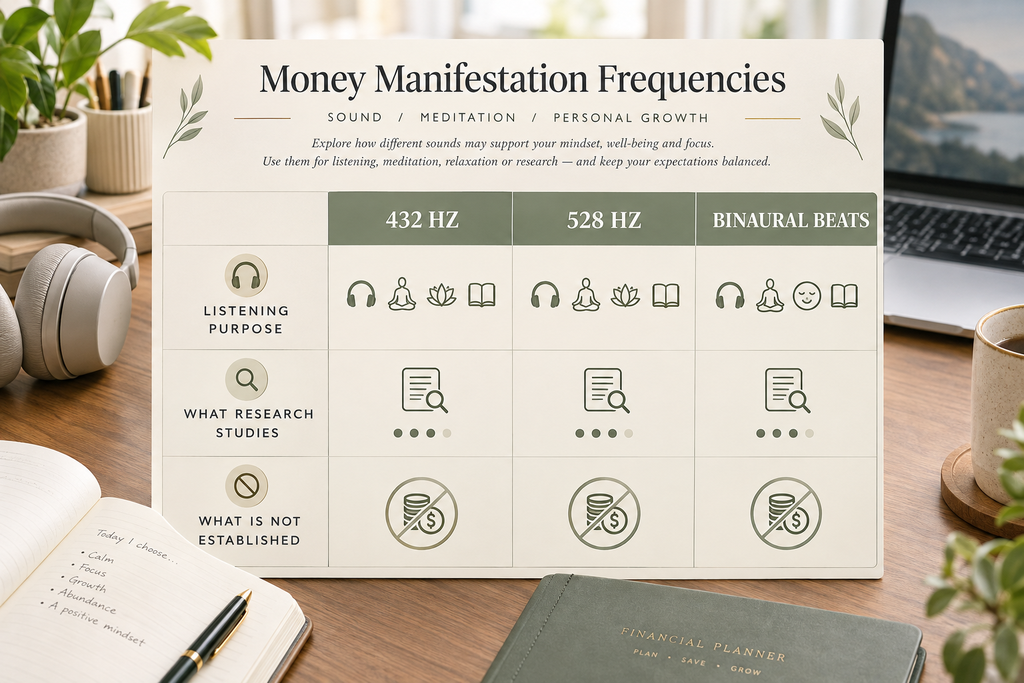
If you are searching for the best frequency for money manifestation, you have probably seen numbers such as 432 Hz, 528 Hz, binaural-beat frequencies, or other so-called abundance tones. There is no scientifically established sound frequency that has been shown to attract money, increase a bank balance, or cause financial opportunities to appear. A more grounded approach is to use sound as part of meditation, visualization, or reflection while connecting the practice with realistic financial goals and action.
Sound and meditation can still be personally useful. The National Center for Complementary and Integrative Health describes meditation as a broad group of mind-body practices that may involve focusing on breathing, sound, a visual image, or a repeated word or phrase. Research has explored meditation for areas such as stress, anxiety, and sleep, although study quality and results vary.
Research on binaural beats also focuses on psychological or physiological outcomes rather than wealth creation. Meta-analyses and recent systematic reviews have examined cognition, anxiety, pain, sleep, mood, and brain activity. Some findings are promising, but the evidence is heterogeneous, and a 2023 systematic review found inconsistent evidence for the underlying brainwave-entrainment hypothesis itself.
So the useful question is not simply, “Which number attracts the most money?” It is:
“Which sound helps me create a focused practice that ends in a better financial decision?”
What is the best frequency for money manifestation?
There is currently no scientifically validated best frequency for money manifestation. Research does not identify 432 Hz, 528 Hz, 888 Hz, or another specific number as a proven way to attract wealth. If you enjoy those sounds, you can use them as meditation music, but the numerical label should not be confused with evidence of a money-creating mechanism.
This distinction matters because frequency is a real physical property of sound, while “wealth frequency” is often used differently in spiritual language. A track can genuinely be tuned or constructed around particular acoustic frequencies without that proving that the sound affects financial events.
Some frequency-based music has been studied for other purposes. For example, randomized studies have examined 432 Hz music in anxiety-related settings, including dental procedures. One trial comparing 432 Hz, 440 Hz, and no music reported reductions in anxiety in both music groups and lower salivary cortisol in the 432 Hz group, but this was a small dental-anxiety study—not evidence of money manifestation.
A 2026 randomized trial also compared 432 Hz and 528 Hz instrumental music with no music in 162 university students under exam-related stress. That research examined biological stress markers and cognition, not wealth attraction.
The practical conclusion is simple: choose sound for focus, relaxation, or enjoyment—not because a particular Hz number guarantees financial results.
432 Hz: What It May—and May Not—Mean
432 Hz music is one of the most common choices in meditation communities. Usually, the label refers to music tuned so that the reference pitch A4 is set around 432 Hz rather than the modern standard of 440 Hz.
Some small studies have reported changes in anxiety or physiological measures when people listened to 432 Hz music. A randomized dental study involving 42 patients, for example, reported lower anxiety with both 432 Hz and 440 Hz music compared with no music, while the 432 Hz group showed lower salivary cortisol. Another randomized study in emergency nurses found decreases in anxiety across several conditions, with some physiological changes in the 432 Hz group.
Those findings may make 432 Hz an interesting relaxation choice for some listeners. They do not establish that 432 Hz attracts money, changes external financial circumstances, or is universally superior for meditation.
If you enjoy how it sounds, use it.
That is enough reason.
528 Hz: Is It a “Money Frequency”?
528 Hz is also common in spiritual and manifestation content, sometimes accompanied by dramatic claims about transformation, healing, abundance, or attraction. Scientific evidence does not establish 528 Hz as a special money frequency.
Research has explored 528 Hz in other contexts. The 2026 randomized study mentioned earlier compared 528 Hz and 432 Hz instrumental music with a control condition in students experiencing exam stress. A separate randomized trial has also investigated 528 Hz OM chanting in people with hypertension and reported changes in several cardiovascular, stress, well-being, and sleep measures.
Those findings concern specific health or stress-related outcomes in specific study populations. They cannot reasonably be extended into “528 Hz produces wealth.”
So if you prefer a 528 Hz track because it feels calm or helps you stay engaged with your meditation, it can still serve a purpose.
Just give it a job that the evidence can support: supporting your listening or reflection experience.
What About Binaural Beats?
Binaural beats are different from simply listening to music labeled 432 Hz or 528 Hz. They occur when two slightly different tones are delivered separately to the two ears, producing the perception of a third rhythmic beat corresponding to the difference between them. Traditional binaural-beat listening therefore generally requires stereo headphones.
Research has explored whether binaural beats can influence cognition, anxiety, pain, memory, attention, and other outcomes. A 2019 meta-analysis of 22 studies reported an overall medium effect across cognition, anxiety, and pain outcomes, but that finding still says nothing about attracting wealth.
The mechanism is also not fully settled. A 2023 systematic review of 14 brainwave-entrainment studies found five studies consistent with the entrainment hypothesis, eight with contradictory findings, and one with mixed findings. The authors highlighted substantial methodological differences between studies.
More recent reviews continue to describe potentially useful effects in some settings while emphasizing small samples, heterogeneity, and limited certainty.
That makes binaural beats an optional meditation tool, not a financial technology.
1. Choose the Sound You Can Actually Focus With
Your first step is not hunting for the most powerful number. Choose audio that helps you stay with the practice without becoming distracted by claims about frequencies.
You might prefer:
- 432 Hz tuned instrumental music;
- 528 Hz labeled meditation music;
- binaural beats;
- nature sounds;
- soft ambient music;
- silence.
If one track makes you tense or constantly wonder whether you selected the “wrong” frequency, choose another.
General research on music interventions suggests that music can affect stress-related outcomes in some settings. A meta-analysis covering 104 randomized controlled trials found significant overall effects of music interventions on both physiological and psychological stress measures.
That provides a much more realistic reason to use music during manifestation meditation: it may help create a calmer mental context for reflection.
2. Define What “More Money” Actually Means
Before starting your audio, identify the financial result you care about.
“Manifest more money” is vague.
Try:
“I want to build an emergency fund.”
“I want to reduce a particular debt.”
“I want more predictable monthly finances.”
“I want to increase my earning capacity.”
“I want more freedom to make work choices.”
The CFPB defines financial well-being around security and freedom of choice. Its framework includes control over everyday finances, capacity to absorb a financial shock, progress toward goals, and freedom to make choices that support your life.
That definition gives your abundance practice something more meaningful to visualize than a random pile of cash.
Write:
“Greater financial abundance would mean __________ in my actual life.”
3. Notice the Money Thought That Appears
Once the music begins and your attention settles, bring your goal to mind.
Notice what thought appears automatically.
Maybe it is:
“There is never enough.”
“I am too far behind.”
“I will never earn more.”
“I always mess up with money.”
“I need a huge breakthrough.”
Instead of immediately covering the thought with a positive affirmation, ask:
What is true right now?
For example:
Thought: “I will never become financially secure.”
Current reality: “My savings are currently below my target.”
Prediction: “My current situation will never improve.”
Grounded perspective: “My situation is difficult now, but I can still improve specific behaviors, skills, and options.”
That type of reflection gives the meditation something concrete to work with.
4. Use an Affirmation You Can Believe
Now choose one grounded affirmation.
Instead of:
“Money flows to me instantly.”
Try:
“I can make thoughtful decisions that strengthen my financial position.”
Instead of:
“I attract unlimited wealth.”
Try:
“I can remain open to opportunities while evaluating them carefully.”
Instead of:
“I never experience financial stress.”
Try:
“I can respond to money concerns without allowing fear to make every decision.”
You do not need the affirmation to sound dramatic. It needs to be useful enough that you can connect it with behavior.
This is where searching endlessly for the best frequency for money manifestation can become a distraction. The quality of the reflection may matter more to your routine than whether the background audio says 432, 528, or something else in the title.
Where The Wealth Signal May Fit
Some readers enjoy building their own meditation practice from music, affirmations, visualization, journaling, and financial goals. Others prefer a more structured mindset framework because they find it easier to maintain a routine when guidance is already organized.
That is the appropriate context for The Wealth Signal. The supplied official sales page could not be reliably accessed during research, so current details such as its creator, exact format, audio material, modules, frequency claims, price, bonuses, guarantee, or specific outcomes cannot be responsibly verified.
Because those details are unavailable, the product should be treated as optional mindset-oriented support rather than evidence that a particular audio frequency creates wealth.
If structured abundance-focused guidance would help you maintain your mindset routine, consider whether The Wealth Signal fits alongside the practical financial habits you already use.
5. Visualize the Behavior Behind the Goal
Visualization becomes more useful when you imagine the process, not only the reward.
If your goal is a larger emergency fund, imagine yourself making the planned transfer when income arrives. Picture opening your account calmly, seeing gradual progress, and continuing the system.
If your goal is higher income, picture the work behind that goal: practicing a valuable skill, preparing strong work, reaching out to potential clients, applying for a position, or preparing for a compensation conversation.
If you want less financial anxiety, imagine yourself reviewing the numbers rather than avoiding them.
Then ask:
“Which behavior from this future can I practice within the next 24 hours?”
The visualization now becomes rehearsal for something you can actually do.
6. Add Gratitude Without Pretending Everything Is Perfect
Abundance meditation often includes gratitude, and it can fit here without becoming forced positivity.
Identify one real resource you appreciate.
Perhaps:
- a skill you can develop;
- income you can currently plan with;
- information you recently learned;
- a supportive person;
- a financial mistake you now understand;
- a small amount already saved;
- time available for a useful task.
Then ask:
“How can I use this resource?”
If you appreciate your existing professional experience, perhaps tomorrow you spend 30 minutes improving your portfolio. If you appreciate that you finally identified a spending pattern, perhaps you create a waiting period before the next impulse purchase.
Gratitude becomes resource awareness rather than a demand to feel wealthy before your circumstances support that feeling.
7. Finish With One Financial Action
The final step should happen outside your imagination.
Choose one action such as:
- reviewing upcoming bills;
- transferring an affordable amount to savings;
- canceling an unnecessary recurring expense;
- comparing two financial options;
- learning one financial concept;
- practicing an income-related skill;
- updating a résumé or portfolio;
- scheduling a financial review.
Make it specific.
Not:
“I will become better with money.”
Use:
“Tomorrow at 10 a.m., I will spend 15 minutes reviewing next week’s expenses.”
The CFPB notes that financial well-being depends on multiple factors, some inside and some outside personal control, and that positive financial behavior, financial skills, and financial self-efficacy may contribute to better financial outcomes.
The meditation can shape your attention.
The action connects that attention with real life.
A Practical 10-Minute Money Manifestation Meditation
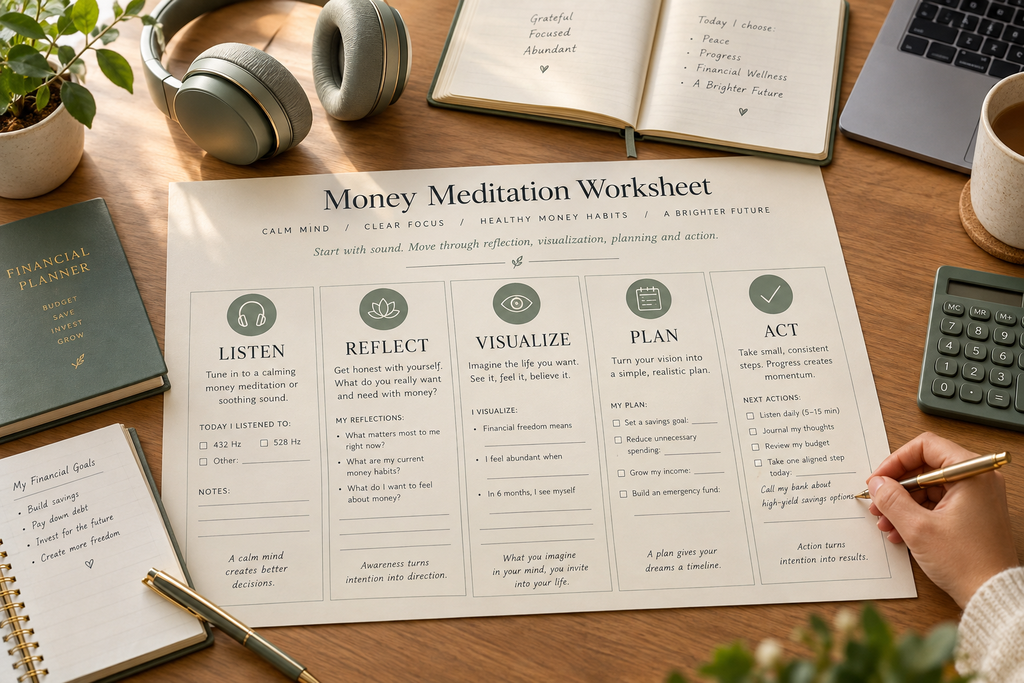
You can combine the seven steps into one short routine.
Minutes 1–2: Listen
Choose music, binaural beats, ambient sound, or silence.
Do not worry about whether you found the “perfect” number.
Minute 3: Set the intention
Say:
“My financial priority is __________.”
Make it specific.
Minute 4: Notice the belief
What thought appears?
Write it down mentally or in a journal afterward.
Minute 5: Choose the grounded affirmation
Use one statement that supports a healthier response.
Example:
“I can make decisions that gradually improve my financial options.”
Minutes 6–7: Visualize the process
Imagine yourself performing the behavior behind the goal.
Do not visualize only the final reward.
Minute 8: Identify a resource
Name one thing already available to you.
Minutes 9–10: Choose the action
Decide exactly what you will do and when.
Your routine now has a complete path:
LISTEN → NOTICE → REFRAME → VISUALIZE → APPRECIATE → ACT
How to Choose the best frequency for money manifestation for Your Routine
Because there is no validated wealth-attraction frequency, your choice can be based on practical preferences.
Ask:
Does this track help me settle?
Can I listen without distraction?
Does it make the visualization easier to follow?
Do I feel calm enough to think clearly afterward?
Am I choosing it because I like the experience—or because I am afraid another number will “block” my results?
If 432 Hz music feels pleasant, use 432 Hz.
If you prefer 528 Hz, use that.
If binaural beats help you focus, headphones may make sense.
If silence works better, you do not need a frequency track at all.
There is no reason to let the search for the perfect audio become more important than the financial goal itself.
Be Careful With “888 Hz,” “Millionaire Frequencies,” and Similar Claims
Online manifestation content may attach spiritual meaning to many different numbers. A track may be labeled “888 abundance,” “millionaire frequency,” “money magnet frequency,” or something similar.
Treat those labels as spiritual or marketing language unless credible evidence demonstrates otherwise.
The research discussed in this article does not establish a sound frequency that causes financial wealth. Even binaural-beat studies investigate very different outcomes, and systematic reviews describe important limitations and inconsistent mechanisms.
You can enjoy symbolic meaning without treating symbolism as financial evidence.
That becomes especially important when money is involved.
Do Not Let “Alignment” Replace Financial Judgment
Feeling calm, optimistic, inspired, or emotionally aligned can be valuable.
It does not prove that an investment, course, opportunity, purchase, or business decision is good.
A study of manifestation beliefs involving 1,023 participants found that stronger manifestation beliefs were associated with higher perceived success and stronger aspirations, but also greater attraction to risky investments, reported bankruptcy, and belief that unlikely success could happen more quickly. The findings were correlational and do not prove manifestation caused those outcomes.
Before putting money into an opportunity, ask:
- What exactly am I paying for?
- What evidence supports the expected result?
- What could I lose?
- Does this fit my current financial position?
- Would I make the same decision without manifestation language?
Optimism and due diligence can coexist.
When Structured Guidance May Be More Useful Than Another Frequency
By this point, you already have a complete free practice. You can choose enjoyable sound, define the financial goal, notice a money thought, use a grounded affirmation, visualize constructive behavior, practice gratitude, and select a next action.
If the routine keeps falling apart because you do not know what to focus on, external structure may be more relevant than finding another Hz number. Some people simply prefer having an organized mindset framework rather than designing each reflection session themselves.
Because the supplied official page for The Wealth Signal was not reliably accessible, no particular audio, frequency, exercise, or format should be attributed to the product without current verification.
If an organized mindset framework would help you practice more consistently, The Wealth Signal may be worth evaluating as optional support alongside your real financial goals.
Review Your Practice Weekly
Once a week, evaluate the routine based on what happened outside the meditation.
Ask:
Which audio did I actually enjoy using?
Did I become calmer or more focused during the practice?
Which money belief kept appearing?
Which financial goal stayed important?
Did I complete the actions I chose?
What financial task did I continue avoiding?
Did I spend more time searching for frequencies than working on the actual goal?
That last question is important.
A useful practice should eventually make your financial priorities clearer rather than sending you into an endless search for a more powerful sound.
Final Thoughts
There is no scientifically established best frequency for money manifestation that can be shown to attract wealth. 432 Hz and 528 Hz music have been researched in limited contexts such as stress or anxiety, and binaural beats have been studied for psychological and cognitive outcomes, but none of that demonstrates a money-attraction effect.
That does not mean you need to stop using manifestation music. Use the frequency you enjoy, let it support focused meditation, define what abundance means in your life, question unhelpful money thoughts, visualize the behavior behind your goals, appreciate the resources you already have, and finish with a real action.
The useful sequence is:
SOUND → ATTENTION → INTENTION → REFLECTION → VISUALIZATION → ACTION
The number on the audio can be optional.
The financial action should not be.
If The Wealth Signal matches the structured abundance approach you prefer, decide whether it belongs alongside—not instead of—the practical financial habits supporting your goals.
Is 432 Hz the best frequency for attracting money?
There is no established scientific evidence that 432 Hz attracts money. Some small studies have examined 432 Hz music for anxiety or physiological stress outcomes, but those findings should not be interpreted as evidence of wealth creation.
Is 528 Hz a money manifestation frequency?
528 Hz is commonly used in spiritual audio, but research does not establish it as a frequency that attracts wealth. Studies involving 528 Hz have examined outcomes such as stress, physiological measures, and well-being instead.
What frequency should I listen to while manifesting money?
Choose music or sound that helps you concentrate and reflect without distracting you. There is no validated Hz value you must use for financial manifestation.
Do binaural beats help with manifestation?
Research on binaural beats has explored anxiety, cognition, pain, memory, sleep, and brain activity. It has not established binaural beats as a method for attracting money, and research on brainwave entrainment remains inconsistent.
Do I need headphones?
For traditional binaural beats, stereo headphones are generally necessary because different tones are presented separately to each ear. Ordinary meditation music such as 432 Hz or 528 Hz tracks does not inherently require headphones.
Can sound meditation replace financial planning?
No. Sound meditation may support reflection or calm, but financial well-being also involves practical control of finances, resilience to shocks, progress toward goals, skills, behavior, and circumstances.