

If you are asking how long do rebound relationships last, the most accurate answer is that there is no reliable three-month, six-month, or one-year rule. Some relationships that begin soon after a breakup end quickly, while others become stable partnerships. Timing alone cannot tell you whether the relationship is shallow, serious, avoidant, healthy, or likely to end.
The urgent mistake is treating a rebound like a countdown. If your ex is dating someone new, searching for an expiration date can keep your life organized around their relationship instead of your recovery. This guide explains what research says, which factors matter more than a timeline, what signs deserve attention, and what to do if the relationship ends or your ex contacts you.
Quick Takeaway: A fast start does not guarantee a fast ending. Judge a relationship by its quality and behavior, not by a popular rebound deadline.
How Long Do Rebound Relationships Last? The Direct Answer
There is no scientifically established average duration for a rebound relationship. The term is used loosely for relationships that begin relatively soon after another relationship ends, often while feelings about the previous partner are still present.
A two-study investigation found that people who entered new relationships quickly after a breakup were not necessarily worse off. Those in new relationships reported greater confidence in their desirability and more resolution regarding their ex, and shorter time spent single was associated with several better psychological or relational outcomes.
Research on remarriage timing also found no evidence that a shorter interval between marital dissolution and a new union made the subsequent union less stable. Still, it directly undermines the popular claim that a relationship must fail simply because it began “too soon.”
Decision Rule: If someone claims every rebound ends within a fixed number of months, treat that as a rule of thumb rather than evidence.
Why There Is No Universal Rebound Timeline
The question how long do rebound relationships last makes rebounds sound like one category, but relationships that look similar from the outside can begin for very different reasons. One person may genuinely connect with someone new, while another may be seeking distraction, validation, companionship, sex, relief from loneliness, or several of these at once.
A bond that begins during a vulnerable period can still include real compatibility, shared values, attraction, and healthy communication, while a relationship that starts months later can still be unstable. A better question is what makes this particular relationship more or less likely to become stable.
1. The Reason the New Relationship Started
Motivation can affect the early dynamic. If someone enters a new romance mainly to avoid being alone, prove they are desirable, provoke an ex, or numb breakup pain, the relationship may carry pressure that has little to do with the new partner. That pressure can create comparison, insecurity, or emotional dependence.
Someone can want comfort after a breakup and still genuinely like the new person, so unresolved emotion does not automatically make the relationship fake. The stronger sign of durability is whether the relationship gradually develops reasons to exist beyond the previous breakup. Over time, the bond needs its own emotional foundation.
Practical Example: If conversations and decisions still revolve around the ex months later, the old relationship may be occupying too much space. If the new couple is building its own routines, solving its own conflicts, and making its own plans, the bond is becoming more independent.
2. Whether the New Couple Is Actually Compatible
Compatibility matters more than the label “rebound.” Shared values, emotional safety, attraction, communication style, lifestyle preferences, commitment goals, and conflict management all influence whether a relationship lasts. A couple with genuine compatibility can become serious even when they met shortly after one partner’s breakup. The calendar cannot substitute for those relationship qualities.
This is one reason how long do rebound relationships last cannot be answered from timing alone. You may know that your ex started dating someone two weeks after your breakup, but you probably do not know the full quality of their day-to-day relationship. Social media gives you even less reliable information about what happens privately.
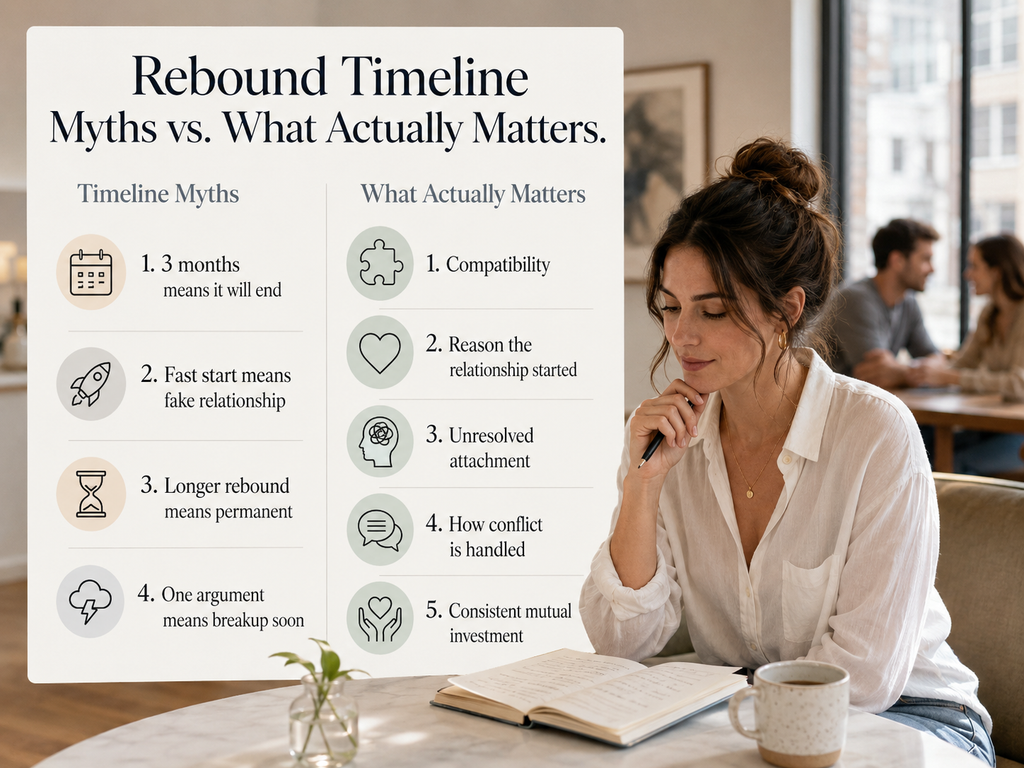
If you are watching from the outside, avoid turning each public detail into a prediction. A vacation does not prove permanence, and one argument does not prove the relationship is ending. The most emotionally protective assumption is that you do not know the outcome yet.
3. How Much Unresolved Attachment to the Ex Remains
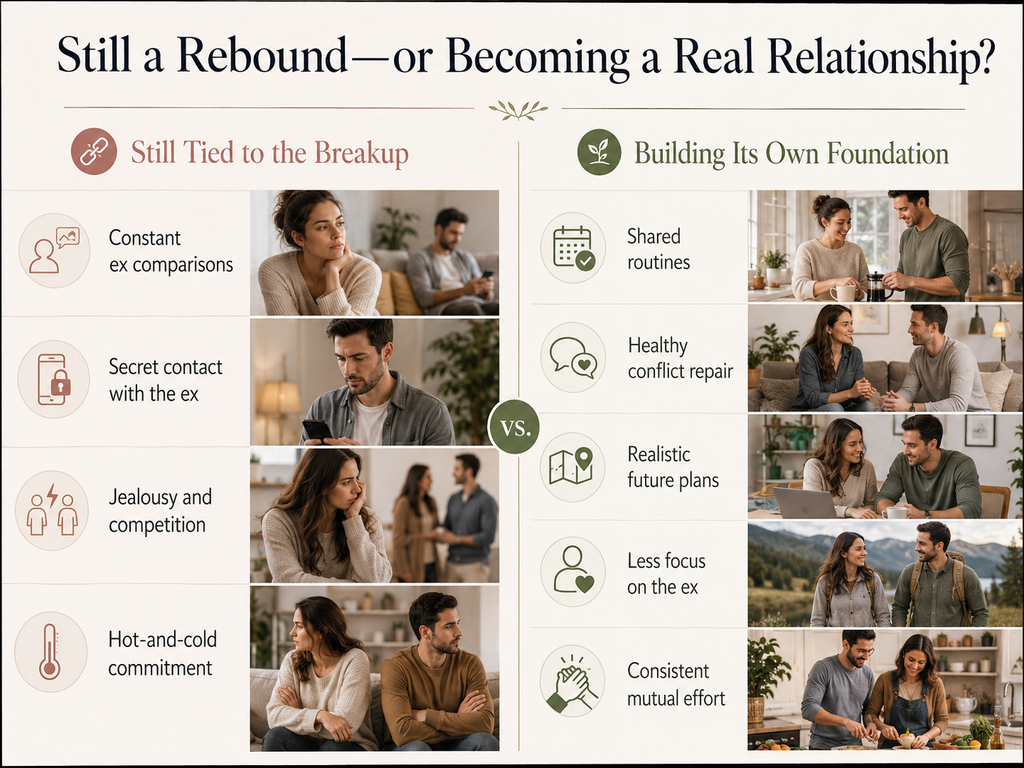
Unresolved feelings can influence a new relationship when someone repeatedly compares the new partner with the ex, keeps secret contact, checks the ex constantly, or uses the new relationship to provoke a reaction. Those behaviors can create insecurity and conflict because the previous relationship remains psychologically present.
Lingering attachment, however, does not automatically prevent a new bond from developing. A 2025 study of young adults found that participants who had entered a new relationship after a breakup reported fewer intrusive thoughts about the previous relationship than those who remained single, although the cross-sectional design cannot show that the new relationship caused better adjustment.
Your former partner can still have memories or feelings about you while also becoming more invested in someone new. Those two facts can exist at the same time. Lingering emotion is not the same as a plan to return.
4. How Quickly the Relationship Escalates
Fast escalation can look intense: constant texting, spending most nights together, immediate exclusivity, dramatic declarations, or large future plans within weeks. Intensity can be exciting, but it is not the same as stability because a relationship still needs time to reveal how both people handle boredom, stress, disagreement, jealousy, and boundaries. Early chemistry can hide differences that become obvious later.
That does not mean fast-moving relationships are destined to collapse. Some couples move quickly and remain compatible, while others slow down after an intense beginning and develop normally.
After substantial independent value, some readers prefer a structured breakup framework. The current women’s offer for The Ex Factor 2.0 lists a 163-page interactive e-book, a 20-part video course, a three-part bonus video series, three additional e-books, immediate digital access, a $47 price, and a 60-day money-back guarantee.
If you want a structured breakup-and-reconnection framework to compare with the independent guidance here, you can consider whether The Ex Factor 2.0 fits your situation and personal boundaries.
5. Whether the Relationship Becomes Its Own Bond
A rebound is more likely to remain tied to the old relationship when the ex is constantly present in conversation, social media, arguments, comparisons, or secret contact. Over time, however, the new couple may build shared routines, inside jokes, social circles, and plans that have little to do with the breakup. At that point, calling the relationship “just a rebound” may no longer describe what it has become.
The reason a couple started is not necessarily the reason they stay together, and a connection that began during breakup recovery can later become an ordinary relationship with its own strengths and weaknesses. Duration becomes a result of the current bond, not simply its origin story. That is why the rebound label often becomes less useful over time.
6. How the Couple Handles the First Real Conflicts
Early attraction can temporarily hide incompatibilities, so the first meaningful disagreements often reveal more than the rebound label. Can the couple disagree without disappearing, insulting each other, threatening the relationship, or using the previous partner as a weapon? Can they repair hurt and maintain reasonable boundaries after the emotional high of the beginning fades?
If conflict repeatedly triggers comparisons with the ex, unresolved breakup dynamics may become more visible. If the couple communicates directly and repairs problems without constant drama, the relationship has a better chance of becoming stable on its own terms. One argument, however, does not prove that a breakup is coming.
Common Mistake: Do not wait for a public disagreement and declare that “the rebound is finally ending.” Healthy couples disagree too, so patterns matter more than isolated moments.
7. Whether Both People Keep Choosing the Relationship After Novelty Fades
Novelty can carry almost any new relationship through an exciting early stage. The stronger test comes later, when the connection becomes ordinary and both people have to decide whether they still want to invest through routines, responsibilities, and less dramatic days.
If you are still asking how long do rebound relationships last several months later, this is the factor that matters most conceptually. Is the relationship becoming more grounded through consistent effort, realistic plans, trust, and normal routines, or does it still depend on emotional highs, competition, and constant reassurance? You may not be able to answer from the outside, which is exactly why monitoring is rarely useful.
Signs a Rebound Relationship May Be Unstable
No single sign proves a breakup is coming, but certain patterns can suggest unresolved pressure. Repeated comparisons with the ex, secret contact, using the new partner to provoke jealousy, extreme hot-and-cold behavior, rapid escalation followed by sharp withdrawal, and chronic uncertainty about commitment can all create instability.
Even then, avoid prediction. A couple can experience several problems and stay together, or appear stable and later separate, and your view will usually be incomplete. If the relationship belongs to your ex, the healthiest use of these signs is to remind yourself that you do not need to interfere.
Signs the Relationship May Be Becoming More Serious
If a new relationship continues and becomes less centered on the breakup, the label “rebound” may become less informative. Integrating social circles, making realistic future plans, handling conflict constructively, reducing comparisons with the ex, and showing consistent mutual investment can all indicate that the relationship is developing its own identity.
For someone asking how long do rebound relationships last because they hope an ex will return, this can be difficult information. Accurate guidance is more useful than reassurance: your ex’s new relationship may end, or it may become serious. Your recovery should be able to move forward under either possibility.
Should You Wait for Your Ex’s Rebound to End?
Waiting places your future on a relationship you cannot control. You may postpone dating, travel, goals, friendships, or emotional recovery because you expect the rebound to expire, then keep moving the deadline when it does not.
A healthier approach is to live as though the outcome is unknown. You do not have to date before you are ready, but you also do not need to reserve yourself for an ex who is currently committed elsewhere. Let your life move forward while their relationship reveals its own outcome.
Mini Checklist:
- Am I checking their relationship more than I am building my own life?
- Am I avoiding opportunities because I expect the rebound to fail?
- Would I still want my ex back if I no longer felt replaced?
- What actually ended our relationship?
- What would have to change before reconciliation made sense?
What If the Rebound Ends Quickly?
A fast breakup may confirm that the new relationship was not stable, but it does not automatically mean your ex is ready to return. They may be grieving two relationships, feeling lonely, or reaching for familiar emotional support, so slow the pace if they contact you immediately.
Look for whether your ex can discuss what ended your relationship, take responsibility, respect your boundaries, and show consistent effort over time. A rebound ending changes their relationship status; it does not repair your previous relationship by itself. The sales presentation for The Ex Factor 2.0 describes a seller-created “3R” framework of recovery, rekindling, and reattraction, along with post-breakup communication material.
If your ex’s rebound has ended and you are unsure how to handle renewed contact without rushing back into the old dynamic, you can review The Ex Factor 2.0’s structured material and keep only guidance that supports clear, respectful, two-way choices.
What If the Rebound Lasts Longer Than You Expected?
This is where how long do rebound relationships last can become emotionally expensive. If you expected three months and the relationship reaches six, you may move the deadline to nine; when it reaches a year, you may search for another explanation. Prediction keeps moving the finish line.
Instead, update your interpretation. A relationship that continues over time deserves to be treated as a real relationship, even if it began soon after your breakup.
What If Your Ex Contacts You While Still in the Rebound?
Keep boundaries clear. Friendly or practical contact may be appropriate, but romantic or secret contact while your ex is committed elsewhere can create an emotional triangle. Do not let shared history turn you into a hidden alternative.
If your ex expresses romantic interest, a clean standard is that they resolve their current relationship before exploring reconciliation with you. That protects everyone involved and gives you better information about whether their choice is genuine. Repeated secret contact is not stronger evidence of love than a clear, accountable decision.
Where The Ex Factor 2.0 May Fit
The current women’s order page for The Ex Factor 2.0 lists a 163-page interactive e-book, 20-part video course, three-part bonus video series, How To Read A Man, Why Men Pull Away, and Flawless Fat Loss Guide. The listed price is $47, access is immediate, and the offer includes a 60-day money-back guarantee.
The program may appeal to readers who prefer a step-by-step breakup and reconciliation framework. One material limitation is its promotional framing: the sales presentation makes strong claims about controlling or reliably influencing an ex’s emotions and promotes tactics including ignoring an ex and what the seller calls “covert jealousy,” including claims about reattracting someone who is with another person. Those are seller marketing claims rather than established guarantees, so manipulation or interference is better filtered out in favor of consent, boundaries, honesty, and voluntary reconciliation.
If you prefer a structured ebook-and-video reconciliation program and are comfortable applying that filter, you can consider The Ex Factor 2.0 as an optional supplement rather than a substitute for compatibility, mutual willingness, boundaries, or your own judgment.
So, How Long Do Rebound Relationships Last?
Ultimately, how long do rebound relationships last does not have a scientifically reliable average that can predict your ex’s relationship. Research does not support the assumption that fast-starting relationships are automatically unhealthy, and studies of relationship timing have not established a universal rebound expiration date. The outcome depends far more on the relationship itself.
What matters more is why the relationship started, whether the couple is compatible, how much unresolved attachment remains, how quickly the bond escalates, whether it develops an independent identity, how conflict is handled, and whether both people keep choosing it after novelty fades. If you are watching an ex’s rebound, stop timing their relationship and protect your own life. That shift gives you back control over your next decisions.
If the relationship ends and your ex later returns with clear, consistent, accountable effort, you can evaluate reconciliation then. Until that happens, the rebound’s duration is not a deadline for your future. Your life does not need to wait for their relationship to finish.
How long do rebound relationships usually last?
There is no scientifically established average duration. Some end quickly, while others become serious or long-term relationships. Timing alone cannot reliably predict the outcome.
Is three months the normal length of a rebound?
No. There is no validated three-month rule. Fixed timelines commonly shared online are not reliable scientific predictors of when a rebound will end.
Can a rebound relationship turn into a serious relationship?
Yes. A relationship that begins soon after a breakup can develop genuine compatibility, commitment, trust, and its own independent identity.
What are signs a rebound may be ending?
Repeated comparisons with an ex, secret contact, extreme hot-and-cold behavior, rapid withdrawal after early intensity, and chronic uncertainty about commitment may suggest instability, but none guarantees a breakup.
Will my ex come back when the rebound ends?
Possibly, but the rebound ending does not guarantee reconciliation. If your ex returns, look for accountability, consistency, changed behavior, respect for boundaries, and clear intentions.
Should I wait for my ex’s rebound to end?
Waiting can keep your life centered on a relationship you cannot control. Continue your own recovery and evaluate reconciliation only if your ex later becomes genuinely available and shows healthy, mutual effort.