

If you are searching for how to get your ex to reach out first, the healthiest goal is not to manipulate your ex into sending a message. It is to stop carrying all the contact, reduce pressure, rebuild your own stability, and create enough space for your ex to make a voluntary choice. If they still have interest, curiosity, regret, or a genuine desire to reconnect, that space gives their behavior room to become visible.
The urgent mistake is using silence as a punishment or treating every day without a message as failure. No strategy can guarantee that another person will contact you. This guide shows you eight practical steps that can reduce chasing, protect your self-respect, and help you recognize the difference between a meaningful reach-out and a temporary emotional check-in.
Quick Takeaway: The goal is not to “make” your ex text. It is to stop doing their half of the reconnection so you can see whether they choose to move toward you.
How to Get Your Ex to Reach Out First Without Playing Games
A grounded approach to how to get your ex to reach out first begins with a shift in control. You cannot control whether your ex sends a message, but you can control whether you keep filling every silence, creating excuses to contact them, posting for a reaction, or making yourself constantly available. When you stop doing those things, the relationship dynamic becomes easier to read because your ex has to contribute if contact is going to continue.
Research on on-again/off-again relationships is useful here because renewed contact can come from lingering feelings while uncertainty remains unresolved. In one study of 274 people who had experienced cyclical relationships, lingering feelings were a predominant reason for renewals, but uncertainty about the previous breakup also mattered. That means an ex reaching out can be emotionally real without automatically meaning they are ready for a healthier relationship.
Decision Rule: Create space for voluntary contact, then judge what arrives by consistency, accountability, and clarity—not by how long you waited for the first message.
How to stop chasing your ex → ways to create healthy space without manipulation
1. Stop Initiating Every Conversation
If you always send the first text, restart every quiet period, react to every story, or invent reasons to check in, you never get clean information about your ex’s willingness to reconnect. Your ex may respond warmly because the contact is easy and familiar, but that is different from choosing to initiate on their own. A period of not carrying the conversation gives you a clearer view of whether they miss the connection enough to create it themselves.
This does not mean abruptly ignoring practical responsibilities or acting hostile when contact is necessary. If you share children, property, work, or other obligations, communicate normally about those issues. The point is to stop unnecessary pursuit, not to turn basic respect into a tactic.
Practical Example: If you usually send a “just checking in” message every few days, stop using that habit to prevent silence. Let the silence exist long enough to show you whether your ex contributes.
2. Respect Any No-Contact Boundary Completely
If your ex explicitly asked you not to contact them, blocked you, or clearly stated that they need space, respect that boundary. Do not use another number, a different account, mutual friends, gifts, or surprise visits to create contact. Reaching around a boundary does not increase the quality of a future reconnection; it increases pressure and can destroy trust.
For how to get your ex to reach out first, this is more than a safety rule. It also removes the temptation to treat every urge to contact as something that must be acted on. You give both people a real opportunity to regulate emotions and decide what they want without being pushed into immediate interaction.

If your ex later reopens communication, respecting their boundary gives that contact a healthier starting point. If they do not, the boundary still deserves to be honored.
3. Rebuild a Life That Does Not Depend on Their Message
Waiting for an ex to text can quietly become a full-time emotional activity. You check the phone, monitor story views, reread old messages, and measure each day by whether their name appears. That state makes any eventual contact feel disproportionately powerful because your mood has been organized around the possibility of hearing from them.
A healthier approach to how to get your ex to reach out first is to make your own life active again. Reconnect with friends, return to routines, make plans that do not involve your ex, and invest in goals that improve your life even if reconciliation never happens. This is not a performance designed to make your ex jealous. It is the process of becoming less dependent on their attention.
After substantial independent value, some readers prefer a structured breakup framework. The current women’s offer for The Ex Factor 2.0 lists a 163-page interactive e-book, a 20-part video course, a three-part bonus video series, three additional e-books, immediate digital access, a $47 price, and a 60-day money-back guarantee.
If you want a structured breakup-and-reconnection framework to compare with the independent steps here, you can consider whether The Ex Factor 2.0 fits your situation and boundaries.
4. Stop Posting for a Reaction
Posting a great photo, a fun night out, or a new goal because it reflects your real life is normal. Posting mainly to make your ex jealous, make them fear losing you, or send coded breakup messages keeps them at the center of your behavior. Even if it gets a reaction, you have not learned whether they wanted genuine contact or simply responded to emotional stimulation.
If your ex watches your stories, likes a post, or suddenly becomes more visible online, treat that as passive attention. Do not rush to convert it into a conversation. A direct message that your ex chooses to send tells you more than any reaction you engineered.
Common Mistake: Do not build a “look how happy I am without you” campaign and then spend the evening checking whether your ex viewed it. That is still emotional pursuit, only through a different channel.
5. Make Real Changes Instead of Announcing Them
If the relationship ended partly because of patterns such as overtexting, conflict escalation, emotional withdrawal, jealousy, or poor communication, work on the relevant pattern before trying to prove you have changed. A speech about being different is easy; consistent behavior is more credible. If your ex eventually reaches out, they will experience the difference through the quality of the interaction.
This is an important part of how to get your ex to reach out first because genuine change lowers the pressure around future contact. You are not waiting for a message so you can return to the exact dynamic that failed. You are becoming more capable of handling the message calmly if it comes.
6. Let Mutual Space Do Its Job
Space after a breakup is often described as a countdown: wait a certain number of days and your ex will miss you enough to return. Real relationships are not that predictable. Some people reach out quickly, some much later, and some not at all.
For how to get your ex to reach out first, space is useful because it removes constant interference. Your ex can experience life without the relationship and decide whether they genuinely want renewed contact, while you can notice whether your desire to reconcile survives beyond the initial shock of rejection.
Research on breakup remorse in cyclical relationships emphasizes intentional decision-making, communication, identity, and power or control dynamics when people are considering whether to renew or end a relationship. The study was small and qualitative, so it cannot predict one ex, but it supports treating reconciliation as a deliberate decision rather than a reaction to temporary distress.
What This Means: Do not judge space by whether it produces a text. Judge it by whether it creates clearer choices for both people.
7. If Your Ex Sends a Small Signal, Do Not Do All the Work for Them
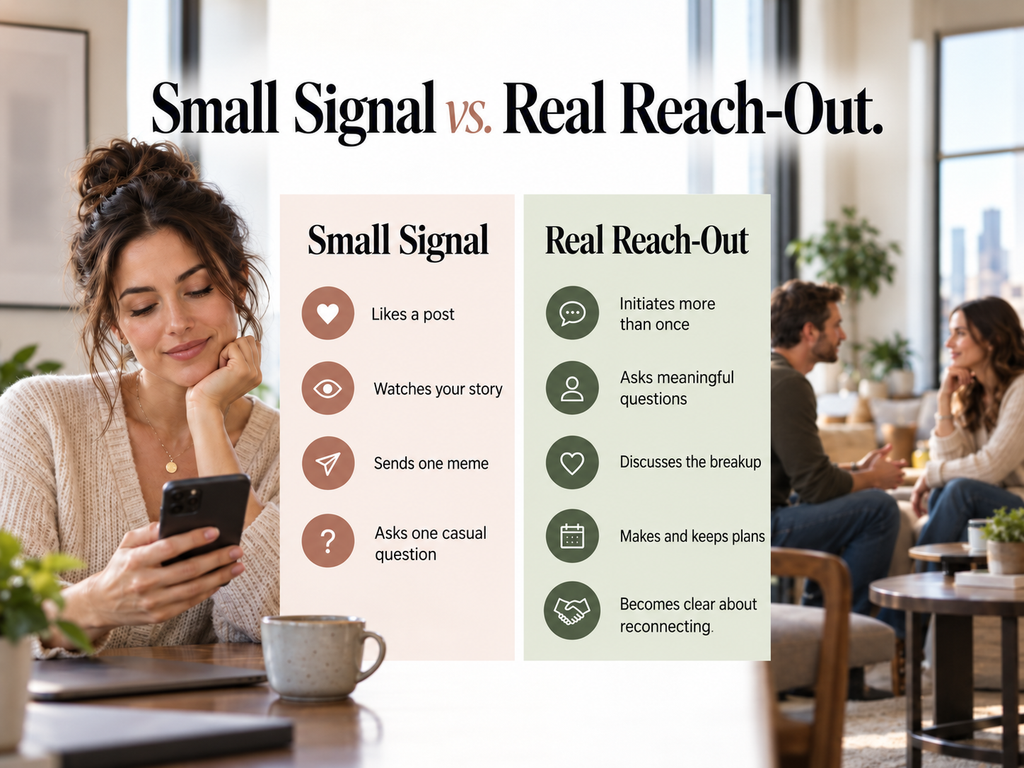
An ex may test the waters indirectly by liking something, replying to a story, or asking a casual question. If you want contact and no boundary prevents it, respond naturally but proportionately. A small signal does not require a full reconciliation conversation.
Let reciprocity become visible. If your ex reaches out again, asks meaningful questions, suggests a plan, or brings up the relationship, you have stronger evidence. If they disappear after receiving reassurance, resist restarting the connection yourself.
The seller behind The Ex Factor 2.0 describes a “3R” framework of recovery, rekindling, and reattraction and includes material for when an ex begins contacting you again. Its sales presentation also promotes ignoring an ex and what it calls “covert jealousy”; those are seller marketing claims, not guarantees, so manipulation-based tactics are better filtered out in favor of consent, boundaries, and mutual choice.
If your ex has started sending small signals and knowing how to respond without chasing is where you feel most stuck, you can review The Ex Factor 2.0’s structured communication material while keeping only guidance that supports respectful, voluntary, two-way choices.
8. Judge the Reach-Out by What Happens After It
The first message can feel like the finish line, but it is only the beginning of new information. “Hey,” “I miss you,” or “How have you been?” can reflect curiosity, loneliness, nostalgia, regret, or genuine interest. The meaning becomes clearer through the pattern that follows.
If you are focused on how to get your ex to reach out first, do not let receiving a message become more important than the quality of the reconnection. Does your ex initiate again, acknowledge what happened, make plans, respect your boundaries, and become more direct about what they want? Those behaviors matter more than the first notification.
Stronger Signs the Reach-Out May Be Becoming Reconciliation Intent:
- They initiate more than once.
- They sustain conversation without you carrying it.
- They ask meaningful questions about your present life.
- They discuss the breakup instead of avoiding it.
- They take responsibility for their part.
- They make and keep real plans.
- They respect your pace and boundaries.
- They directly discuss whether trying again makes sense.
Signs your ex wants to reconnect → how to evaluate genuine effort after your ex reaches out
How Long Should You Wait for Your Ex to Reach Out?
There is no reliable universal timeline. The relationship history, the breakup, prior contact, and each person’s coping style can all shape what happens next. Treating 21, 30, 45, or 60 days as a psychological deadline can turn healthy space into a stressful countdown.
Instead, decide how long you are willing to remain emotionally paused. You can move forward with your life while remaining open to a respectful future conversation. If waiting is stopping you from making plans or enjoying your life, the waiting itself has become a problem.
What If Your Ex Never Reaches Out?
This is the possibility every guide on how to get your ex to reach out first has to take seriously. Your ex may decide not to reopen communication even if they still care. They may believe the breakup was right or simply choose distance.
That outcome does not mean you failed. Another person’s decision is not proof of your value. Stepping back partly reveals whether reconciliation has two willing participants, while your rebuilt routines and stronger boundaries still move your life forward.
Should You Ever Reach Out First Instead?
Yes, sometimes. “Let them reach out first” is not a permanent rule that applies to every breakup. If there is no explicit no-contact boundary, enough time has passed for emotions to settle, and you genuinely want a calm conversation, one respectful message can be reasonable.
Before sending it, ask whether you can handle all possible responses: warmth, politeness, rejection, or silence. If you cannot, more time may help. If you can, a short message may give you clearer information than months of trying to create the perfect conditions for your ex to initiate.
The key is one respectful opening, not repeated pursuit.
What If Your Ex Watches Your Stories but Still Does Not Reach Out?
Passive attention can show curiosity or lingering emotion without showing readiness for direct contact. Your ex may watch because your life still interests them, because they miss the familiarity, or simply because your content remains available. Story views do not create an obligation for either person to message.
Do not post increasingly dramatic content to pull a response out of them. If they want direct communication, they are capable of choosing it. Your task is to decide whether you are comfortable with passive attention or whether hiding stories, muting them, or reducing your own monitoring would protect your peace.
What If Your Ex Reaches Out and Then Disappears?
One message does not always lead to consistent contact. Your ex may have felt lonely, nostalgic, or curious, received reassurance that you would respond, and then pulled back again. This can happen without malicious intent, but it can still be destabilizing.
Do not immediately chase the disappearing contact. Watch whether your ex returns and contributes more effort. If hot-and-cold behavior becomes a pattern, you can set a boundary around vague contact rather than repeatedly restarting from zero.
A healthy reconnection should gradually create more clarity, not more detective work.
Where The Ex Factor 2.0 May Fit
The current women’s order page for The Ex Factor 2.0 lists a 163-page interactive e-book, a 20-part video course, a three-part bonus video series, How To Read A Man, Why Men Pull Away, and Flawless Fat Loss Guide. The listed price is $47, access is described as immediate, purchases are processed by ClickBank, and the offer includes a 60-day money-back guarantee.
The program may appeal to readers who prefer a structured breakup and reconciliation system, especially once contact resumes and they want a framework for the next stage. Its promotional claims should not be treated as proof that a specific tactic can compel another person to contact or reconcile. Any useful material is best applied with consent, healthy boundaries, realistic expectations, and mutual willingness.
If you prefer a structured ebook-and-video reconciliation program and are comfortable applying that filter, you can consider The Ex Factor 2.0 as an optional supplement rather than a substitute for compatibility, mutual effort, healthy communication, or your own judgment.
How to Get Your Ex to Reach Out First: The Bottom Line
Ultimately, how to get your ex to reach out first is not about finding a psychological trick powerful enough to force a message. Stop initiating every conversation, respect boundaries, rebuild your own life, avoid reaction-seeking posts, make relevant personal changes, allow real space, respond proportionately to small signals, and judge any reach-out by what follows.
Your ex may contact you because they miss you, feel curious, regret the breakup, or want to explore reconnection. They may also choose not to reach out. Both outcomes are possible, which is why the process has to protect your dignity either way.
The most useful sign is not that you successfully made your ex send a text. It is that any renewed connection becomes voluntary, reciprocal, and clear enough that you no longer have to carry it alone.
Can I really get my ex to reach out first?
You cannot guarantee another person’s behavior. You can stop carrying all the contact, create respectful space, focus on your own life, and let your ex’s voluntary choices become easier to see.
Does no contact make an ex reach out?
Not reliably. Space can reduce pressure and give both people room to think, but it should not be treated as a countdown or a guaranteed psychological tactic.
How long should I wait for my ex to text first?
There is no universal number of days. Consider the breakup context, existing boundaries, your emotional well-being, and whether waiting is preventing you from moving forward.
What if my ex watches my stories but never reaches out?
Story views may show curiosity or lingering emotion, but they are passive. Direct messages, repeated initiation, accountability, and real plans provide stronger information.
Should I respond if my ex finally reaches out?
If contact is welcome and no boundary or safety issue prevents it, respond naturally and proportionately. Then watch whether your ex continues contributing effort rather than assuming one message means reconciliation.
Is it ever okay for me to reach out first?
Yes. If there is no explicit no-contact boundary and you can accept any response, including silence, one respectful message can sometimes be reasonable. Avoid repeated pursuit if the interest is not reciprocated.