

If you are searching for how to reprogram your mind for wealth, you may feel that old beliefs about money keep pulling you back even when you genuinely want to save more, earn more, make better decisions, or build a more secure future. The useful version of “reprogramming” is not about magically changing your brain so money appears. It is about noticing learned patterns, practicing more constructive responses, and repeatedly connecting those new responses with real financial behavior.
The word reprogram is popular in personal-growth and manifestation communities, but it should be understood as a metaphor rather than a precise neuroscience claim. Research on habit formation supports the idea that repeated behavior in stable contexts can strengthen learned cue-response patterns and eventually make some behaviors more automatic. That gives you a practical foundation: lasting change usually requires repetition, environment, and action—not one powerful thought.
The same principle applies to money. If you repeatedly avoid checking your accounts, make purchases whenever you feel stressed, assume financial planning is too difficult, or tell yourself that you will always struggle, those patterns can become familiar. Changing them means creating new responses often enough that healthier choices become easier to repeat.
Limiting money beliefs → common limiting beliefs about money and how to reframe them
How to reprogram your mind for wealth without magical thinking
A wealth mindset is most useful when it changes the way you relate to decisions, opportunities, setbacks, and financial goals. It should make you more willing to learn, plan, save, evaluate risks, build skills, and recover from mistakes—not more willing to ignore reality.
Research on habits reinforces this distinction. Habits are learned partly through repeated behavior in consistent contexts, and repetition can gradually strengthen automaticity. A 2024 systematic review of health-related habit research found wide individual variation in how long this process takes, which is another reason to avoid claims that your mindset can be permanently “rewired” in exactly 21 or 30 days.
For wealth-building, that means your mindset routine should lead toward behaviors you can observe. You want to be able to point to something and say, “I handled that differently,” not simply, “I repeated a sentence.”
The seven shifts below create that bridge.
1. Identify the Money Script You Keep Repeating
Before you create a new mindset, identify the old one. Automatic money beliefs often sound normal because you have heard or repeated them for years.
Common examples include:
- “I will always struggle with money.”
- “I am terrible at saving.”
- “People like me never become financially secure.”
- “If I earn more, something will take it away.”
- “I have already made too many mistakes.”
- “I need to spend money now because I may not have it later.”
- “I am simply not a money person.”
A belief can feel true without being a complete description of reality. Start by recording the thought exactly as it appears rather than immediately replacing it with a positive affirmation.
Then ask three questions:
What experience may have taught me this belief?
What evidence supports it today?
What evidence shows it is not completely true?
Suppose the belief is, “I can never save.” You may discover that saving has been inconsistent, but you have managed to save for certain purchases, handle some unexpected expenses, or reduce unnecessary spending before. That changes the statement from an identity—“I cannot save”—to a skill that can improve.
Quick reflection
Write:
Old belief: I always __________.
What is actually true: __________.
What I want to practice instead: __________.
The objective is not to insult your old thinking. It is to make it visible enough to change.
2. Replace Extreme Beliefs With Grounded Alternatives
Many people approach how to reprogram your mind for wealth by jumping directly from a painful belief to an extreme affirmation. “I have no financial security” becomes “I am a millionaire.” “I struggle to save” becomes “Money flows to me effortlessly.”
For some people, this language is motivating. For others, it creates immediate resistance because the statement conflicts so strongly with current reality.
A more grounded alternative is to create a bridge belief:
Old belief: “I am bad with money.”
Bridge belief: “I can learn better ways to manage money.”
Old belief: “I will never get ahead.”
Bridge belief: “My current situation can improve through better decisions, skills, and opportunities.”
Old belief: “I always spend everything.”
Bridge belief: “I can practice keeping part of what I earn.”
Research on self-affirmation offers useful perspective here. A 2025 meta-analysis summarized by the American Psychological Association reviewed 129 studies and found small positive effects on areas including well-being and self-perception. Importantly, these interventions typically involved reflection on personal values, strengths, and identity rather than simply declaring that a desired financial result had already happened.
That makes grounded self-talk a more defensible strategy than promising yourself instant wealth.

3. Visualize the Behavior Behind the Wealth
Visualization becomes more practical when you stop imagining only the result.
You can picture the home, savings balance, flexible schedule, successful business, or other outcome you want. But then ask a second question: What does the person living that life actually do on an ordinary Tuesday?
Maybe they:
- review spending before making a large purchase;
- save automatically after getting paid;
- negotiate instead of automatically accepting the first offer;
- invest time in a valuable skill;
- follow up with potential clients;
- maintain an emergency fund;
- compare financial choices carefully;
- recover from setbacks without abandoning the entire plan.
Visualize those behaviors too.
Instead of imagining only “I have $20,000 saved,” picture yourself making the monthly transfer that contributes to that goal. Instead of imagining only a successful business, picture yourself doing the less glamorous work—learning, contacting prospects, improving an offer, reviewing expenses, and showing up consistently.
This shifts visualization from fantasy toward preparation.
After each visualization, complete the sentence:
If I were moving toward this future, today I would __________.
Then do something small that fits the answer.
4. Connect Every Wealth Affirmation to One Action
Positive financial language becomes more useful when behavior immediately follows it.
If the affirmation is:
“I respect the money I earn.”
The action might be reviewing where last week’s money went.
If the affirmation is:
“I am building financial security gradually.”
The action might be transferring a manageable amount into savings.
If the affirmation is:
“I am becoming more capable of creating income.”
The action might be spending 30 focused minutes developing a marketable skill.
This gives you a simple formula:
Belief → intention → action → evidence
The action creates evidence that the new belief is becoming part of your behavior. Eventually, instead of saying “I am becoming more intentional with money” without proof, you begin to accumulate examples of intentional decisions.
The Consumer Financial Protection Bureau recommends a similarly concrete approach to financial goals: understand your current situation, define the goal, determine what needs to happen, test the plan against real-world numbers, adjust it, and automate parts of the process when appropriate.
That is what a practical wealth mindset looks like.
Where The Wealth Signal May Fit
Some people enjoy creating their own journaling prompts, mindset exercises, affirmations, and reflection routines. Others prefer a more structured resource that gives their mindset practice a framework.
That is the context in which The Wealth Signal may be relevant. However, the supplied official sales-page URL could not be reliably fetched during research, so current claims about its creator, format, modules, audio content, bonuses, pricing, guarantee, or financial results cannot be responsibly verified here.
The product should therefore be viewed as optional mindset-oriented material rather than as evidence that a specific technique can scientifically produce wealth. Practical financial actions remain necessary regardless of which personal-growth resource someone uses.
If you want optional structured support for your money-mindset practice, consider whether The Wealth Signal fits the routine you prefer.
5. Design Your Environment for Better Money Decisions
Changing your thinking becomes much easier when your environment supports the new behavior.
Imagine telling yourself every morning, “I am committed to saving,” but leaving every dollar in the same spending account with no plan. Your intention is competing with an environment that makes spending easier than saving.
Now imagine setting up a manageable automatic transfer shortly after payday. You make the decision once and create a system that can repeat it.
The CFPB specifically recommends automatic saving as one tool for building consistency. Its guidance suggests testing a savings plan against real income and expenses first, then setting up automatic transfers when the plan works for your situation.
Your environment might include:
- an automatic savings transfer;
- separate accounts for specific goals;
- a weekly financial-review reminder;
- a 24-hour waiting rule for nonessential purchases;
- automatic bill reminders;
- a visible written financial goal;
- removing saved payment details from tempting shopping sites;
- scheduling skill-development time;
- keeping important financial documents organized.
These systems reduce the number of moments when your future depends on motivation alone.
When people ask how to reprogram your mind for wealth, this part is easy to overlook. You are not only changing thoughts—you are changing the cues and routines that repeatedly shape your behavior.
Weekly money routine → simple weekly financial planning routine for building consistency
6. Create Evidence That You Are Becoming Financially Capable
Identity changes become more believable when you collect evidence.
Suppose you are trying to replace “I cannot manage money” with “I am becoming more financially capable.” Repeating the new statement may help, but completing one real action makes it easier to believe.
Your evidence could include:
- saving $25 instead of spending it impulsively;
- negotiating a bill;
- learning how interest works;
- completing a budget;
- sending a proposal to a potential client;
- paying something on time;
- canceling an unused subscription;
- reviewing a retirement plan;
- building your first small emergency buffer;
- asking a useful financial question instead of avoiding it.
Do not dismiss small evidence because it does not look like dramatic wealth.
Financial confidence can grow when you repeatedly prove to yourself that you can face money decisions rather than avoiding them. The CFPB’s financial-capability framework includes behaviors such as planning, setting goals, saving consistently, paying bills, improving credit profiles, and strengthening financial well-being.
Create a “money evidence” journal
Once a day or several times per week, write:
Old pattern I noticed: __________
Better choice I made: __________
What this proves I can practice: __________
My next step: __________
For example:
Old pattern: I wanted to ignore my credit card statement.
Better choice: I opened it and reviewed the transactions.
Evidence: I can face uncomfortable financial information.
Next step: I will decide how much I can realistically pay this month.
You are creating a record of behavior, not trying to manufacture confidence from nothing.
7. Repeat the New Pattern Until It Becomes Easier
Mindset work fails when it depends on one burst of motivation.
You may feel incredibly inspired after journaling, watching a motivational video, or setting a new goal. A week later, the old pattern can return because familiar habits still have years of repetition behind them.
Habit research shows why repetition matters. Habits develop through learned relationships between cues and behaviors, and repeated performance in consistent contexts can strengthen automaticity. The exact timeline varies substantially by person and behavior, so rigid claims such as “your brain is completely reprogrammed in 21 days” should be treated cautiously.
Choose a small wealth-building behavior and attach it to a predictable cue.
After payday → transfer savings.
Every Sunday evening → review finances for 10 minutes.
Before an unnecessary purchase → wait 24 hours.
After morning coffee → review one financial goal.
Every weekday at 7 p.m. → spend 20 minutes developing an income-related skill.
The behavior should be realistic enough to repeat.
If you miss one repetition, resume at the next opportunity rather than turning one interruption into evidence that you failed.
A Simple 5-Minute Wealth Mindset Reset
You can combine the previous steps into one short routine:
- NOTICE — What money thought is running automatically?
- CHECK — Is it a fact, fear, prediction, or old belief?
- REFRAME — What is a more accurate and constructive perspective?
- CHOOSE — What action would support that perspective?
- ACT — Complete the smallest useful version now.
For example:
Notice: “I will never earn enough.”
Check: That is a prediction, not a known fact.
Reframe: “I can increase my options by developing useful skills and pursuing realistic opportunities.”
Choose: Improve one portfolio sample.
Act: Work on it for 20 minutes today.
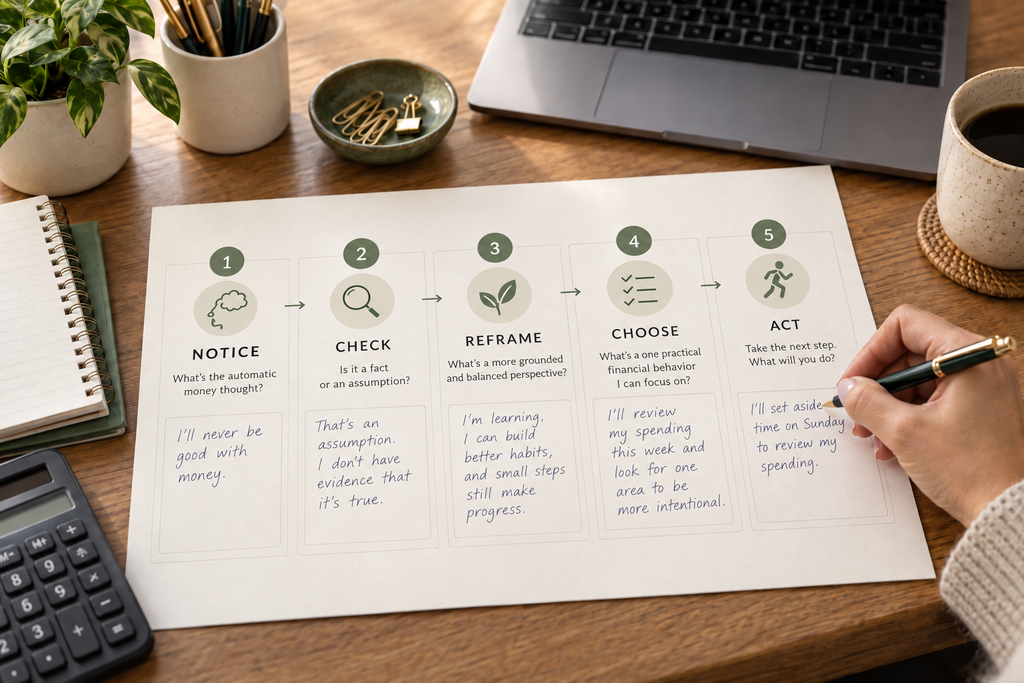
The reset takes the idea of “reprogramming” out of the abstract. Each time the old pattern appears, you practice a different response.
Do You Need to Think Positively All the Time?
No.
A healthy money mindset leaves room for disappointment, fear, frustration, and uncertainty. Difficult emotions can contain useful information. The goal is not to suppress every negative thought but to stop treating every negative thought as a command or permanent truth.
For example, “I am worried about my finances” may be accurate. The problem begins when it automatically becomes, “There is nothing I can do, so there is no reason to look at the numbers.”
A grounded response might be: “I am worried, and understanding the numbers is the first step toward deciding what is possible.”
That is constructive without being falsely cheerful.
Why Mindset Alone Does Not Build Wealth
Your mindset influences how you approach decisions, but it cannot control every financial outcome.
Wealth is affected by earnings, expenses, debt, education, access to opportunity, economic conditions, taxes, health, caregiving responsibilities, business risk, market performance, unexpected events, and many other factors. Telling someone that financial hardship proves their thoughts are “low vibration” can turn personal growth into unfair self-blame.
A wealth mindset is useful when it helps you engage more effectively with reality.
It may encourage you to:
- learn instead of assume;
- negotiate instead of automatically accepting;
- plan instead of avoid;
- save instead of relying entirely on future income;
- assess opportunities instead of chasing every promise;
- build skills instead of waiting passively;
- recover from mistakes instead of defining yourself by them.
The mindset supports the behavior. The behavior interacts with real-world circumstances.
Build a Weekly “Reprogramming” Review
Once a week, review whether the thoughts you are practicing are showing up in your decisions.
Ask:
Which old money belief appeared most often?
Maybe it was “I am behind,” “I cannot save,” or “I have to take every opportunity.”
What did I do differently?
Look for concrete evidence rather than feelings alone.
Where did I fall back into an old pattern?
Treat this as information rather than failure.
Which system could make the better behavior easier next week?
You might schedule a transfer, add a reminder, change a shopping trigger, block time for learning, or simplify a financial goal.
What is one measurable priority for the coming week?
Keep it small enough to complete.
Where Structured Mindset Support Can Help
The free exercises in this guide give you the core process: notice beliefs, create more useful alternatives, connect them with behaviors, build supportive systems, and review your evidence.
The difficulty for some people is not understanding what to do. It is maintaining a routine long enough to practice it consistently.
Structured material can be useful for people who prefer guided reflection instead of designing every exercise independently. The important standard is whether that structure helps you think and act more intentionally without encouraging unrealistic expectations about guaranteed financial outcomes.
If a guided mindset framework would help you stay consistent, The Wealth Signal may be worth evaluating alongside your practical financial plan.
A 30-Day Practice That Stays Grounded
If you want to experiment with mindset change for one month, measure practice rather than demanding a dramatic financial transformation.
For 30 days:
- choose one limiting belief you want to work on;
- write one believable replacement perspective;
- repeat one financial behavior in a consistent context;
- track one small piece of evidence each day;
- review progress once a week;
- adjust anything that is too difficult to sustain.
For example, your belief may be, “I always spend whatever I earn.”
Your replacement could be: “I am learning to keep part of what I earn.”
Your behavior might be moving a predetermined amount into savings after each paycheck.
Your evidence tracker records each successful transfer.
After 30 days, evaluate whether the behavior became easier, whether your self-talk changed, and what system helped most. Do not judge the practice solely by whether your income suddenly increased.
Final Thoughts
Learning how to reprogram your mind for wealth is more useful when you stop thinking of your mind as a computer that can be instantly rewritten with the perfect affirmation. Think instead about learned beliefs, repeated choices, environmental cues, habits, skills, and evidence.
Notice the story you have been repeating. Replace extreme beliefs with perspectives you can genuinely practice. Visualize the behaviors behind the future you want, connect affirmations with action, design systems that make good decisions easier, collect evidence of financial capability, and repeat useful behaviors consistently.
That approach respects both mindset and reality.
You do not need to believe that every financial dream is guaranteed. You need a way of thinking that helps you recognize your options, learn from mistakes, pursue realistic opportunities, and repeatedly make decisions that support the financial life you want to build.
If The Wealth Signal aligns with the kind of structured reflection you want, decide whether it belongs in your broader wealth-building routine.
Can you really reprogram your mind for wealth?
“Reprogramming” is best treated as a metaphor for changing learned beliefs, responses, and habits. Research supports the role of repetition in habit development, but there is no established scientific process that programs the brain specifically to generate wealth.
How long does it take to change a money mindset?
There is no universal timeline. A 2024 systematic review of health-related habits found substantial variation in habit-formation timelines, which illustrates why fixed rules such as 21 or 30 days should not be treated as guarantees for behavior change.
Can affirmations change your financial life?
Affirmations may support constructive self-reflection, but they do not directly create financial outcomes. Research summarized by the APA found modest psychological benefits from self-affirmation practices focused largely on values, strengths, and identity.
What are good wealth mindset affirmations?
Grounded statements include “I can improve my financial habits,” “I am becoming more intentional with money,” and “I can learn skills that expand my financial options.” Statements that feel believable enough to guide action may be more useful than extreme declarations you immediately reject.
Does visualization help with wealth?
Visualization can be used to clarify your goals and mentally connect them with relevant behaviors. It should not be treated as proof that imagining money causes it to appear. Pair visualization with a concrete action that supports the future you pictured
What is the most important wealth-building mindset habit?
One of the most useful habits is connecting intention with repeatable behavior. A financial goal becomes more actionable when it is paired with a plan, a system, and consistent follow-through. CFPB guidance similarly emphasizes goal-setting, testing plans against real numbers, and automating savings where appropriate.