

Using money affirmations before sleep can be a gentle way to end the day if your mind tends to replay financial worries, compare your progress with other people, or focus only on what is missing. The most useful bedtime affirmations do not ask you to pretend that bills, debt, uncertainty, or financial goals have magically disappeared. Instead, they can help you close the day with a more balanced perspective and identify one practical money action for tomorrow.
Self-affirmation research offers a helpful but limited foundation for understanding this practice. A 2025 meta-analysis identified 129 independent tests from 67 published articles and found small positive effects on outcomes including self-perception, general well-being, and social well-being. These interventions generally involved reflecting on personal values, identity, strengths, and positive qualities—not proving that repeating wealth statements at bedtime directly produces money.
There is also no established evidence that bedtime is a special period when financial affirmations become more powerful or “program” the subconscious to attract wealth. What bedtime does offer is a natural transition point. Health guidance from NHLBI recommends a regular, relaxing bedtime routine, while NCCIH notes that relaxation techniques can be one component of healthy sleep habits, although the evidence for relaxation alone as an insomnia treatment is limited.
That makes the goal simple: use your bedtime mindset practice for reflection and emotional steadiness, then let tomorrow’s financial behavior carry the intention forward.
How to use money affirmations before sleep without forcing positivity
A useful bedtime routine should make you feel clearer, not pressured to believe something that contradicts your current reality. If you are struggling financially, repeating “I have unlimited money” may create more internal resistance than reassurance. A bridge statement such as “I can make one thoughtful financial decision tomorrow” is easier to connect with something real.
The timing can also help keep the practice simple. Instead of scrolling through dozens of affirmations in bed, choose two or three beforehand, write them in a journal, and use them as part of a quiet wind-down routine. NHLBI recommends reducing stress and following a consistent bedtime routine, and it also advises limiting bright artificial light from screens close to sleep.
Think of the routine as four steps:
NOTICE → AFFIRM → APPRECIATE → PLAN
First, notice what money thought is following you into the night. Next, choose a healthier statement. Then identify something real that you appreciate, and finally decide on one useful action for tomorrow.
The affirmation is not the financial result. It is a way to influence the perspective you bring to the next decision.
Notice the Money Thought You Are Carrying Into Bed
Before repeating anything positive, identify the thought that actually needs attention.
Perhaps you are thinking:
- “I am so far behind.”
- “I should be earning more by now.”
- “I will never get this debt under control.”
- “Everyone else seems to be doing better.”
- “I made a bad decision, so I am terrible with money.”
- “If I do not fix everything quickly, I have failed.”
Write the strongest thought in one sentence.
Then ask two questions:
What part of this is objectively true?
What part is fear, interpretation, or prediction?
For example:
Thought: “I will never become financially secure.”
What is true: “My current savings are lower than I want.”
What is prediction: “My current position will never change.”
A healthier statement could be:
“I cannot change everything tonight, but I can continue improving specific financial habits.”
This does not erase financial difficulty. It stops one difficult moment from becoming a permanent conclusion about your future.
25 Grounded Bedtime Money Affirmations
You do not need all 25 in one session. Choose the two or three statements that best match what you are dealing with tonight.
For calming financial worry
- “I do not need to solve every financial problem tonight.”
- “I can rest now and return to my financial priorities with a clearer mind tomorrow.”
- “One difficult money moment does not define my entire financial future.”
- “I can feel uncertain without making a fear-driven decision.”
- “Tomorrow gives me another opportunity to take a useful financial step.”
These affirmations are designed to reduce pressure rather than promise a dramatic result. If a financial issue genuinely requires urgent action, handle that appropriately; otherwise, allowing yourself to postpone ordinary planning until tomorrow can keep the bedtime routine from becoming another stressful work session.
For financial confidence
- “I am capable of learning skills that improve my money decisions.”
- “I can become more organized with money through practice.”
- “My past financial mistakes can teach me without defining me.”
- “I can ask questions when I do not understand a financial decision.”
- “I can become more confident through repeated practical action.”
Confidence is more sustainable when you can point to evidence. If you paid a bill on time, reviewed your spending, asked for help, started saving, or avoided an impulsive decision, acknowledge that as evidence of a developing skill.
For saving and financial stability
- “I can build financial stability gradually.”
- “Small amounts can matter when they become part of a consistent habit.”
- “I can make today’s resources support tomorrow’s priorities.”
- “I can create simple systems that make saving easier.”
- “My financial goals deserve patient, realistic progress.”
The CFPB defines financial well-being partly through having control over everyday finances, being able to absorb financial shocks, being on track toward goals, and having greater freedom of choice. That provides a more practical picture of “abundance” than simply imagining a particular bank balance.
For opportunity and growth
- “I can continue developing skills that expand my options.”
- “I can stay open to opportunities while evaluating them carefully.”
- “Another person’s success does not make my progress impossible.”
- “I can create value without measuring my worth only by income.”
- “I can make room for growth without expecting instant results.”
An abundance mindset does not require assuming that every opportunity is good. Staying open and staying discerning can happen at the same time.
For gratitude and perspective
- “I can appreciate what I have while still working toward more.”
- “I notice useful resources that I may have overlooked.”
- “Small progress is still progress worth recognizing.”
- “I am grateful for what today’s experiences taught me.”
- “I can end today with gratitude and begin tomorrow with one intentional action.”
These statements work best when gratitude remains specific. Rather than forcing yourself to feel grateful for a difficult financial situation, identify a real resource: a skill, supportive person, useful lesson, income source, available time, small savings balance, or opportunity to make a different decision.
Turn One Affirmation Into Evidence
A practical way to use money affirmations before sleep is to pair each statement with one piece of evidence.
Suppose your affirmation is:
“I can become more organized with money through practice.”
Now ask:
What happened recently that supports this?
Maybe you reviewed your upcoming bills instead of avoiding them. Perhaps you created a simple spending plan, transferred a small amount into savings, or caught an unnecessary recurring charge.
Write:
Affirmation: I can become more organized with money through practice.
Evidence: I reviewed next week’s bills yesterday.
Tomorrow’s action: Spend 10 minutes updating my financial plan.
Your affirmation now has something concrete behind it.
Where The Wealth Signal May Fit
Some people prefer designing their own bedtime affirmations, visualization exercises, gratitude prompts, and money-mindset journal. Others find that an external structure makes a personal-growth routine easier to maintain.
That is the appropriate context for The Wealth Signal in this article. The supplied official sales page could not be reliably fetched during research, so current details about its creator, delivery format, modules, audio material, bonuses, price, guarantee, or specific outcome claims cannot be responsibly verified here.
For that reason, the product should be considered only as optional mindset-oriented support. It should not be presented as evidence that listening to or repeating something before sleep can scientifically attract wealth.
If a structured abundance mindset practice would make your bedtime routine easier to follow, consider whether The Wealth Signal fits alongside the practical financial habits you already use.
Add Gratitude Without Ignoring Financial Reality
Gratitude can soften a bedtime practice, but it should never become pressure to pretend everything is fine.
Use a three-part exercise:
What went well financially today?
Perhaps you avoided an unnecessary purchase, finished an important task, earned income, compared options before buying, or simply looked at an account you had been avoiding.
What resource do I appreciate?
Maybe it is your professional experience, a supportive relationship, access to information, a steady paycheck, a new opportunity, or even the fact that you recognize a financial habit that needs to change.
How can I use that resource tomorrow?
That last question prevents gratitude from remaining passive.
For example:
“I am grateful for my existing professional skill.”
Tomorrow’s action:
“Spend 30 focused minutes improving my portfolio.”
Gratitude becomes a reminder of available resources rather than proof that you should be satisfied with every part of your current circumstances.
Try Process Visualization Instead of Only Visualizing Wealth
Bedtime visualization often focuses on the destination: a large savings balance, dream home, thriving business, debt freedom, or greater lifestyle flexibility.
Keep the desired outcome if it inspires you, but also visualize the process.
If you want more savings, imagine yourself following the savings system you created. If you want better income opportunities, picture yourself practicing a marketable skill, preparing strong work, applying for opportunities, or communicating confidently. If you want less financial stress, picture yourself reviewing your numbers calmly instead of avoiding them.
Finish with:
“Which behavior from that future can I practice tomorrow?”
That question keeps visualization linked to reality.
Guided imagery and other relaxation techniques are sometimes used as part of bedtime relaxation strategies, but the evidence for relaxation techniques alone as treatment for chronic insomnia is limited. CBT-I remains the most strongly recommended treatment when insomnia is persistent.
So visualization can be a personal wind-down practice without being treated as a sleep cure or financial guarantee.
Create a Five-Minute Bedtime Routine
You do not need to turn your bedroom into another productivity space.
A five-minute routine is enough.
Minute 1: Notice
Write the strongest money thought you are carrying.
Example:
“I did not make enough progress today.”
Minute 2: Reframe
Choose a statement that is both supportive and believable.
“I can measure progress over time instead of judging my entire future by one day.”
Minute 3: Find evidence
Identify something real.
“I completed the work I planned today.”
Minute 4: Practice gratitude
Write one useful resource.
“I am grateful that I have a skill I can continue developing.”
Minute 5: Set tomorrow’s action
Choose one practical step.
“Tomorrow at 10 a.m., I will spend 20 minutes on the next income-related task.”
Then stop.
Your bedtime routine has done its job.
Avoid Turning Bedtime Into a Financial Strategy Session
There is an important difference between reflection and activating yourself with a long list of problems.
If your bedtime routine becomes 45 minutes of checking accounts, analyzing investments, calculating debt, scrolling financial news, and worrying about every decision, it may no longer feel relaxing.
NHLBI recommends a relaxing bedtime routine and reducing bright artificial light near bedtime. NCCIH similarly notes that relaxation can be incorporated into healthy sleep habits, alongside consistent sleep schedules and a quiet, cool, dark environment.
Do detailed financial planning earlier in the day when possible.
At night, identify tomorrow’s priority and give yourself permission to return to it later.
What If an Affirmation Feels Completely Fake?
Change the wording.
If you have $200 in savings, the statement “I am surrounded by unlimited wealth” may create immediate resistance.
Try:
“I can strengthen my financial position over time.”
Instead of:
“I attract money effortlessly.”
Try:
“I can recognize realistic opportunities and act thoughtfully.”
Instead of:
“I have no financial worries.”
Try:
“I can respond to financial concerns without letting panic make every decision.”
Instead of:
“I am already financially free.”
Try:
“I can make choices that move me toward greater financial security.”
Bridge statements leave room for growth.
The 2025 self-affirmation meta-analysis found benefits from self-affirmation interventions, but those interventions focused on meaningful values and aspects of identity rather than magical financial outcomes.
Your statement does not have to sound dramatic to be useful.
Write a Bedtime Money Journal
When money affirmations before sleep become part of a journal, you can review whether they are actually influencing your thinking and behavior.
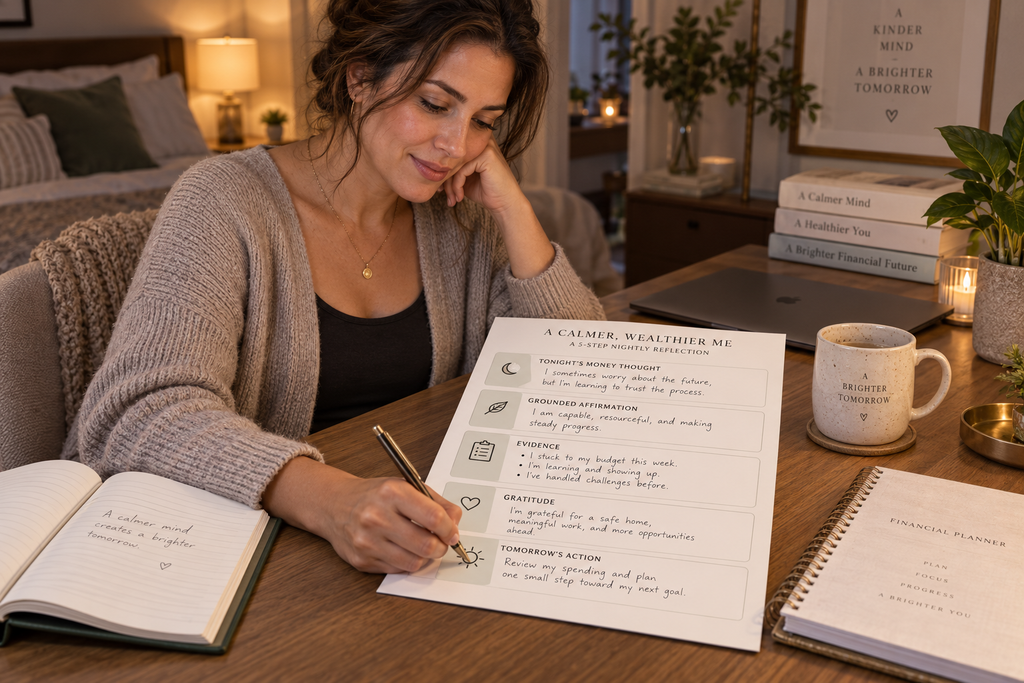
Use five sections:
TONIGHT’S MONEY THOUGHT
What financial thought is still on my mind?
GROUNDED AFFIRMATION
What healthier statement fits the situation?
EVIDENCE
What already supports this perspective?
GRATITUDE / RESOURCE
What real resource do I appreciate?
TOMORROW’S ACTION
What one thing will I do?
Example:
Money thought: “I never save enough.”
Affirmation: “I can build savings gradually through a repeatable system.”
Evidence: “I saved something during two of the last three pay periods.”
Gratitude: “I currently have income I can plan with.”
Tomorrow’s action: “Review the amount I can realistically transfer next payday.”
This is more useful than filling several pages with statements you never connect to behavior.

Pair Affirmations With Real Financial Goals
If your affirmations focus on abundance, identify what progress would actually mean.
“I want financial abundance” is difficult to measure.
Try:
“I want to build an emergency cushion.”
“I want to reduce a specific debt balance.”
“I want to increase my earning capacity.”
“I want to make my monthly spending more predictable.”
“I want to save consistently.”
The CFPB’s financial-well-being framework emphasizes financial security and freedom of choice, including control over everyday finances, capacity to handle a financial shock, and progress toward goals.
Your bedtime statement can then reinforce the behavior supporting that goal.
Goal:
Build emergency savings.
Affirmation:
“I can protect part of today’s resources for tomorrow’s needs.”
Action:
Set or review a realistic savings transfer.
When Structured Guidance Could Make the Routine Easier
By this point, you already have everything needed to create your own practice: select a grounded affirmation, identify evidence, use specific gratitude, visualize useful behavior, and decide on tomorrow’s action.
For some readers, self-directed structure is ideal. Others prefer following an organized mindset framework because it reduces the effort involved in creating prompts and maintaining a routine.
Specific claims about The Wealth Signal’s current content should not be assumed because its supplied official page was not reliably accessible during research.
If you want more structure than a self-created nightly routine provides, The Wealth Signal may be worth evaluating as optional mindset support alongside your real-world financial goals.
Common Mistakes With Bedtime Money Affirmations
The first mistake is trying to use too many. Twenty-five affirmations are useful as a library, but you do not need to repeat all of them every night. Choose what fits the issue you are actually facing.
The second mistake is using statements that intensify pressure. If you lie in bed repeating “I must become wealthy” while becoming more anxious, the practice is working against the purpose of a calm bedtime routine.
The third mistake is expecting sleep itself to perform the financial work. A statement may help organize your thinking, but tomorrow’s decisions still matter.
The fourth mistake is using affirmations instead of financial information. “Everything will work out” is not a replacement for reviewing a bill, understanding an investment, creating a budget, or seeking appropriate professional help.
The fifth mistake is treating every financial difficulty as proof of a bad mindset. Financial well-being is affected by multiple factors, including circumstances outside personal control. Positive financial behaviors and stronger financial skills may support financial well-being, but mindset cannot determine every outcome.
Review Your Affirmations Once a Week
After a week of money affirmations before sleep, ask whether anything changed beyond the words.
Which statement did you use most often?
Which statement actually felt believable?
Which one created resistance?
Did you complete the actions you selected for the following day?
Did you notice less avoidance around a particular financial task?
Which financial worry continued to appear?
What needs more than an affirmation?
You might discover that one recurring thought deserves practical attention.
For example:
“I am constantly afraid of unexpected expenses.”
A better next step may be creating an emergency-savings goal rather than finding a stronger affirmation.
This is exactly why the weekly review matters. The practice should help reveal where action is needed.
If Financial Worry Is Interfering With Sleep
Occasional worry about money is different from persistent insomnia or significant anxiety.
If you regularly struggle to fall asleep, stay asleep, or function during the day, affirmations should not be treated as a substitute for appropriate medical or psychological care. NCCIH notes that multicomponent cognitive behavioral therapy for insomnia is the most strongly recommended treatment for chronic insomnia, while evidence for relaxation techniques alone is much weaker.
Likewise, serious financial problems may require practical expertise rather than additional mindset exercises.
A bedtime affirmation can support your emotional response.
It does not have to solve every problem.
Deciding Whether External Structure Fits You
Before adding any structured resource to your routine, ask what you actually need.
Do you need more affirmations?
Or do you need a regular reminder to reflect?
Do you need inspiration?
Or do you need a clearer financial plan?
Do you enjoy self-directed journaling?
Or would a structured mindset framework make consistency easier?
Those questions help separate genuine product fit from impulse.
Because The Wealth Signal’s current official product details could not be reliably verified, the decision should be based on the actual material available to you rather than assumptions about features or results.
Final Thoughts
Used thoughtfully, money affirmations before sleep can become a calm transition between today’s financial experiences and tomorrow’s choices. The aim is not to convince yourself that money will appear while you sleep. It is to end the day with less harsh self-talk, recognize evidence of progress, appreciate useful resources, and make your next financial action clearer.
Choose two or three affirmations rather than overwhelming yourself with dozens. Make them believable enough to connect with your current reality, use visualization to picture useful behavior, and keep detailed financial planning outside your bedtime wind-down whenever possible.
A simple routine is enough:
Notice → Affirm → Find Evidence → Appreciate → Plan Tomorrow.
That gives positive thinking a practical destination.
If The Wealth Signal matches the type of structured abundance practice you prefer, decide whether it belongs alongside—not instead of—the financial actions supporting your goals.
Do money affirmations before sleep really work?
Self-affirmation research has found small positive effects on several aspects of well-being, particularly with exercises focused on values, identity, and positive qualities. Research does not establish that repeating wealth statements before sleep directly creates money.
Is the subconscious more receptive to money affirmations while falling asleep?
There is not solid evidence establishing bedtime as a special period when financial affirmations can “program” the subconscious to produce wealth. It is more reasonable to use bedtime because it can provide a quiet, repeatable context for reflection.
How many money affirmations should I say before bed?
There is no required number. Two or three relevant, believable statements are usually easier to reflect on than a long list repeated mechanically.
Can bedtime affirmations help me sleep?
Affirmations themselves are not an established treatment for insomnia. Relaxation practices may be included in healthy bedtime routines, but evidence for relaxation alone in treating chronic insomnia is limited, and CBT-I has stronger support.
What should I do if an affirmation feels fake?
Rewrite it as a bridge statement. Instead of “I am already wealthy,” try something such as “I can build stronger financial habits and improve my options over time.”
Should money affirmations replace financial planning?
No. Financial well-being also depends on practical factors such as everyday money management, resilience to financial shocks, progress toward goals, financial skills, circumstances, and behavior.