

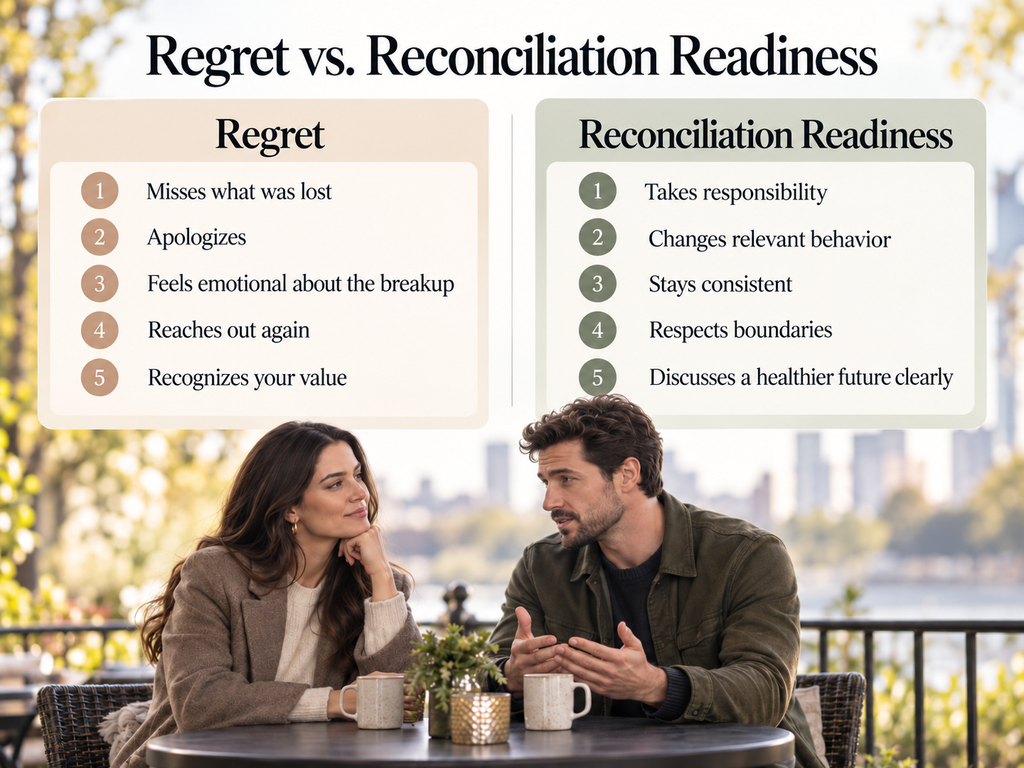
If you are searching for signs your ex regrets losing you, focus less on dramatic words and more on what your ex does after the breakup becomes real. Regret can show up as renewed contact, specific apologies, greater curiosity about your life, or a willingness to revisit what went wrong. But regret is not the same as readiness to reconcile, and missing you does not automatically mean the relationship would work better a second time.
The mistake is treating every emotional message as proof that your ex has changed. Someone can regret losing the connection, comfort, or future they imagined with you while still being unprepared to rebuild responsibly. This guide explains nine stronger clues, weaker signals that are easy to overread, and how to tell genuine regret from loneliness, nostalgia, or fear of losing access.
Quick Takeaway: Regret becomes meaningful when it moves from emotion into accountability, consistency, and clearer choices.
Signs Your Ex Regrets Losing You: Look for a Pattern, Not One Emotional Moment
When evaluating signs your ex regrets losing you, begin with the difference between feeling bad and understanding what was lost. A late-night “I miss you” may be sincere, but it does not tell you whether your ex understands why the relationship ended or what would need to change. Stronger regret usually becomes more specific over time: they identify their mistakes, acknowledge the consequences, and behave differently when they have another chance to interact with you.
Research on on-again/off-again dating relationships helps explain why caution matters. In a study of 274 people who had experienced cyclical relationships, lingering feelings were a predominant reason for renewals, while uncertainty about the previous breakup also played a role. Former partners can therefore feel strongly pulled back toward each other without having solved the uncertainty that made the relationship unstable.
Decision Rule: Give more weight to regret that produces accountability and steady behavior than regret that appears only when your ex feels lonely, jealous, or afraid you are moving on.
1. They Admit the Breakup Cost Them More Than They Expected
One of the clearer signs is when your ex stops talking only about the breakup itself and starts acknowledging what they lost through it. They may say they underestimated how important your companionship, support, shared routines, or future plans were to them. The language is less about “I hate being alone” and more about recognizing the specific value you brought to their life. Loss can create perspective, but listen for whether your ex’s realization includes your experience too. Regret that centers only on what they no longer receive is weaker than regret that also recognizes what you needed and did not get.
Practical Example: “I miss having someone there for me” describes loss; “I realize I took your support for granted” shows more reflection.
2. They Give a Specific Apology Instead of a Vague “Sorry”
Another of the signs your ex regrets losing you is a more specific apology. Instead of saying “sorry for everything,” they name what they did: avoiding commitment, withdrawing during conflict, breaking trust, taking you for granted, or failing to communicate when the relationship needed honesty. Specificity suggests they have spent time thinking about cause and effect rather than only trying to reduce their own discomfort. A useful apology does not demand immediate forgiveness or reunion; it acknowledges impact and leaves room for your response. If your ex becomes defensive as soon as you describe how their behavior affected you, the apology may not yet represent the deeper accountability that healthy reconciliation requires.
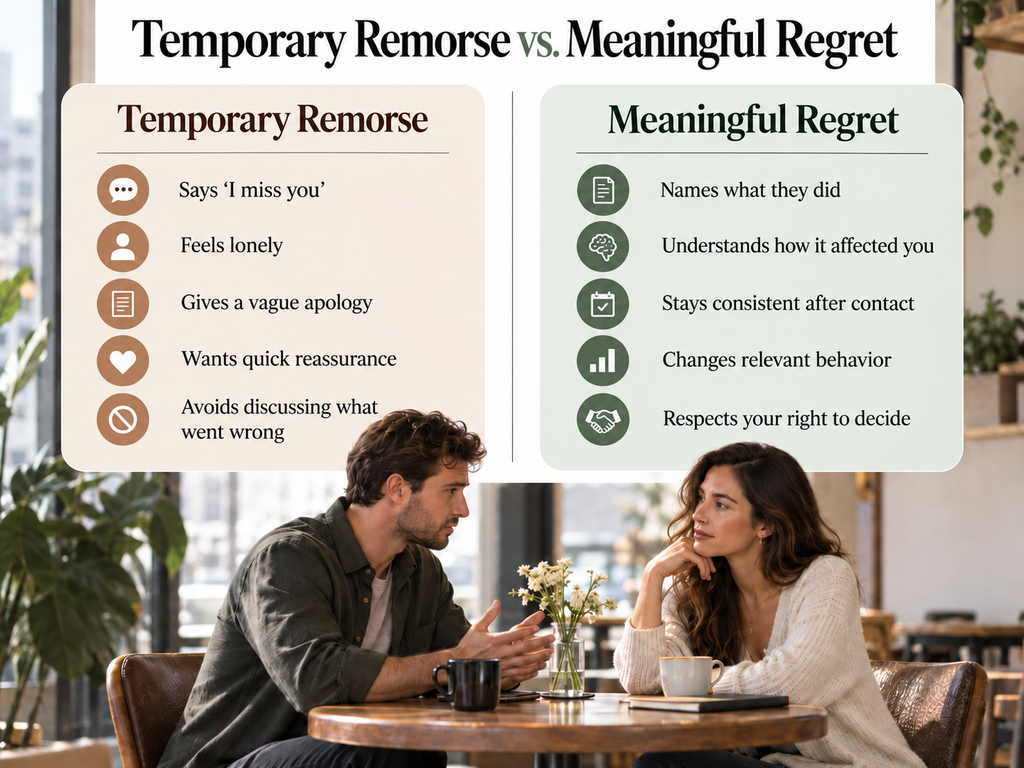
Research on breakup remorse in cyclical relationships highlights intentionality, communication, identity, and power or control dynamics in decisions about renewal. The study was small and qualitative, so it cannot predict your situation, but it supports looking beyond emotion toward deliberate decision-making.
3. They Reach Out Consistently, Not Only When They Feel Lonely
Regret becomes more credible when contact is steady. Your ex may initiate during ordinary parts of the week, continue conversations without you carrying them, and check in because they genuinely want to know how you are doing. That pattern is different from appearing late at night, during a lonely weekend, or after a stressful event and then disappearing again.
For signs your ex regrets losing you, consistency matters because temporary emotion is easy to express. Watch whether your ex remains engaged once they know you still care. If they repeatedly vanish after receiving reassurance, they may regret losing access more than they regret losing the relationship itself.
After substantial independent value, some readers prefer a structured framework for navigating renewed contact. The current women’s offer for The Ex Factor 2.0 lists a 163-page interactive e-book, a 20-part video course, a three-part bonus video series, three additional e-books, immediate digital access, a $47 price, and a 60-day money-back guarantee.
If you want a structured breakup-and-reconnection framework to compare with the independent guidance here, you can consider whether The Ex Factor 2.0 fits your situation and boundaries.
4. They Ask Meaningful Questions About Your Life Now
An ex who regrets losing you may become more interested in who you are now rather than simply replaying old memories. They ask about your work, goals, routines, family, friendships, or changes you have made since the breakup. The questions feel less like surveillance and more like an attempt to understand the person they no longer automatically have access to.
Curiosity alone is not proof of regret. Notice whether they listen, remember what you say, and ask follow-up questions, rather than mainly trying to learn whether you are dating someone else. Genuine interest in your present life is more meaningful than jealousy-driven information gathering.
5. They React to Your Independence but Do Not Try to Control It
Seeing you move forward can make loss feel more final. Your ex may become more attentive after you stop initiating, make new plans, seem happier, or become less emotionally available to them. That timing can fit a regret pattern because they are experiencing the consequences of no longer being central in your life.
The quality of the reaction matters. Healthy regret may lead to honest communication; unhealthy possessiveness may lead to criticism, pressure, or attempts to interfere with your choices. Do not confuse control with love.
Common Mistake: Do not deliberately make your ex jealous to test whether they regret losing you. A reaction you manufacture tells you less than voluntary behavior that appears without manipulation.
6. They Revisit the Breakup With a Different Understanding
One of the stronger signs your ex regrets losing you is when their story about the breakup becomes more thoughtful rather than simply more emotional. They may recognize their contribution to recurring conflict or admit that they made a decision too quickly. Reflection matters most when it is specific enough to be tested in future behavior.
Listen for learning, not rewriting. Regret should not erase the real reasons the relationship ended or turn the past into a fantasy where everything was perfect. A healthier conversation can hold two truths at once: the relationship had serious problems, and your ex may now understand that losing it also meant losing something valuable.
7. They Follow Words With Concrete Effort
Words such as “I made a mistake” or “I should have treated you better” can matter, but effort gives them weight. Your ex may make and keep plans, show up on time, communicate when something changes, or do the small things that were missing before. If reliability was a problem, they become more reliable; if avoidance was a problem, they stay present for uncomfortable conversations. Behavior should connect to the original problem. Buying flowers after months of emotional neglect may feel romantic, but meaningful change is relevant to what actually damaged the relationship.
What This Means: The strongest evidence of regret is not a bigger declaration. It is different behavior in the exact places where the old relationship repeatedly broke down.
8. They Respect Your Boundaries Even When They Want Another Chance
Regret can make someone eager to repair things, but genuine care should still leave room for your autonomy. Your ex may want more contact while accepting that you need time, may ask to meet without pressuring you, and may hear “not yet” without becoming angry or punishing you. Respectful restraint shows that their desire to reconnect is not more important to them than your right to choose.
The seller behind The Ex Factor 2.0 describes a “3R” framework of recovery, rekindling, and reattraction and includes guidance for the stage when post-breakup contact resumes. That may be relevant for readers whose ex has moved from regret into direct communication, although the framework is the seller’s description rather than independent evidence of a guaranteed outcome.
If your ex is showing regret and contacting you consistently, but you are unsure how to move from emotional conversations into a clearer reconciliation discussion, you can review The Ex Factor 2.0’s structured communication material while keeping only guidance that supports respectful, voluntary, two-way choices.
9. They Directly Ask Whether Rebuilding the Relationship Is Possible
The clearest clue is when your ex stops relying on hints and asks whether another relationship is possible. They may explain what they regret, what has changed, and ask for a conversation about rebuilding rather than assuming they are entitled to return. Directness reduces the need for detective work.
A serious request still does not require an immediate yes. Ask what would be different, how both of you would handle the problem that ended the relationship, and whether enough time has passed for change to become real. Regret is an opening for evaluation, not a guarantee that reconciliation is the right decision.
What to do when your ex comes back → how to evaluate another chance before saying yes
Weak Signs That Do Not Prove Your Ex Regrets Losing You
Some post-breakup behaviors are emotionally tempting to interpret because they are easy to see. Story views, likes, unfollowing and refollowing, vague quotes, watching your profile, or asking mutual friends about you can all happen when an ex is curious or emotionally unsettled. They may support a larger pattern, but they should not be treated as proof on their own.
When looking for signs your ex regrets losing you, the same caution applies to one late-night message or one nostalgic conversation. A person can miss you for an evening without wanting to rebuild. Ask whether the signal becomes more direct and effortful: accountability, consistent contact, real plans, and willingness to discuss the breakup require more than passive attention.
Does Regretting Losing You Mean Your Ex Wants You Back?
Not always. Your ex can regret ending the relationship, regret how they treated you, or regret losing your companionship while still believing that staying apart is the better choice. Regret describes an evaluation of the past; reconciliation requires a decision about the future. That distinction can protect you from waiting for a relationship that has not actually been offered. If your ex says, “I regret how things ended, but I do not want to get back together,” believe the whole statement.
Do not use their regret as evidence that persistence will eventually change their mind.
Does Your Ex Regret Losing You if They Start Dating Someone Else?
Dating someone else does not automatically erase regret, but their current choices matter more than theories about hidden emotions. If they are in another relationship, respect that boundary and do not build secret romantic contact. Any future reconciliation should begin only after that relationship is resolved independently.
Why Does an Ex Realize Your Value After the Breakup?
Distance can change perspective because conflict no longer dominates every interaction, while the absence of support, intimacy, and familiar routines becomes easier to feel. Hindsight can also idealize the relationship, so mature regret should recognize both what was valuable and what would need to be different.
What Should You Do if Your Ex Clearly Regrets Losing You?
Stay open to information rather than immediately rewarding regret with a reunion. Ask what they understand now, what they would do differently, and what they are actually asking from you. If you want to explore reconnection, let trust rebuild through repeated behavior instead of restoring the old relationship overnight. For signs your ex regrets losing you, the most important transition is from observation to decision. Once your ex becomes direct, evaluate whether the relationship being offered is healthier; your needs, trust, compatibility, and future goals matter just as much as their remorse.
How to Tell Regret From Loneliness or Nostalgia
Loneliness usually seeks relief. Nostalgia focuses on good memories. Regret includes a clearer understanding of a decision, behavior, or missed opportunity and often produces a desire to respond differently.
Regret Is More Credible When Your Ex:
- identifies what they did or failed to do;
- understands how it affected you;
- stays in contact after receiving reassurance;
- respects your boundaries;
- makes changes relevant to the original problem;
- follows through on plans;
- discusses what a healthier future would require;
- accepts that you are free to say no.
Look for a cluster that remains consistent over time.
When Regret Is Not Enough for Reconciliation
Some problems are not solved by remorse. Major incompatibilities around commitment, children, lifestyle, location, trust, or values may remain, and a heartfelt apology cannot make incompatible futures fit. Regret is also not enough after coercion, threats, stalking, violence, or repeated serious boundary violations; prioritize safety and appropriate support rather than restoring access.
Where The Ex Factor 2.0 May Fit
The current women’s order page for The Ex Factor 2.0 lists a 163-page interactive e-book, a 20-part video course, a three-part bonus video series, How To Read A Man, Why Men Pull Away, and Flawless Fat Loss Guide. The seller lists a $47 price, immediate digital access, ClickBank processing, and a 60-day money-back guarantee.
The program may appeal to readers who prefer a structured breakup-and-reconnection system once contact becomes mutual. Its promotional presentation also makes strong claims about influencing an ex’s feelings and promotes tactics including ignoring an ex and what the seller calls “covert jealousy.” Those are seller marketing claims, not dependable predictions about another person’s choices, so manipulation-based tactics are better filtered out in favor of consent, accountability, boundaries, realistic expectations, and mutual willingness.
If you prefer a structured ebook-and-video reconciliation program and are comfortable applying that filter, you can consider The Ex Factor 2.0 as an optional supplement rather than a substitute for compatibility, healthy communication, mutual effort, or your own judgment.
Signs Your Ex Regrets Losing You: The Bottom Line
The strongest signs your ex regrets losing you are not cryptic social-media clues. They are specific apologies, consistent contact, genuine interest in your present life, reflection on the breakup, relevant behavioral change, respect for your boundaries, and direct willingness to discuss whether rebuilding makes sense. The pattern should become clearer instead of forcing you to keep guessing.
Even strong regret does not guarantee a healthy second chance. Your ex can miss what they lost and still be incompatible with you, or they may need more growth than has actually happened. Let remorse open a conversation if you want one, but let accountability and repeated behavior decide how much trust you give it.
The goal is not to prove the loss hurt them. It is to understand whether they have learned enough from the loss to participate in something better.
What are the strongest signs your ex regrets losing you?
The stronger clues include a specific apology, consistent contact, meaningful interest in your present life, recognition of what they took for granted, behavior related to the original breakup problem, respect for your boundaries, and direct discussion about rebuilding.
Does an ex regretting losing you mean they still love you?
It can reflect lingering love, but regret can also involve loneliness, attachment, guilt, nostalgia, or recognizing the value of what was lost. Look at the wider behavior rather than one emotion.
Does regret mean my ex wants me back?
Not necessarily. Someone can regret how the relationship ended while still choosing not to reconcile. Wanting another chance normally becomes clearer through direct communication, accountability, and consistent effort.
Why would my ex realize my value only after the breakup?
Distance can make routines, support, companionship, and other positive parts of a relationship easier to notice because they are no longer automatically available. Hindsight can also idealize the past, so changed behavior matters more than nostalgia.
What if my ex apologizes but nothing else changes?
Treat the apology as one piece of information. If the same avoidance, unreliability, boundary problems, or communication patterns continue, the regret has not yet translated into enough evidence of change.
Should I take my ex back if they clearly regret losing me?
You do not need to decide based on regret alone. Consider why the relationship ended, whether relevant behavior has changed, whether trust can be rebuilt, whether your future goals still fit, and whether both people genuinely want a healthier relationship.