

A wealth frequency meditation can be appealing if you enjoy combining music, sound, visualization, affirmations, and abundance-focused reflection. The practice can become more useful when it does not depend on the idea that a particular sound frequency will automatically attract money. Instead, you can use the meditation to settle your attention, clarify what financial abundance means to you, notice unhelpful money thoughts, and choose one practical action that supports the life you want to build.
Meditation itself includes many different practices. The National Center for Complementary and Integrative Health describes meditation as a range of mind-body practices that may involve focusing on breathing, a sound, a visual image, or a repeated word or phrase. Research suggests mindfulness and meditation may help some people with areas such as stress, anxiety, and sleep, although results vary and some studies have important limitations.
“Frequency,” however, needs more careful interpretation. In audio, frequency is a measurable physical property of sound. In spiritual abundance language, “frequency” may instead be used metaphorically to describe an emotional or mental state. Current scientific evidence does not establish a particular audible tone, binaural beat, or numerical frequency as a mechanism that attracts financial wealth.
That distinction does not make the meditation meaningless. It simply gives the practice a more realistic job: helping you become calmer, clearer, more intentional, and more prepared to act.
How to use wealth frequency meditation in a grounded way
A useful wealth frequency meditation combines inner reflection with something you can observe afterward. You might use relaxing music or an audio track because it helps you focus, but the effectiveness of your financial practice should not depend on believing that a particular number of hertz is secretly producing wealth.
Research on binaural beats illustrates why careful framing matters. A 2023 systematic review of 14 studies examining the brainwave-entrainment hypothesis found inconsistent results: some studies supported entrainment, others contradicted it, and methodological differences made strong conclusions difficult. Earlier research has found possible effects of binaural beats on outcomes such as anxiety, attention, or pain, but those findings do not demonstrate wealth attraction.
So if a sound helps you relax or stay focused, you can use it. Just separate “this audio supports my meditation” from “this frequency causes money to arrive.”
The seven steps below keep the practice reflective, spiritual if you want it to be, and connected with practical financial behavior.
1. Define What Wealth Means in Your Actual Life
Before turning on any meditation audio, clarify what you are trying to create.
“Wealth” is often pictured as an unlimited bank balance, but your real goal may be much more specific. You might want a stronger emergency fund, less debt, more predictable monthly finances, increased earning capacity, the ability to reduce work stress, or enough flexibility to make meaningful life choices.
Write one sentence:
“Greater financial abundance would allow me to __________.”
Then turn that answer into something concrete.
For example, “I want abundance” could become “I want enough emergency savings to handle an unexpected expense without immediately relying on debt.” “I want financial freedom” could become “I want to reduce my fixed expenses and build enough savings to have more flexibility around work.”
The CFPB defines financial well-being around security and freedom of choice. Its framework includes control over day-to-day finances, capacity to absorb a financial shock, progress toward financial goals, and freedom to make choices that support quality of life.
That gives wealth meditation a practical destination.
2. Use Sound to Support Attention, Not Promise Wealth
Choose a sound environment that makes it easier for you to focus. That could be gentle instrumental music, ambient sound, silence, nature audio, or an auditory-beat track if you personally enjoy it.
If the audio is labeled with a particular “wealth frequency,” treat the label as part of the meditation experience rather than proof of a financial mechanism. There is research on binaural and other auditory beats, but it focuses on outcomes such as anxiety, cognition, pain, sleep, mood, and brain activity—not the creation of financial wealth. A 2026 systematic review of music and binaural-beat interventions in young adults reported promising findings across some psychological outcomes while also emphasizing small samples and substantial heterogeneity.
Sit comfortably and listen for one or two minutes before adding any money-focused thoughts. Let your breathing remain natural. When your attention wanders, gently return to the sound or breath.
This first stage has one purpose: become present enough to notice what is happening in your mind.
3. Notice the Money Thought That Appears
Once you feel settled, bring your financial goal to mind.
Notice the first thought that appears without trying to make it positive.
It could be:
- “There is never enough.”
- “I am too far behind.”
- “I will never earn more.”
- “People like me do not become financially secure.”
- “I always mess up with money.”
- “I need a big breakthrough immediately.”
Write the strongest thought down after the meditation.
Then ask:
What is fact, and what is prediction?
For example:
Automatic thought: “I will never become financially secure.”
Current fact: “My savings are currently lower than I want.”
Prediction: “My current situation can never improve.”
Grounded perspective: “My savings are limited now, but I can still improve specific financial behaviors and options over time.”

This keeps the meditation from becoming forced positivity.
4. Choose a Grounded Wealth Affirmation
After noticing the old thought, choose one statement that gives you a more constructive direction.
You do not need to repeat something extreme.
Instead of:
“I am instantly attracting unlimited money.”
Try:
“I can build a healthier relationship with money through repeated choices.”
Instead of:
“Wealth comes to me automatically.”
Try:
“I can stay open to realistic opportunities and evaluate them carefully.”
Instead of:
“I am already completely financially free.”
Try:
“I can take actions that move me toward greater financial security.”
Instead of:
“I never worry about money.”
Try:
“I can experience financial uncertainty without letting fear make every decision.”
Repeat your chosen statement slowly several times. Allow a few breaths between repetitions.
The purpose is not to hypnotize yourself into believing an unsupported claim. It is to give your attention a useful alternative to the automatic thought you identified earlier.
Where The Wealth Signal May Fit
Some readers enjoy building their own abundance meditation from sound, visualization, affirmations, journaling, and financial planning. Others prefer having a more structured mindset framework so they do not need to design every reflection exercise themselves.
That is the most appropriate context for The Wealth Signal here. The supplied official sales page could not be reliably fetched during research, so current details about its creator, exact format, audio content, modules, bonuses, pricing, guarantee, or claimed outcomes cannot be responsibly verified.
Because those specifics are unavailable, it is better to treat the product as optional mindset-oriented support rather than assume it uses any particular sound frequency or scientifically validated wealth mechanism.
If structured abundance-focused guidance would help you maintain a consistent mindset practice, consider whether The Wealth Signal fits alongside the practical financial habits you already use.
5. Visualize the Process Behind the Wealth Goal
Visualization is often where a wealth frequency meditation becomes emotionally engaging. You may picture the financial future you want, but add the behaviors that could help support it.
If you want more savings, do not visualize only a larger balance. Picture yourself receiving income, making your planned savings transfer, reviewing your progress, and choosing not to interrupt the habit for an unnecessary purchase.
If you want higher earning potential, imagine yourself doing the work behind it: practicing a valuable skill, finishing a strong project, communicating with clients, preparing for an interview, or applying for realistic opportunities.
If you want less financial stress, visualize yourself calmly opening your accounts and understanding what is actually happening rather than avoiding the information.
Then ask:
“What behavior from that future can I practice tomorrow?”
That question matters because visualization becomes more actionable when it includes the process rather than only the reward.
6. Practice Gratitude as Resource Awareness
Many abundance meditations include gratitude. Keep it, but make it specific.
You do not need to feel grateful for financial stress or pretend that a difficult situation is ideal. Instead, identify one resource that currently exists.
You might think:
“I am grateful for the professional experience I already have.”
“I am grateful that I started saving, even though the amount is small.”
“I am grateful for access to information that can help me make a better decision.”
“I am grateful that I recognize a financial habit I want to change.”
“I am grateful for someone who supports my growth.”
Now ask:
“How can I use this resource?”
If you appreciate an existing skill, perhaps tomorrow you spend 30 minutes strengthening it. If you appreciate having some income to plan with, perhaps you choose a realistic savings amount. If you appreciate finally recognizing an unnecessary spending habit, perhaps you create a waiting period before your next purchase.
Gratitude becomes more powerful as a practical reflection when it helps you notice what you can work with.
7. End With One Financial Action
Do not finish the meditation immediately after feeling inspired.
Choose one action.
It could be:
- reviewing upcoming bills;
- making a realistic savings transfer;
- canceling an unused recurring expense;
- comparing two financial choices;
- spending time on an income-building skill;
- completing an application;
- updating a résumé or portfolio;
- organizing one financial account;
- scheduling a financial-planning session.
The action should be specific enough that you can tell whether you completed it.
Instead of:
“I will improve my finances.”
Use:
“Tomorrow at 11 a.m., I will spend 15 minutes reviewing next week’s expenses.”
Instead of:
“I will create more income.”
Use:
“Tomorrow after lunch, I will spend 30 minutes completing the next lesson in the skill I am developing.”
This creates a complete sequence:
SETTLE → NOTICE → REFRAME → VISUALIZE → APPRECIATE → ACT
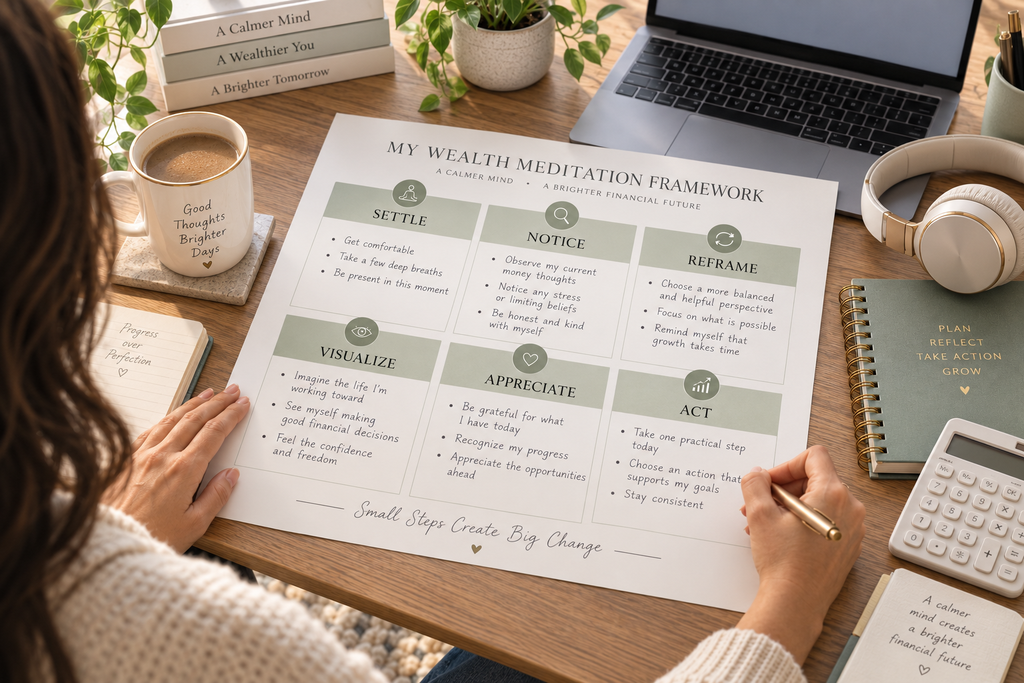
A Complete 10-Minute Wealth Frequency Meditation Routine
You can practice the entire framework in about 10 minutes.
Minutes 1–2: Settle
Play your preferred meditation sound or sit in silence. Focus on your breathing or the audio.
Minute 3: Name the financial intention
Choose one goal.
For example:
“I want to build a stronger emergency fund.”
Minute 4: Notice the automatic thought
Perhaps:
“I never manage to save consistently.”
Do not argue with it yet. Simply notice it.
Minute 5: Choose a grounded affirmation
Try:
“I can build consistency through small, repeatable actions.”
Minutes 6–7: Visualize
Picture yourself completing the behavior behind the goal—making the transfer, reviewing progress, and continuing next time.
Minute 8: Practice gratitude
Identify one existing resource:
“I am grateful that I currently have income I can plan with.”
Minutes 9–10: Choose and schedule the action
Write:
“On payday, I will transfer the amount I have already decided is realistic.”
This simple routine is enough. Longer is not automatically better.
Does the Exact Sound Frequency Matter?
For meditation enjoyment, you may have personal preferences. For proven wealth creation, there is no established “correct” frequency.
Binaural beats are a real auditory phenomenon. They occur when slightly different tones are presented separately to each ear, producing the perception of a beat related to the difference between those frequencies. Researchers have investigated whether this can influence psychological states or brain activity.
The evidence is not the same as the marketing language sometimes surrounding frequency-based content. The 2023 systematic review of binaural-beat entrainment found that empirical findings were inconsistent and that methodological heterogeneity limited firm conclusions.
More importantly for this article, none of that establishes a frequency that attracts money.
Choose audio because it helps create a useful meditation environment, not because a number guarantees financial results.
Create a Wealth Meditation Journal
Your journal can turn the internal practice into something you can review.
Use six sections:
FINANCIAL INTENTION
What am I moving toward?
AUTOMATIC MONEY THOUGHT
What belief appeared?
GROUNDED PERSPECTIVE
What is a more balanced way to view it?
VISUALIZATION
Which useful behavior did I picture?
RESOURCE / GRATITUDE
What do I already have that could help?
NEXT FINANCIAL ACTION
What will I do?
For example:
Financial intention: Build emergency savings.
Automatic thought: “Small amounts are pointless.”
Grounded perspective: “Small amounts can become meaningful when the habit continues.”
Visualization: Completing a transfer each payday.
Resource: Predictable income this month.
Next action: Decide on an affordable recurring amount.
This gives your meditation a record beyond how you felt during the session.
Avoid the Biggest Frequency-Meditation Mistake
The biggest mistake is outsourcing financial judgment to a spiritual feeling.
Feeling calm, optimistic, or “aligned” does not automatically mean an investment, business opportunity, or purchase is financially sound.
Research on manifestation beliefs found that people who scored higher on a manifestation scale also reported stronger expectations of future success, but they were more likely to be attracted to risky investments and to believe unlikely levels of success could happen more quickly. The studies were correlational and do not establish that manifestation caused those behaviors, but they provide a useful reason to pair optimism with scrutiny.
Before committing money, ask:
- What evidence supports this opportunity?
- What could I realistically lose?
- Does it fit my current financial situation?
- Am I evaluating the details or reacting to an exciting promise?
- Would the decision still look sensible without spiritual or emotional language?
You can value intuition and still verify the facts.
How Structured Mindset Guidance Can Fit
This article already gives you a complete self-directed practice. You can use a sound you enjoy, settle your attention, identify an automatic money thought, choose a grounded affirmation, visualize a useful behavior, practice gratitude, and schedule a financial action.
External structure is therefore optional, not essential.
Some people prefer organized mindset material because they find routines easier to maintain when prompts or exercises are already structured. Since the official information for The Wealth Signal could not be reliably accessed, however, specific product features should not be assumed.
If an organized mindset framework would make your abundance practice easier to maintain, The Wealth Signal may be worth evaluating as optional support alongside your financial goals.
Pair the Meditation With a Real Financial Goal
Abundance becomes easier to evaluate when you know what progress means.
Instead of:
“I want more wealth.”
Choose:
“I want to build three months of essential expenses over time.”
Or:
“I want to reduce this specific balance.”
Or:
“I want to improve one skill that could broaden my earning opportunities.”
Or:
“I want to understand exactly where my money goes each month.”
The CFPB’s financial-well-being framework offers a useful reality check: financial progress involves everyday control, capacity to absorb shocks, movement toward goals, and greater freedom of choice.
Your meditation can help keep the goal mentally visible. Your financial systems and behavior are what move the plan forward.
Financial abundance goals → how to turn abundance intentions into realistic financial goals
Review the Practice Once a Week
Do not judge your meditation only by whether it felt peaceful.
Ask what happened afterward.
Which automatic money thought appeared most often?
Which affirmation helped you respond differently?
Which action did you complete?
Which financial task did you continue avoiding?
Did the meditation make your goal clearer?
Did the audio help you focus, or did you become preoccupied with finding the “perfect” frequency?
What should you change next week?
A particularly useful question is:
“If I removed the sound track entirely, would the underlying financial practice still be useful?”
If the answer is yes, your routine probably has a strong foundation.
A 30-Day Experiment
You can try the routine for 30 days without treating 30 days as a guaranteed transformation deadline.
Each day, track your:
- financial intention;
- automatic thought;
- grounded affirmation;
- visualization focus;
- gratitude or existing resource;
- practical financial action;
- follow-through.
At the end of the month, look for behavioral changes rather than miraculous outcomes.
Are you more willing to look at your finances?
Do you understand your goals more clearly?
Have you completed more small financial tasks?
Are you noticing impulsive or fear-based thoughts sooner?
Have you developed greater confidence around one specific financial behavior?
These changes may be less dramatic than “manifesting wealth overnight,” but they give you something real to build on.
Final Thoughts
A grounded wealth frequency meditation does not require you to reject spiritual reflection, meaningful music, affirmations, visualization, or an abundance mindset. It simply keeps those practices in the role they can responsibly serve: supporting attention, reflection, intention, and emotional steadiness while you work on real financial goals.
Use sound if it helps you settle. Notice the money story that appears. Choose a healthier perspective, visualize the process behind your goal, identify a resource you appreciate, and end with one action you can actually complete.
The most useful sequence is simple:
Settle → Notice → Reframe → Visualize → Appreciate → Act.
Your meditation can help shape the mindset you bring to money, but it does not need to carry the impossible burden of controlling every financial outcome.
If The Wealth Signal matches the structured abundance approach you prefer, decide whether it belongs alongside—not instead of—the practical financial plan supporting your goals.
What is wealth frequency meditation?
It is a meditation practice that typically combines abundance-focused reflection with sound, visualization, affirmations, or intention-setting. “Frequency” may refer to actual sound frequency or be used metaphorically in spiritual language.
Is there a scientifically proven frequency for attracting wealth?
No established scientific evidence shows that a particular sound frequency attracts money or creates financial wealth. Research on auditory beats examines areas such as cognition, anxiety, pain, mood, and brain activity rather than wealth attraction.
Do binaural beats change brain waves?
The evidence is mixed. A 2023 systematic review found inconsistent findings across studies examining binaural-beat brainwave entrainment, with methodological differences limiting strong conclusions.
Can meditation still be useful for money mindset?
It can be used as a reflection tool. Meditation may help some people with stress or attention, and a money-focused practice can provide space for identifying beliefs, clarifying goals, and choosing deliberate actions.
Do I need headphones for a wealth meditation?
Not necessarily. Headphones are needed to experience traditional binaural beats as intended because separate tones are presented to each ear, but ordinary meditation can use speakers, ambient sound, or silence.
Should wealth meditation replace financial planning?
No. Financial well-being also involves practical control over finances, resilience to shocks, progress toward goals, and freedom of choice.