

If you are wondering what to do when your ex comes back, the most important thing is not to decide immediately. Their return may feel validating, exciting, confusing, or even painful, especially if you spent weeks hoping they would reach out. But an ex coming back can mean many things: regret, loneliness, nostalgia, genuine change, or simply uncertainty about the breakup. The safest first move is to slow the moment down long enough to see what they are actually offering.
The urgent mistake is treating renewed contact as proof that the old problems are solved. Missing each other can reopen communication, but it cannot rebuild trust by itself. This guide gives you eight practical steps for responding calmly, understanding why your ex returned, checking whether anything has changed, rebuilding trust gradually, and deciding whether a second chance is healthier than moving on.
Quick Takeaway: Your ex returning answers only one question: they wanted contact. It does not yet answer whether you should restart the relationship.
What to Do When Your Ex Comes Back: Slow Down Before You Reconnect
A grounded approach to what to do when your ex comes back begins with separating emotion from evidence. You can be happy to hear from them and still avoid making a relationship decision in the first conversation. Instead of asking, “Does this mean we are getting back together?” ask, “What has changed, what do they want, and what would need to be different for this to work?”
Research on on-again/off-again relationships helps explain why this distinction matters. In a study of 274 people who had experienced cyclical relationships, lingering feelings were a predominant reason for renewals, while uncertainty about the previous breakup also mattered. That means former partners can return because the emotional bond is still strong even when the practical reasons for the breakup remain unresolved.
Decision Rule: Treat the return as an invitation to gather information, not as a requirement to reconcile.
1. Do Not Give an Immediate Yes
The first step is to resist the pressure to define the relationship immediately. Your ex may say they miss you, made a mistake, or want another chance, and hearing those words can trigger a rush of relief. You are allowed to appreciate the moment without making a decision that same day. A calm response such as, “I’m open to talking, but I want to take this slowly,” gives both of you room to understand what the return actually means.
Emotional intensity can make the old relationship feel safer than it really was. Slowing down protects you from confusing the reversal of rejection with proof that the relationship is now healthy.
Practical Example: If your ex asks, “Can we just get back together?” you can agree to talk without agreeing to restart the relationship.
2. Ask Why They Came Back
If you are deciding what to do when your ex comes back, you need more than “I miss you.” Ask what changed in their thinking and why they want contact now. A thoughtful answer may include reflection on the breakup, what they regret, what they learned, and why they believe another relationship could be different.
Listen for specificity. “I was lonely” and “I realized I still love you” may be emotionally real, but neither explains how the old problem would be handled differently. A more useful answer sounds like, “I understand now that I avoided every conversation about commitment, and I see how that made you feel alone. I’ve been working on that pattern, and I want to talk about whether rebuilding is possible.”
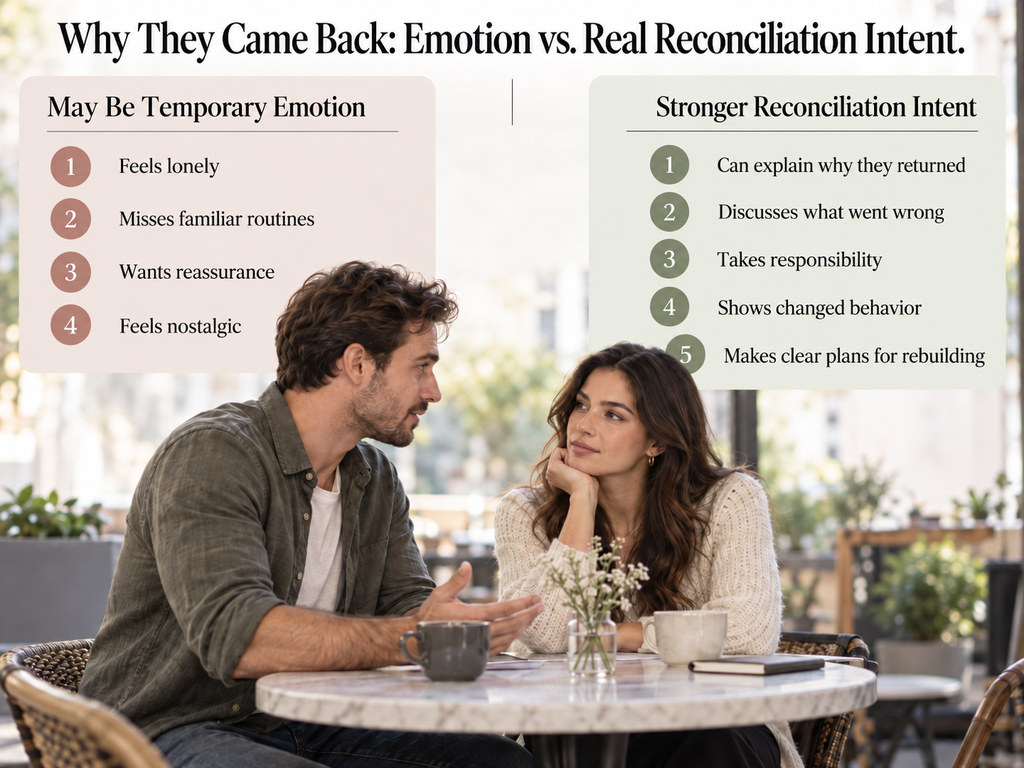
You are looking for evidence that their return comes from reflection rather than a temporary wave of loneliness.
3. Revisit Why the Relationship Ended
Before rebuilding anything, both people should be able to name what ended the relationship. Was it trust, commitment, distance, communication, incompatible goals, repeated conflict, emotional withdrawal, or something else? If the breakup reason stays vague, the reunion may rely on chemistry while leaving the original problem untouched.
For what to do when your ex comes back, this conversation is one of the most important filters. A second chance becomes more realistic when both people can discuss the past without immediately blaming, minimizing, or rewriting it. Each person should be able to own their contribution while still being honest about what they needed and did not receive.
Some readers prefer a structured framework once an ex returns and communication restarts. The current women’s offer for The Ex Factor 2.0 lists a 163-page interactive e-book, a 20-part video course, a three-part bonus video series, three additional e-books, immediate digital access, a $47 price, and a 60-day money-back guarantee.
If you want a structured breakup-and-reconnection framework to compare with the independent guidance here, you can consider whether The Ex Factor 2.0 fits your situation and boundaries.
4. Look for Changed Behavior, Not Just Better Words
Apologies and promises matter, but they are only the beginning. If your ex says they have changed, ask what that looks like in behavior. Someone who previously disappeared during conflict might now stay in the conversation. Someone who avoided plans might become more reliable. Someone who crossed boundaries should show that they can now hear “no” without pressure or punishment.
Consistency matters more than one impressive week. Give the new behavior enough time to become ordinary before treating it as established change.
Common Mistake: Do not let one apology erase a pattern that took months or years to create. Trust should be rebuilt at the speed of consistent evidence.
Signs your ex regrets the breakup → how to tell whether regret has turned into meaningful change
5. Rebuild Contact Before Rebuilding the Whole Relationship
One of the healthiest answers to what to do when your ex comes back is to reconnect in stages. You can talk, meet for coffee, or spend limited time together without immediately restoring daily texting, exclusivity, physical intimacy, shared routines, or every privilege of the previous relationship. This slower structure lets you observe whether the renewed connection is actually different.
Pay attention to reciprocity. Does your ex initiate, make plans, keep them, ask about your experience, and tolerate difficult conversations? Or do they expect you to provide emotional closeness while they remain vague about commitment? A gradual reconnection makes that difference easier to see.
If physical chemistry returns quickly, do not let it replace clarity. Intimacy can make you feel reunited before either person has decided what the relationship is.
6. Have a Direct Conversation About What Would Be Different
At some point, renewed contact needs to become future-focused. Ask what each of you would do differently if the old problem returned. Discuss communication, commitment, trust, boundaries, time together, other relationships, long-distance issues, family pressures, or any other factor that mattered before.
For what to do when your ex comes back, this is where hope becomes a plan—or reveals that there is no plan yet. “We will try harder” is vague. “We will schedule a weekly check-in, bring up concerns before resentment builds, and be explicit about exclusivity” is more concrete. The details will vary, but both people should be able to describe a relationship that is meaningfully different from the one that ended.
The seller behind The Ex Factor 2.0 describes a “3R” framework of recovery, rekindling, and reattraction and includes material for the stage when post-breakup contact resumes. That structure may appeal to readers who want a step-by-step sequence for navigating renewed communication.
If your ex has returned but you feel stuck between casual contact and a serious reconciliation conversation, you can review The Ex Factor 2.0’s structured communication material while keeping only guidance that supports consent, honesty, boundaries, and two-way choice.
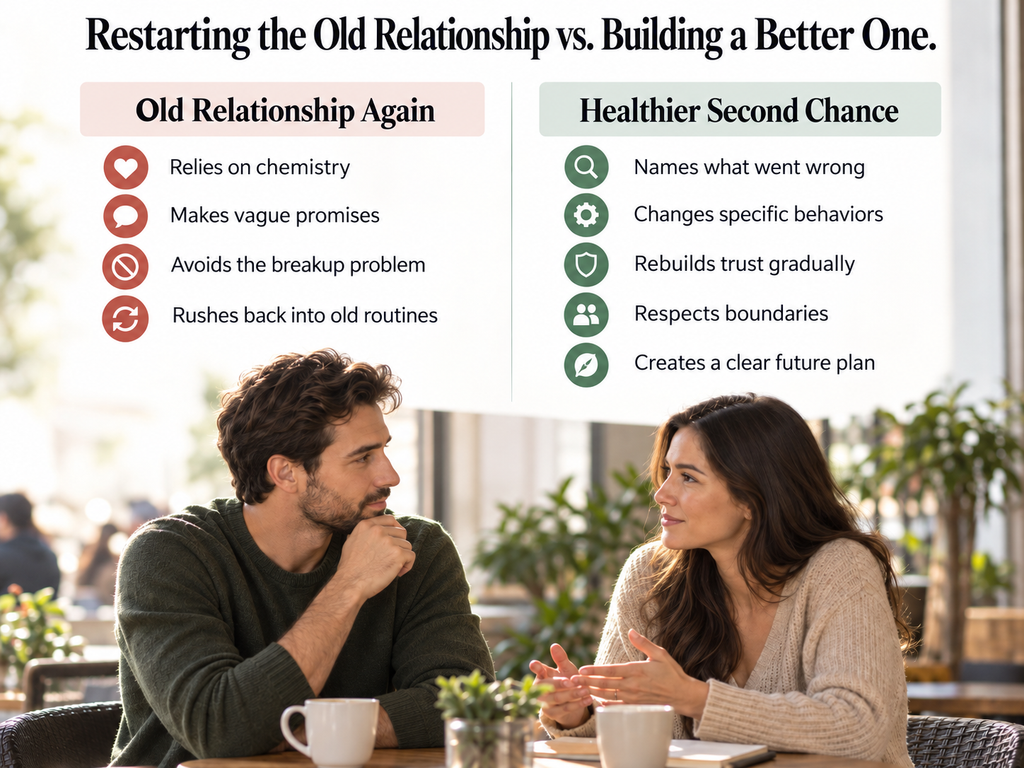
7. Check Whether You Actually Want Them Back
Your ex wanting you again can feel deeply validating, especially if the breakup left you rejected or replaced. But relief is not the same as desire, and desire is not the same as compatibility. Ask whether you want the relationship that is realistically available now, not merely the feeling of being chosen again.
This is a crucial part of what to do when your ex comes back because sometimes the breakup changed you. You may have become calmer, clearer about your standards, or more aware of what the relationship cost you. Their return can reopen feelings without changing the fact that you are healthier apart.
Decision Check: If your ex had never rejected you, would you still choose this person based on who they are now? That question can separate genuine compatibility from the powerful urge to reverse the breakup.
8. Decide Based on the New Pattern, Not the Old Chemistry
The final decision should be based on what the renewed connection is becoming. If communication is more honest, accountability is specific, plans are kept, boundaries are respected, and both people can discuss the original problem without collapsing into the old cycle, a second chance may be worth considering. If the return is mostly nostalgia, flirting, apologies without change, or hot-and-cold access, you may be looking at the old relationship in a new moment.
Research on breakup remorse in cyclical relationships highlights the role of intentional decision-making, communication, identity, and power or control dynamics when people decide whether to continue or end an on-again/off-again pattern. The study was qualitative and small, so it cannot predict your outcome, but it supports making a deliberate choice rather than allowing momentum to decide for you.
Reconciliation Readiness Checklist:
- Both people can explain why the relationship ended.
- Your ex’s reason for returning goes beyond loneliness or access.
- Both people take responsibility for their own contribution.
- Relevant behavior has changed consistently.
- Contact and effort are mutual.
- Boundaries are respected without punishment.
- Trust is rebuilding through actions, not promises.
- Future expectations are compatible.
- Either person can slow the process down without fear.
What If Your Ex Comes Back but Says They Are Confused?
Believe the confusion. Your ex may genuinely miss you and still be unsure whether they want a relationship. You do not need to convert their uncertainty into certainty by giving more affection, more access, or more reassurance. Let them participate in figuring out what they want.
You can say that you are open to talking but do not want an indefinite half-relationship. If the contact stays emotionally intimate while commitment remains unavailable, set a boundary around what you are willing to continue. Confusion may be understandable, but it should not become a permanent arrangement that keeps you waiting.
What If Your Ex Comes Back After Dating Someone Else?
Do not automatically assume that you are a backup choice, but do not ignore the context. Ask why they are returning now and whether they have had enough time to make a clear decision rather than reacting to another breakup.
If they are still in another relationship, keep the boundary clean. Do not build a secret romantic connection while they remain committed elsewhere. They should resolve that relationship independently before asking you to consider reconciliation.
What If Your Ex Comes Back but Nothing Has Changed?
If the same conflict, avoidance, unreliability, boundary problems, or incompatibility returns quickly, take that seriously. You do not owe another full relationship simply because your ex came back. Sometimes the return answers the emotional question—“Did I matter?”—while also showing that the practical answer is still no.
One of the strongest choices may be declining a reunion that cannot offer anything meaningfully different. Closure can come from seeing the pattern clearly rather than trying it again until there is nothing left to question.
What If You Still Do Not Trust Them?
Do not force trust because your ex is apologetic. Trust is not a favor you grant to prove that you are forgiving. It is an expectation that becomes more reasonable as someone behaves reliably over time.
Start with smaller opportunities for follow-through. Notice whether your ex keeps plans, communicates openly, respects boundaries, and tells the truth when honesty is uncomfortable. If the original breakup involved betrayal or serious deception, rebuilding may require much more time and possibly professional support. You are allowed to decide that the level of repair required is more than you want to undertake.
What If Your Friends or Family Do Not Support the Reunion?
Listen to their concerns without automatically giving them the final vote. People close to you may remember patterns that are harder for you to see when feelings return, so ask for specific concerns rather than general approval or disapproval. Compare those concerns with current evidence before deciding.
When Should You Say No to an Ex Who Comes Back?
A clear no may be appropriate when the relationship involved repeated disrespect, coercion, violence, stalking, serious boundary violations, or a pattern that consistently damaged your well-being. It may also be right when your futures are incompatible or when your ex wants access without accountability. Missing them does not require you to reopen a relationship that was unsafe or chronically unhealthy.
If you do not want to reconcile, clarity is kinder than leaving the door half-open. You can acknowledge the contact and say that you are choosing not to restart the relationship. You do not need to keep debating your decision until your ex agrees with it.
Where The Ex Factor 2.0 May Fit
The current women’s order page for The Ex Factor 2.0 lists a 163-page interactive e-book, a 20-part video course, a three-part bonus video series, How To Read A Man, Why Men Pull Away, and Flawless Fat Loss Guide. The page lists a $47 price, immediate digital access, ClickBank processing, and a 60-day money-back guarantee.
The program may appeal to readers who prefer a structured breakup and reconciliation system after an ex returns. Its promotional presentation also makes strong claims about influencing an ex’s emotions and promotes tactics including ignoring an ex and what the seller calls “covert jealousy.” Those are seller marketing claims, not reliable guarantees about another person’s behavior, so manipulation-based tactics are better filtered out in favor of consent, accountability, healthy boundaries, realistic expectations, and mutual willingness.
If you prefer a structured ebook-and-video reconciliation program and are comfortable applying that filter, you can consider The Ex Factor 2.0 as an optional supplement rather than a substitute for compatibility, mutual effort, healthy communication, or your own judgment.
What to Do When Your Ex Comes Back: The Bottom Line
Ultimately, what to do when your ex comes back is not to reward the return with an automatic reunion. Slow down, ask why they came back, revisit why the relationship ended, look for changed behavior, rebuild contact gradually, discuss what would be different, check what you genuinely want, and make the final decision from the new pattern rather than the old chemistry.
Your ex coming back can be meaningful. It can also be the beginning of another cycle if neither person has changed what made the relationship fail. The healthiest second chance becomes clearer with time because both people contribute effort, accept accountability, and respect each other’s freedom to choose.
You are not deciding whether the past was real. You are deciding whether the future being offered now is healthy enough to accept.
Should I take my ex back immediately if they come back?
Usually, no immediate decision is necessary. Slow the process down, understand why they returned, and look for consistent behavior before deciding whether reconciliation makes sense.
How can I tell if my ex really changed?
Look for specific behavioral changes related to what caused the breakup. Consistency, accountability, reliability, respect for boundaries, and better communication matter more than promises alone.
What if my ex says they miss me but are still confused?
Their feelings may be genuine while their readiness remains uncertain. You can stay open to conversation without accepting an indefinite half-relationship or providing relationship-level closeness without clarity.
Should I take my ex back after they dated someone else?
The fact that they dated someone else does not decide the answer. Consider why they are returning, whether their previous relationship is fully over, whether enough reflection has happened, and whether your old relationship problems have changed.
What if I still love my ex but do not trust them?
Love does not require immediate trust. Rebuild trust through small, repeated opportunities for reliability and honesty, and decide whether the amount of repair required is something you genuinely want.
When should I say no when an ex comes back?
A no may be appropriate when nothing meaningful has changed, important incompatibilities remain, boundaries are not respected, or the relationship involved coercion, violence, stalking, or repeated harmful patterns.