

If you are wondering why men pull away when things get serious, the sudden change can feel especially confusing because it often happens after the relationship seemed to be moving forward. He may have been texting consistently, making plans, opening up, or talking about the future—and then become quieter, less available, or harder to read. That shift does not have one universal explanation. Sometimes increasing intimacy activates discomfort or fear; sometimes stress or relationship pressure plays a role; and sometimes the person simply is not willing or able to offer the commitment you want.
The most important mistake to avoid is assuming that every form of distance means the same thing. Chasing harder, sending repeated messages, or trying to trigger jealousy may temporarily produce a response without solving the actual problem. Instead, look at the pattern: what changed, what was happening when it changed, whether he communicates about it, and whether he eventually moves back toward the relationship.
Quick Takeaway: Temporary space and emotional disengagement are different. Healthy space usually includes communication and a return to connection; ongoing withdrawal leaves you repeatedly guessing.
Why Men Pull Away When Things Get Serious: The Pattern to Understand First
Before looking at individual reasons, remember that pulling away is not uniquely male behavior. People of any gender may create distance when intimacy, conflict, stress, commitment, or uncertainty becomes uncomfortable. Research on romantic attachment does, however, link greater attachment avoidance with withdrawal strategies and romantic disengagement in some individuals.
That means a partner’s withdrawal may sometimes reflect the way he regulates closeness rather than a calculated attempt to hurt you. But explanation is not the same as permission. If his coping style repeatedly creates confusion, prevents honest conversation, or leaves you carrying the entire relationship, you still have the right to decide that the pattern does not work for you.
The goal is therefore not to diagnose him from a distance. It is to distinguish temporary discomfort from a persistent inability or unwillingness to participate in a secure relationship.
Signs of emotional unavailability → how to recognize emotional unavailability in dating
1. Growing Intimacy May Activate Attachment Avoidance
One possible explanation for why men pull away when things get serious is that increasing emotional closeness feels threatening rather than simply comforting. Someone higher in attachment avoidance may enjoy attraction, dating, or connection while the relationship still feels relatively low-risk. When commitment becomes more concrete, however, vulnerability and dependence become harder to avoid.
Research has associated attachment avoidance with withdrawal during relationship conflict and with romantic disengagement. This does not mean every quiet or independent man has an “avoidant attachment style,” and it should not be used as an internet diagnosis. Look for repeated patterns: does he become distant specifically when vulnerability, commitment, or deeper emotional conversation increases?
A healthier response is curiosity plus observation. You can ask whether the increased seriousness feels overwhelming or whether he has concerns about the relationship. Then pay attention to whether he can engage with the question honestly.
2. Commitment May Feel Like a Threat to His Independence
Some people begin experiencing commitment as a loss of freedom, identity, or autonomy. Interestingly, recent research found that people higher in attachment avoidance may experience relationship-related self-change as a subjective loss of self even when outside measures do not show an equivalent loss. That perceived self-loss was associated with lower commitment.
This can help explain why men pull away when things get serious in some relationships. Future plans, greater expectations, more shared time, or labels may suddenly feel like evidence that the individual’s independent life is disappearing. The reaction may be distance, hesitation, irritability, or a sudden desire for more personal space.
Healthy commitment should not require either partner to erase their individual life. Friendships, interests, routines, alone time, and personal goals can continue alongside intimacy. If he needs reasonable independence and still remains caring and communicative, that is very different from using “freedom” to avoid every form of responsibility or commitment.
Decision Check: Does space help him remain a healthier partner, or does “needing freedom” consistently mean you receive less clarity, effort, and respect?
3. Emotional Flooding Can Make Him Shut Down During Conflict
Sometimes pulling away is less about commitment itself and more about what happens when serious relationships create more difficult conversations. As intimacy grows, couples eventually discuss exclusivity, boundaries, expectations, sex, money, family, time, and the future. Those conversations can trigger emotional overwhelm.
The Gottman Institute describes emotional flooding as a state in which stress becomes intense enough to push a person toward fight-or-flight reactions. Stonewalling or withdrawal can occur when someone feels overwhelmed and no longer processes the conversation effectively.
A temporary pause can therefore be constructive. “I am too overwhelmed to talk well right now; can we continue tonight?” is different from disappearing for days whenever you raise a concern. Healthy regulation includes returning.
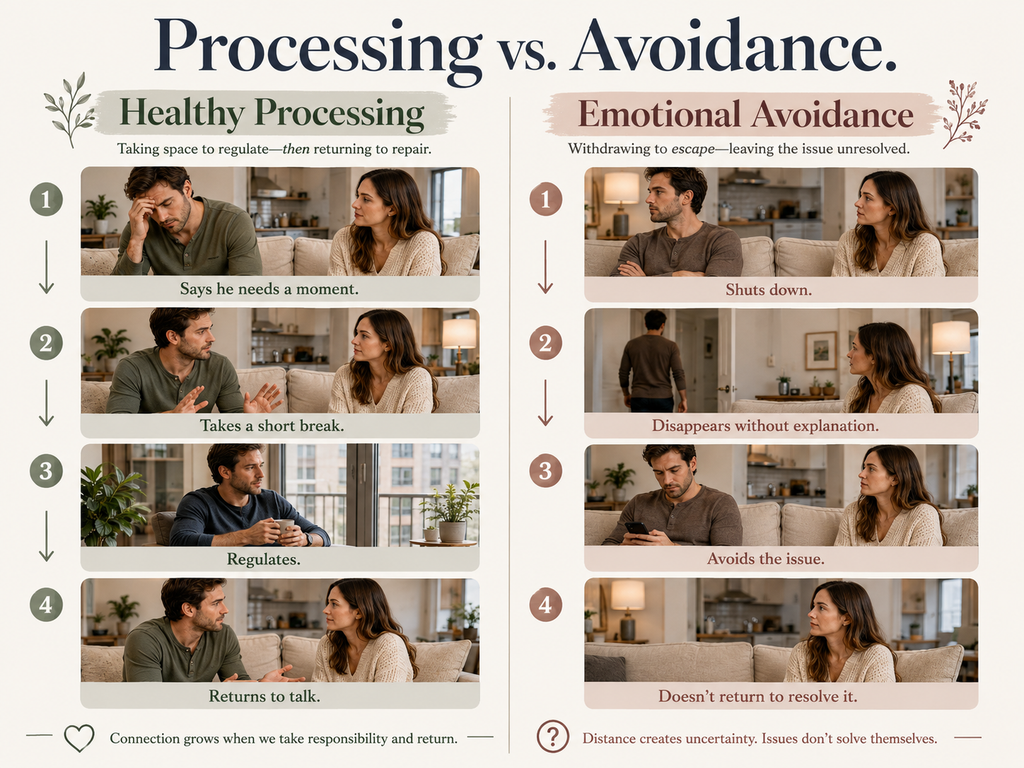
If you are trying to understand why men pull away when things get serious, observe what happens after the shutdown. Does he calm himself and come back? Or does every serious conversation end with you pursuing and him avoiding? Research on demand-withdraw patterns suggests repeated withdrawal combined with partner pursuit can be associated with lower relationship satisfaction.
4. Your Relationship Timelines May Not Match
Sometimes there is no complicated psychological explanation. Two people may simply want different things at different speeds. One person interprets several months of strong dating as the beginning of commitment while the other still views the relationship as exploratory.
When expectations become visible, a person who was comfortable with casual closeness may suddenly feel pressure. That does not automatically mean you did anything wrong by wanting clarity. Wanting exclusivity, consistency, or a future conversation is not inherently “needy”; it may simply reveal that you and your partner are operating with different expectations.
The solution is not to make yourself appear less interested than you really are. Ask what he is looking for and listen carefully to the answer. If he repeatedly says he is unsure while continuing to accept all the benefits of a relationship, his uncertainty is information too.
At this point, some readers want a more structured male-perspective explanation of attraction, emotional withdrawal, and communication. The official Make Him Worship You material from Michael Fiore specifically discusses male psychology and why men pull away, and the vendor describes videos, worksheets, and specific communication techniques within the digital program.
If you want a structured male-perspective framework alongside the independent guidance in this article, you can consider whether Make Him Worship You fits your situation and values.
5. Stress May Reduce His Emotional Bandwidth
Work problems, financial pressure, family issues, health concerns, exhaustion, or other stress can sometimes make a partner less communicative. Serious relationships often coincide with fuller integration into each other’s lives, which means you may become more aware of external pressures that were less visible early in dating.
Stress can explain reduced energy, but it should not become a permanent excuse for disappearing. A partner does not need to provide constant updates, yet a simple message such as “Work is brutal this week; I am quieter than usual, but this isn’t about us” can make an enormous difference.
When evaluating why men pull away when things get serious, compare his behavior with the rest of his life. Has he withdrawn from friends and hobbies too, or only from you? Does his usual warmth return when the stressful period eases? Does he make any attempt to keep you informed?
A temporary decrease in availability with basic communication can be understandable. Chronic emotional absence without explanation is something else.
6. Seriousness May Expose Doubts About Compatibility
Early attraction can temporarily hide differences that become harder to ignore later. As commitment approaches, people start thinking more concretely about lifestyle, values, communication, finances, children, family, sex, location, and long-term goals. A partner may pull back because the relationship has begun requiring decisions he previously did not need to make.
That possibility can hurt, but clarity is healthier than trying to convince him out of every doubt. If he has genuine compatibility concerns, invite a direct conversation rather than launching a campaign to prove that the relationship is perfect.
Practical Example: Instead of asking, “Why don’t you want me anymore?” you might say, “I’ve noticed our communication changed after we started discussing the future. Is something about the relationship making you uncertain?”
That question makes honesty easier without removing accountability. If he refuses to discuss the issue but continues behaving like a half-present partner, his refusal is part of the answer.
7. He May Simply Be Losing Interest or Avoiding Commitment
Not every case of why men pull away when things get serious needs to be interpreted as hidden fear caused by overwhelming feelings. Sometimes attraction changes. Sometimes someone enjoyed dating but does not want a committed relationship. Sometimes he likes you but not enough to build the type of partnership you want.
This explanation is often the hardest to accept because it offers less hope for a technique that will “fix” the situation. Yet recognizing it can protect you from spending months translating inconsistent behavior into evidence of secret love.
Pay attention to actions. If communication steadily decreases, plans disappear, affection vanishes, serious conversations are avoided, and he makes no meaningful effort to repair the distance, do not rely entirely on how passionate he seemed earlier.
Signs he is losing interest → signs a relationship is becoming one-sided
What to Do When a Man Pulls Away
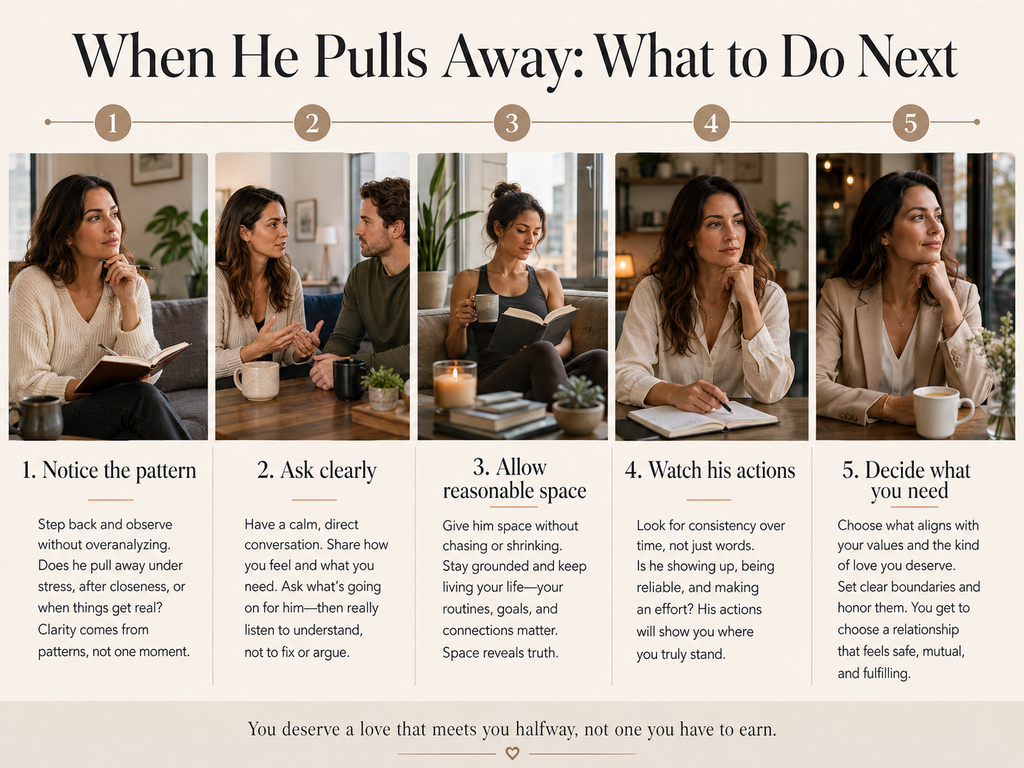
Understanding why men pull away when things get serious is useful only if it helps you respond more clearly. The first step is to resist panic-driven action. A sudden change in communication can trigger the urge to send more texts, ask for reassurance repeatedly, or become strategically distant in return. Those reactions can intensify a demand-withdraw cycle in which one partner pursues harder as the other retreats further.
Give enough room to see whether he moves toward you voluntarily, but do not disappear into an indefinite waiting game. If the change is noticeable, name it calmly. “I’ve noticed we have been talking and seeing each other less. Is something going on for you, or has something changed between us?” is clear without being accusatory.
Then listen to both his words and behavior.
Use This Simple Response Framework
- Notice the pattern before reacting. One difficult weekend is different from six weeks of declining effort.
- Ask once, clearly. You should not need ten increasingly emotional conversations to get a basic answer.
- Allow reasonable processing time. If he genuinely needs a little time, define when you will return to the conversation.
- Do not compete with withdrawal. Jealousy posts, deliberate silence, fake indifference, and threatening to leave are poor substitutes for clarity.
- Decide what you require. Your needs for communication, exclusivity, affection, or commitment matter too.
The official Make Him Worship You sales material discusses male emotional withdrawal and includes concepts around communication, vulnerability, attraction, and male psychology. However, the sales page also makes very aggressive claims about creating “addiction,” “worship,” sexual obsession, and specific emotional triggers. Those are vendor marketing claims rather than guarantees about how an individual man will respond.
If knowing how to communicate when he withdraws is where you feel most stuck, you can review Make Him Worship You’s structured material critically and keep only ideas that respect consent, boundaries, and mutual choice.
Does He Need Space—or Is He Emotionally Disengaging?
A useful way to evaluate why men pull away when things get serious is to compare healthy space with disengagement.
Healthy Space Often Looks Like:
- He tells you he is stressed or needs time.
- He gives some indication of when you will reconnect.
- His affection and interest return.
- He continues making reasonable plans.
- He can discuss what happened afterward.
- You do not need to repeatedly chase him for basic communication.
Emotional Disengagement May Look Like:
- Contact keeps decreasing with no explanation.
- He becomes vague about plans and the future.
- Serious conversations repeatedly disappear into silence.
- He wants relationship benefits without relationship clarity.
- Your concerns are treated as pressure simply because you raise them.
- You are doing nearly all the repair and initiation.
No checklist can determine another person’s feelings with certainty. The purpose is to identify patterns that help you decide whether the relationship is still reciprocal.
Give him space or move on → how to know when relationship space has become emotional distance
Where Make Him Worship You May Fit
The official offer currently lists Make Him Worship You for $37 and states that buyers receive unique login credentials for digital access on phone, tablet, or computer. The official site also displays a 60-day satisfaction or money-back guarantee.
The long-form sales page currently lists three bonuses: When To Sleep With A Man, Unstoppable Confidence, and The Good Girl’s Guide To Texting Dirty. The seller also presents sections focused on men’s emotional lives, vulnerability, conflict, attraction, and reasons men may pull away.
The program may appeal to adult readers who prefer direct, gender-specific dating advice and concrete examples. It may be less suitable if you dislike highly promotional frameworks suggesting that another person’s desire, commitment, or attention can be reliably triggered or controlled. A sensible approach is to separate potentially useful communication concepts from claims that promise predictable control over someone else’s emotional response.
If that structured format appeals to you, Make Him Worship You can be considered as an optional supplement—not a replacement for honest communication, compatibility, reciprocity, or your own judgment.
What His Distance Ultimately Tells You
The deeper answer to why men pull away when things get serious is that distance can mean several different things: discomfort with intimacy, fear of losing independence, emotional overwhelm, different relationship expectations, external stress, compatibility concerns, or a genuine decline in interest. You usually cannot know which explanation fits by analyzing his texts alone.
What matters most is what he does next. A person who is temporarily overwhelmed can still communicate, return, repair, and participate in the relationship. A person who continually retreats whenever closeness requires responsibility may be showing you an important limitation.
Your task is not to become so psychologically perfect that he never feels uncertain. It is to create room for honest communication while protecting your own standards. If he wants the relationship, seriousness should eventually lead to greater clarity—not endless confusion.
Why do men pull away after getting close?
Possible reasons include discomfort with vulnerability, attachment avoidance, emotional overwhelm, stress, fear of losing independence, relationship doubts, or reduced interest. The pattern surrounding the withdrawal matters more than one isolated quiet period.
Should I give him space when he pulls away?
Reasonable space can help when someone genuinely needs time to regulate or think. Space should not mean accepting indefinite silence or repeatedly waiting for someone who refuses to communicate.
How long should I wait when a man pulls away?
There is no universal number of days. Consider the established communication pattern, what he told you, and whether there is a clear plan to reconnect. Ongoing ambiguity matters more than an arbitrary deadline.
Does pulling away mean he is scared of his feelings?
Sometimes increasing intimacy may trigger discomfort, especially in people higher in attachment avoidance, but withdrawal does not prove that someone’s feelings are secretly stronger. Loss of interest and compatibility concerns are also possible explanations.
Should I text him when he becomes distant?
One calm, direct message is usually more useful than repeated reassurance-seeking. You can acknowledge the change and invite communication, then observe whether he responds and contributes to solving the problem.
How can I tell if he needs space or is losing interest?
Healthy space usually includes some communication, continued care, and eventual reconnection. Declining interest is more likely to appear as a sustained pattern of reduced contact, fewer plans, less affection, avoidance of relationship conversations, and little effort to repair the distance.