

Right now, the breakup probably doesn’t feel like something you’re processing — it feels like something you’re stuck inside of. You keep replaying the last conversation, wondering what you could have said differently, and checking your phone a little too often. If you’re searching for how to get your ex back, you’re not looking for empty encouragement. You want an actual plan: something that tells you what to do, what to avoid, and whether this is even realistic in your situation.
It can be. Not always, and not through tricks or games — but a genuine reconciliation is possible when it’s approached with patience, self-awareness, and the right timing. This guide walks through exactly that.
What’s Really Going On When You Want Your Ex Back
Before getting into tactics, it helps to understand what’s actually happening emotionally. Breakups trigger a kind of grief — you’re not just missing a person, you’re missing the future you had planned with them, the routines you built, and the version of yourself that existed inside that relationship.
That grief can make the urge to reconnect feel urgent, even desperate. But desperation is exactly what tends to push an ex further away. The goal isn’t to act on that urgency immediately — it’s to understand it, let it settle a little, and then make decisions from a clearer headspace.
This doesn’t mean suppressing your feelings or pretending you’re fine. It means recognizing that the first few days after a breakup are rarely the right time to make your case for getting back together, because neither of you is thinking clearly yet.
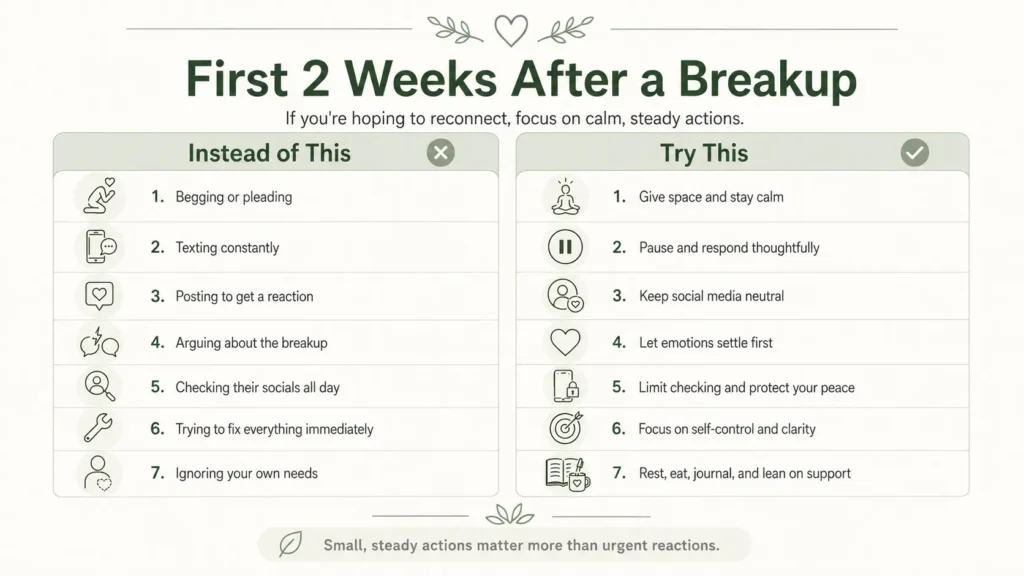
The First Two Weeks: What Not to Do
The period right after a breakup is when most people do the most damage to their chances of reconciliation, usually without realizing it. Immediately after a split, emotions are at their peak and judgment is at its weakest — which is precisely why this window is so easy to get wrong.
During this time, avoid:
- Sending long messages explaining your feelings or asking to talk things through
- Showing up unannounced or engineering “accidental” run-ins
- Asking mutual friends to pass along messages or check in on your behalf
- Posting anything obviously aimed at your ex on social media
None of these are dramatic mistakes on their own. The problem is what they communicate: that you haven’t accepted the breakup, and that your ex’s space isn’t being respected. Both of those things tend to reinforce the distance rather than close it.
5 Mistakes That Push Your Ex Further Away
Beyond the first two weeks, there are a handful of recurring mistakes that tend to sabotage reconciliation attempts even months later.
- Over-apologizing or over-explaining. Repeating the same apology or explanation across multiple conversations reads as anxious rather than sincere, and it keeps both people stuck re-litigating the past instead of moving forward.
- Trying to make them jealous. Dating other people, or making it look like you are, as a strategy to provoke a reaction almost always backfires — it either pushes your ex away for good or, if it “works,” builds the reconciliation on a shaky foundation of insecurity rather than genuine desire.
- Skipping the self-reflection step. Wanting your ex back without honestly examining what went wrong means you’re likely to recreate the same patterns if you do get back together.
- Contacting them when you’re upset. Reaching out during an emotional low point — late at night, after a few drinks, right after seeing something painful online — tends to produce messages you’ll regret and conversations that go nowhere good.
- Treating “no contact” as a manipulation tactic. Going quiet specifically to “make them chase you” is a different thing entirely from using that time to actually work on yourself, and exes can often tell the difference.
Recognizing yourself in one or two of these isn’t a reason to panic. It’s useful information — it tells you exactly where to focus first.
How to Get Your Ex Back: A Step-by-Step Approach
Once the initial emotional intensity has settled, the process of rebuilding a relationship with an ex tends to follow a fairly consistent shape, even though every situation is different in the details.
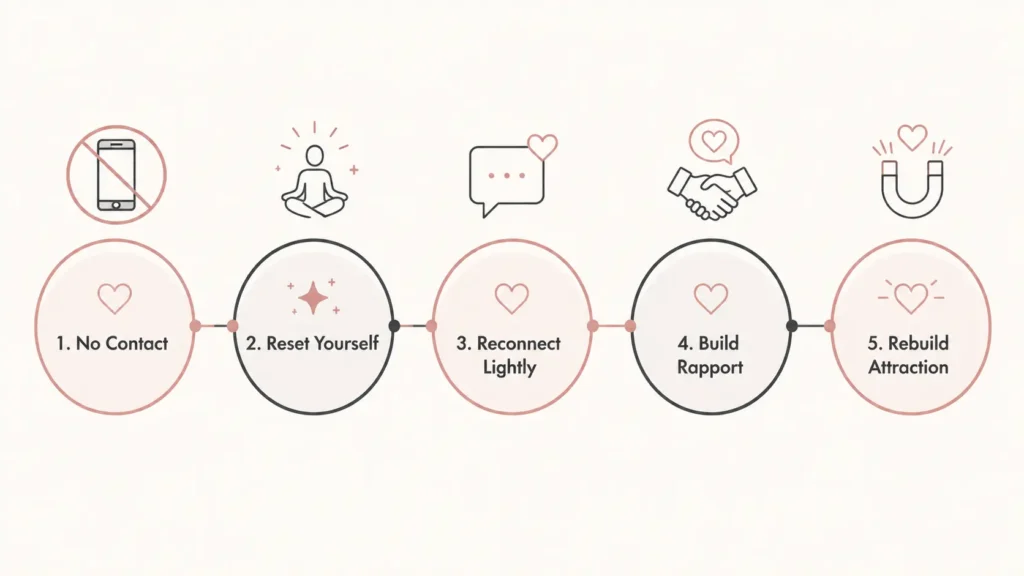
Step 1: Give Yourself Real Space (The No-Contact Period)
Most relationship coaches recommend a deliberate no-contact period, often somewhere between three and six weeks depending on the relationship’s history and how the breakup happened. This isn’t a punishment or a game — it serves two real purposes: it gives both people room to process the breakup without pressure, and it gives you time to genuinely work on yourself instead of orbiting your phone waiting for a text.
During this window, resist the urge to check whether they’ve viewed your story or texted a mutual friend about you. That kind of monitoring keeps you emotionally stuck in the relationship without actually moving anything forward.
Step 2: Get Honest About What Went Wrong
This step gets skipped constantly, usually because it’s uncomfortable. But reconciliation without an honest account of what broke the relationship in the first place tends to lead right back to the same breakup a few months later.
Ask yourself specific questions: Was this about a single event, or a pattern that built up over time? What was your role in it — not your ex’s, yours? What would genuinely need to be different for this relationship to work long-term, not just get back to where it was?
Step 3: Rebuild Yourself First
This is less about “glow-up” advice and more about genuinely re-engaging with your own life — your friendships, your work, your hobbies, your routines. Not as a performance for your ex to notice, but because a person who has rebuilt some stability and confidence is simply in a stronger position, both to pursue reconciliation and to walk away from it if that’s ultimately the healthier choice.
Step 4: Re-Open Communication the Right Way
When the no-contact period ends, the first message matters more than people expect. It should be low-pressure, warm, and not loaded with subtext — something closer to a genuine, casual check-in than a reopening statement about the relationship.
A short, friendly message referencing something specific and positive tends to land better than a vague “hey, how have you been” or a heavy “we need to talk.” The goal of this first contact isn’t to resolve anything. It’s simply to reestablish that a normal, low-stakes conversation is possible again.
Step 5: Rebuild Attraction, Not Just Familiarity
Slipping back into old patterns — the same inside jokes, the same routines — can feel comforting, but comfort alone rarely rebuilds attraction. It’s worth paying attention to how you show up in these early conversations: present, genuinely interested in their life, and not immediately steering things toward getting back together.
Attraction tends to rebuild gradually, through a series of low-pressure, positive interactions rather than one big conversation.
6 Signs Your Ex Might Still Be Open to Getting Back Together
Not every situation is heading toward reconciliation, and it helps to read the signals honestly rather than hopefully. Some common signs that an ex may still be open include:
- They respond to your messages fairly quickly and with genuine engagement, not one-word replies.
- They initiate contact occasionally, even for small, low-stakes reasons.
- They ask questions about your life that go beyond surface-level small talk.
- They haven’t cut off all shared social or friend-group overlap.
- Conversations, when they happen, feel warm rather than tense or clipped.
- They bring up shared memories or inside references without you prompting it.
One or two of these on their own don’t mean much. Several of them together, over a sustained period, are a more reliable signal than any single conversation.
When You Might Want a More Structured Framework
Everything covered so far will genuinely help you approach this situation more thoughtfully, whether or not you ultimately use any additional resources. But some people reach this point and still want something more specific to their exact circumstances — timing that fits their situation, exact wording for difficult conversations, or a clearer sense of what to do at each stage instead of piecing it together.
For a complete, structured plan — including guidance on what to say and when to say it — the Ex Factor Guide by Brad Browning breaks this entire process down step by step. Browning is a Vancouver-based relationship and breakup coach with over a decade of experience in the field, and the program is delivered as a digital guide with accompanying audio and video material, built specifically around this kind of reconciliation process.
What to Say When You Talk About Getting Back Together
When the conversation does turn toward the relationship itself, a few things tend to matter more than the exact script:
- Timing. This conversation goes better after trust has already started rebuilding through smaller, positive interactions — not as the opening topic of the first conversation.
- Ownership. Naming your own role in what went wrong, specifically, lands very differently than a general “we both made mistakes.”
- Clarity without pressure. Being honest about wanting to try again, while also making clear you respect whatever they decide, tends to feel far less threatening than an emotional appeal.
- A real plan, not just intentions. If the same issue caused the breakup, being able to say specifically what’s different now matters more than saying “I’ve changed.”
When It’s Better to Let Go
Not every relationship is worth rebuilding, and recognizing that isn’t failure — it’s clarity. Some signals worth taking seriously include a pattern of the same issue resurfacing across multiple relationships, an ex who’s clearly and consistently moved on, or a relationship that, when you’re honest with yourself, wasn’t actually healthy even before the breakup.
Wanting someone back and a relationship being genuinely good for you are two different things. It’s worth sitting with that distinction before investing months into reconciliation.
Final Thoughts
No version of this process works instantly, and anyone promising a guaranteed outcome isn’t being honest with you. What actually tends to help is a combination of real self-reflection, patience, and a willingness to rebuild trust gradually instead of trying to force a fast resolution.
If you’ve made it this far and still want a more complete, step-by-step system to work from, the Ex Factor Guide is a reasonable next step to look into. Whether or not you use it, the fundamentals covered here — space, honesty, self-work, and patient communication — are the foundation any reconciliation is built on.
How long does it usually take to get an ex back?
There’s no fixed timeline — it depends on how the relationship ended and how much work both people put in. Some reconciliations happen within a couple of months; others take longer, or don’t happen at all. Be cautious of any advice promising a specific, guaranteed timeframe.
Does the no-contact rule actually work?
No-contact isn’t a manipulation tactic when it’s used correctly — it’s primarily a tool for giving both people space to process the breakup clearly. It tends to be more effective when it’s genuinely used for self-reflection rather than as a strategy to provoke a reaction.
What if my ex is already dating someone else?
This significantly changes the situation and often means it’s not the right time to pursue reconciliation, if it’s appropriate at all. Respecting their current relationship matters more than any reconciliation strategy.
Is it ever a bad idea to try to get an ex back?
Yes. If the relationship involved abuse, consistent disrespect, or the same painful pattern repeating across multiple breakups, reconciliation usually isn’t the healthiest path forward, even if the emotional pull is strong.
What’s the difference between trying to get an ex back and just being needy?
Neediness usually shows up as urgency — needing a resolution right now, monitoring their activity, or reaching out repeatedly. A healthier approach involves patience, respecting their space, and being genuinely okay either outcome, even while hoping for reconciliation.
Can a relationship really be stronger after getting back together?
It can, but only if the underlying issue that caused the breakup was actually addressed. Getting back together without resolving that issue tends to lead to the same conflict resurfacing.
10 thoughts on “How to Get Your Ex Back: A Realistic, Step-by-Step Approach”