

If you are wondering what to do after no contact, the answer is not automatically “text your ex.” The end of a no-contact period is a decision point, not a deadline. Before you reopen communication, you need to know why you want contact, whether you can handle any response, what actually changed during the time apart, and whether reconnecting would move you toward a healthier relationship instead of restarting the same breakup cycle.
The urgent mistake is treating the final day of no contact like a launch date. A calendar cannot tell you whether you are emotionally ready or whether your ex wants contact. The eight steps below help you decide whether to reach out, what to say, and what to watch before assuming reconciliation is happening.
Quick Takeaway: Finish no contact with a decision, not an impulse. The goal is clarity, self-control, and respectful communication—not getting a particular reaction.
What to Do After No Contact: Start With a Readiness Check
A useful answer to what to do after no contact begins with your emotional state. If you are still checking your phone constantly, rehearsing the perfect message, or believing that one reply will determine your future, the calendar may have ended before the emotional purpose of the space did. No contact is more useful when it reduces panic enough for you to choose your next move instead of needing your ex to relieve uncertainty.
Research on recently separated adults offers some context for why distance can matter. In a five-month study of 122 adults, more frequent in-person contact with an ex predicted greater separation-related distress two months later among participants without shared children. The study was not a test of a formal no-contact rule, so it does not show that strict silence is best for everyone, but it does caution against assuming that more post-breakup contact is automatically healthier.
Decision Check: Ask yourself, “Could I send one respectful message and still feel okay if the answer is warm, neutral, or nonexistent?” If the honest answer is no, extending the distance may be more useful than forcing yourself to contact because a certain number of days passed.
Should I break no contact → how to know whether you are emotionally ready to contact an ex
1. Decide Why You Want to Reopen Contact
Before writing anything, name your purpose in one sentence. “I want to see whether calm communication is possible” is different from “I need him to tell me he still loves me.” The first purpose can tolerate uncertainty. The second puts your emotional stability inside his response.
If you want closure, be honest about whether your ex can realistically provide it. If you want reconciliation, admit that goal without turning the first message into a relationship proposal. If you only feel lonely tonight, give that feeling time before converting it into action.
Common Mistake: Do not reach out just because you fear that waiting longer will make your ex forget you. A message sent from panic often creates pressure and makes it harder to evaluate whether contact is genuinely mutual.
2. Review What Actually Changed During the Time Apart
No contact is not meaningful simply because days passed. Ask what became different. Did you understand the breakup more clearly? Did you rebuild routines, calm repeated reassurance-seeking, work on communication habits, or recognize an incompatibility you were previously avoiding? If nothing changed except the date on the calendar, renewed contact can easily restart the same pattern.
For what to do after no contact to lead somewhere healthier, separate promises from observable change. “I will be less anxious” is vague. “I no longer send multiple messages when someone needs space, and I can tolerate not getting an immediate reply” is behavioral. Apply the same standard to your ex if contact resumes. Reconciliation should not become a one-person improvement project.

Some readers prefer a structured framework after doing this independent reflection. The current women’s offer for The Ex Factor 2.0 lists a 163-page interactive e-book, a 20-part video course, a three-part bonus video series, three additional e-books, immediate digital access, a $47 price, and a 60-day money-back guarantee.
If you want a structured breakup-and-reconnection framework to compare with the independent steps in this guide, you can consider whether The Ex Factor 2.0 fits your situation and boundaries.
3. Check Whether Contact Is Appropriate Before You Send Anything
Not every no-contact period should end with a message. If your ex explicitly asked you not to contact them, blocked you, or made it clear that further communication is unwanted, respect that boundary. Do not use another number, a new account, mutual friends, or an unexpected visit to bypass it.
Practical contact may still be necessary for shared children, housing, belongings, finances, or work. Keep those messages focused on the real obligation rather than using logistics as a hidden doorway into reconciliation.
If no explicit boundary prevents contact and you chose no contact for your own recovery, then one respectful outreach may be reasonable. The key is that it should be easy for the other person to decline or ignore without being punished by repeated follow-ups.
4. Send One Simple, Low-Pressure Message
When you are ready, keep the first message short. You do not need to summarize the relationship, explain every lesson you learned, or ask whether you are getting back together. Your goal is to reopen a door, not push someone through it.
A message could be: “Hey, I hope you’re doing well. I’ve had some time to reflect and wanted to check in. No pressure if you’d rather keep your space.” If a sincere apology is appropriate, make it specific and ownership-based: name what you did, acknowledge the impact, and do not attach a demand for forgiveness.
This is one of the most practical parts of what to do after no contact because the first exchange gives you information. A warm response can support another conversation. A polite but distant reply suggests caution. No response should be treated as a response to the invitation, not as a challenge to send a better message.
5. Match Their Level of Engagement Instead of Creating All the Momentum
If your ex responds, do not immediately turn relief into overinvestment. Match the level of the conversation and allow reciprocity to become visible. If they ask questions, answer and ask some back. If they give short polite replies, do not send paragraphs trying to manufacture warmth. If they initiate again later, that tells you more than one enthusiastic exchange.
Renewed contact can feel intensely validating after weeks of silence. Slow down enough to separate responsiveness from initiative. A person can enjoy talking to you without being ready for reconciliation.
Signs to Watch: Stronger interest usually becomes easier to observe over time. Your ex begins initiating without prompting, keeps conversations going, suggests specific plans, follows through, and gradually becomes clearer about why they are back in contact.
6. Meet in a Low-Pressure Setting if Communication Becomes Mutual
If conversations become comfortable and both of you want to meet, choose a setting that allows easy conversation without creating excessive romantic pressure. Coffee, a walk, or a casual meal can be more informative than an elaborate date designed to recreate the relationship instantly. You are learning how it feels to interact now.
Do not make the entire meeting a breakup autopsy. Leave room for normal conversation while noticing whether the interaction feels respectful, whether old tension quickly returns, and whether both of you are genuinely curious about who the other has become.
Research on on-again/off-again relationships found that lingering feelings were a predominant reason people renewed relationships, while uncertainty about the prior breakup also mattered. That is useful context because renewed warmth can be real while the underlying decision remains unresolved.
7. Talk About the Breakup Before You Call It Reconciliation
Once contact has become mutual, what to do after no contact shifts from “How do I restart communication?” to “Is there actually a healthier relationship available?” Do not skip that question simply because attraction or affection returned. The old relationship ended for reasons that still need to be understood.
Discuss what went wrong without turning the conversation into a trial. What patterns hurt the relationship? What has changed? What would each of you do differently when the old trigger appears again? If trust was damaged, what behavior would rebuild it? If commitment was unclear, what does each person want now?
The seller of The Ex Factor 2.0 describes a “3R” framework of recovery, rekindling, and reattraction and includes material on post-breakup communication and what to do when contact resumes. Its promotional presentation also makes strong claims about influencing an ex’s emotions and promotes tactics such as ignoring an ex and what the seller calls “covert jealousy.” Those are seller marketing claims rather than dependable predictions, so manipulation-based tactics are better filtered out in favor of consent, boundaries, accountability, and voluntary choice.
If knowing how to move from a first reply into a real reconciliation conversation is where you feel most stuck, you can review The Ex Factor 2.0’s structured communication material and keep only guidance that supports clear, respectful, two-way decisions.
8. Judge the Reconnection by Consistency, Not the First Emotional High
The first few conversations after no contact can feel unusually intense because uncertainty has finally changed. That emotional high is not the same as stability. The stronger test is what happens across ordinary days after the initial relief settles.
Look for consistency in initiation, communication, plans, boundaries, and accountability. Does your ex keep showing up after the nostalgia settles? Do difficult conversations become more productive? Are both people making effort, or are you slowly returning to the role of carrying the relationship?
A healthy answer to what to do after no contact includes the possibility that you may decide not to continue. Reconnection gives you new information. If the same inconsistency, avoidance, disrespect, or incompatibility reappears quickly, you do not have to keep investing simply because the silence ended.
What If Your Ex Contacts You First?
If your ex contacts you during or immediately after no contact, you do not need to reward the message with instant emotional access. First consider why the distance existed. If it protected you from unsafe or unwanted contact, you do not have to reply. If it was mainly for emotional recovery and the message is respectful, you can decide whether responding fits your goals.
Match the message. A practical question can receive a practical answer. A casual “How are you?” can remain a simple conversation. A sincere request to discuss the relationship can be considered when you feel ready.
One Message Rule: One message is evidence of one message. Stronger reconciliation evidence comes later through repeated initiative, clear communication, specific plans, accountability, and respect for your pace.
What If Your Ex Does Not Reply?
Do not send a second, third, and fourth message to overcome silence. If you sent one clear, respectful outreach and received no answer, the invitation is already visible. Repeated attempts can turn a healthy check-in into pressure and make it harder to protect your own progress.
Give the situation time and return your attention to your life. No reply can hurt, but it also gives you useful information about the level of contact currently available. You do not need to translate silence into a story about why they are not answering in order to respect it.
If a response comes much later, evaluate it then rather than staying emotionally frozen around the possibility.
What If the Conversation Becomes Hot and Cold?
Hot-and-cold behavior can be especially destabilizing after no contact because every warm moment feels like a breakthrough and every withdrawal feels like another breakup. Instead of trying harder during the cold periods, step back and look at the pattern. Consistency matters more than peaks.
Ask directly what the renewed contact means if ambiguity continues. You can say that you are open to exploring reconnection but do not want an indefinite cycle of closeness followed by disappearance. That is not an ultimatum; it is a boundary around the type of relationship you are willing to participate in.
For what to do after no contact, clarity is a better goal than maintaining contact at any cost.
How Long Should You Wait Before Reaching Out?
There is no universal 21-day, 30-day, 45-day, or 60-day formula that determines readiness. The useful question is whether the emotional conditions have changed. Can you communicate without panic? Can you tolerate any response? Do you understand why you want contact, and are you prepared to respect a no?
A calendar can create structure, but it cannot predict your ex’s feelings. If you are still obsessively counting days and searching for proof the strategy “worked,” more time may help. If you can accept uncertainty, the decision becomes less about completing a rule and more about making a thoughtful choice.
How to Know If Reconciliation Is Becoming Real
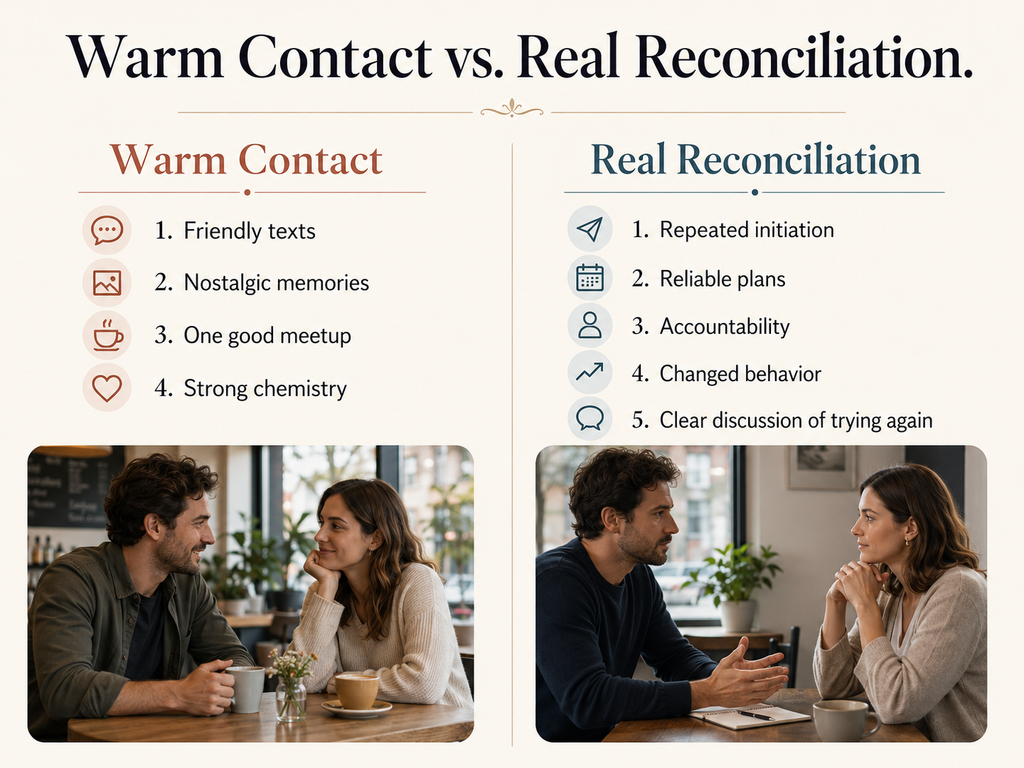
Reconciliation becomes more credible when several behaviors appear together. Your ex initiates repeatedly, makes and keeps plans, discusses the breakup without avoiding responsibility, respects your boundaries, and shows behavioral change in the areas that caused problems. You also feel able to maintain your own routines and standards rather than becoming consumed by the connection again.
Do not rely on sex, nostalgia, frequent texting, or one emotional confession as proof. Those experiences can be genuine without resolving incompatibility or trust. A second chance becomes more meaningful when the relationship is gradually becoming clearer, safer, and more mutual.
The key question is not simply “Are we talking again?” It is “Are we building differently?”
Where The Ex Factor 2.0 May Fit
The current women’s order page for The Ex Factor 2.0 lists a 163-page interactive e-book, a 20-part video course, a three-part bonus video series, How To Read A Man, Why Men Pull Away, and Flawless Fat Loss Guide. The offer lists a $47 price, immediate digital access, ClickBank processing, and a 60-day money-back guarantee.
The program may appeal to readers who prefer a step-by-step breakup and reconciliation framework, especially around recovery, renewed communication, and rebuilding attraction. Because relationship outcomes depend on two people, any program is better treated as optional guidance rather than a substitute for compatibility, consent, boundaries, and mutual willingness.
If you prefer a structured ebook-and-video reconciliation program and are comfortable applying that filter, you can consider The Ex Factor 2.0 as an optional supplement rather than a substitute for your own judgment or a mutual decision to rebuild.
What to Do After No Contact Comes Down to One Question
Ultimately, what to do after no contact is not “send the perfect text.” It is decide whether renewed communication can serve clarity, respect, and a healthier relationship. Start by checking your readiness, understanding what changed, confirming that contact is appropriate, and sending one low-pressure message if you choose to reach out.
If your ex responds, watch reciprocity instead of rushing. If you meet, pay attention to how the connection feels now rather than only how much you missed it. If reconciliation becomes possible, discuss what would actually be different and judge the relationship by consistent behavior.
No contact ends when silence stops being the main strategy. What matters next is whether both people can communicate and choose clearly.
What should I do first after no contact ends?
Check your emotional readiness before messaging. Make sure you know why you want contact and can handle a warm response, neutral reply, or no response without repeatedly pursuing your ex.
What should I text my ex after no contact?
Keep the first message short, calm, and easy to decline. A simple check-in or specific apology is usually more useful than a long relationship essay.
What if my ex contacts me first?
Decide whether responding fits the reason you created distance. If contact is appropriate, match the level of the message and watch for consistency rather than treating one text as proof of reconciliation.
What if my ex does not respond after no contact?
Do not keep sending messages to force an answer. One respectful outreach is enough to make your invitation clear. Return your attention to your own life and respect the lack of response.
How long should I wait before contacting my ex?
There is no universal day count. Emotional readiness, boundaries, the breakup circumstances, and your ability to tolerate any response matter more than completing a fixed timeline.
How do I know if reconciliation is actually happening?
Look for repeated initiation, reliable plans, accountability, respectful communication, changed behavior, boundary respect, and a clear willingness from both people to address what ended the relationship.