

If you are looking for signs your ex is trying to get your attention, you may be noticing a strange shift after the breakup: more story views, casual messages, old inside jokes, sudden questions, or unexpected attempts to cross your path. Some of those behaviors can reflect lingering interest, but attention is not automatically the same as wanting the relationship back.
The biggest mistake is interpreting every small signal as a hidden declaration of love. Your ex may be curious, lonely, nostalgic, jealous, seeking reassurance, or genuinely testing whether reconnection feels possible. This guide shows you nine stronger clues, the weaker signs that are easy to overread, and how to respond without chasing or turning social media into detective work.
Quick Takeaway: Attention tells you that your ex wants to be noticed. What they consistently do after getting your attention tells you much more about why.
Signs Your Ex Is Trying to Get Your Attention: Look for a Pattern, Not One Notification
When evaluating signs your ex is trying to get your attention, context matters more than one isolated action. A story view, like, or random “Hey” can have dozens of explanations. The pattern becomes more meaningful when your ex repeatedly creates opportunities for you to notice them, especially if the behavior increases after you become less available.
Research on on-again/off-again relationships shows why emotional contact after a breakup can be real without automatically meaning reconciliation. In a study of 274 people who had experienced cyclical relationships, lingering feelings were a predominant reason for renewals, while uncertainty about the preceding breakup also mattered. An ex can therefore feel pulled toward contact while still being unsure what they actually want.
Decision Rule: Give more weight to repeated, direct, and effortful behavior than to passive digital signals that require almost nothing from your ex.
1. They Keep Finding Small Reasons to Message You
One of the clearest patterns is repeated contact disguised as something casual. Your ex may send a meme, ask about something they could easily look up, mention a shared interest, or suddenly remember an item that has been unimportant for weeks. Any single message could be innocent; the repetition is what makes it noteworthy.
Pay attention to what happens after you answer. Does your ex use the small excuse only to open a longer conversation, ask follow-up questions, and find another reason to contact you later? That behavior suggests the practical topic may be less important than creating access to you.
Practical Example: Asking once where a shared subscription password was stored is probably logistical. Asking that question, staying to chat for an hour, and starting another unrelated conversation two days later looks more like an attempt to remain on your radar.
2. They Suddenly Become Much More Visible on Social Media
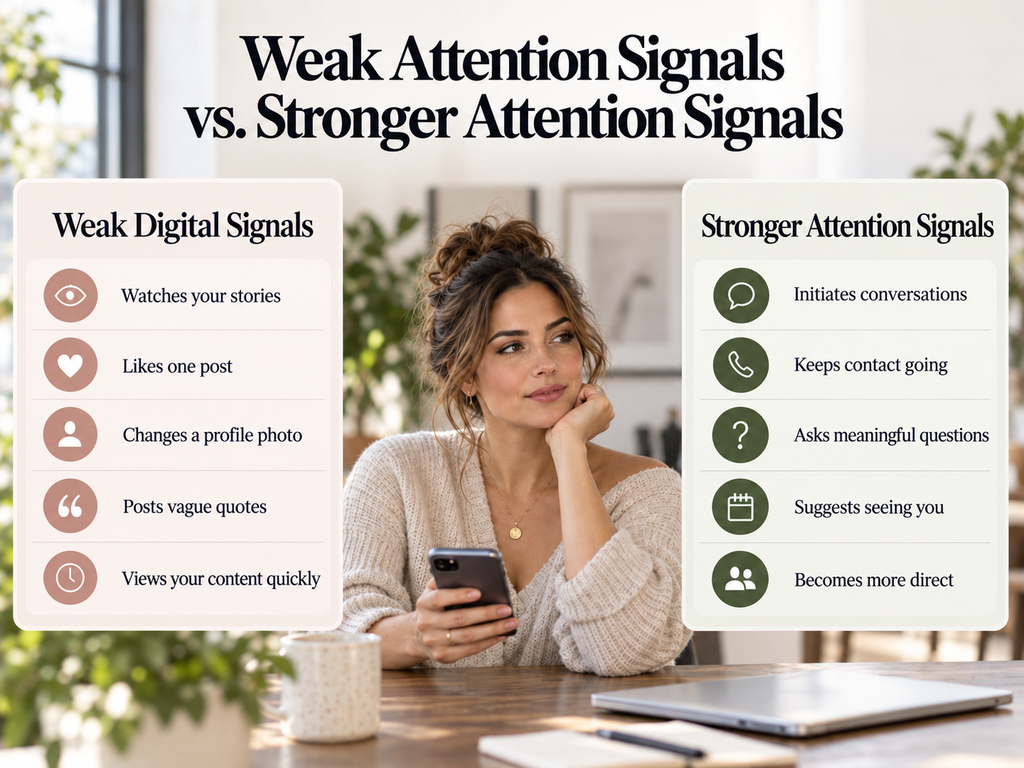
Your ex may begin viewing your stories quickly, liking posts after a period of silence, reacting to content they normally ignored, or posting more noticeably around the same times you are active. Increased visibility can be one of the signs your ex is trying to get your attention, especially when it represents a clear change from their normal online behavior.
Still, social-media activity is weak evidence by itself. Research involving 431 adults found that post-breakup emotional distress predicted monitoring an ex on social-networking sites. That means online attention can reflect unresolved emotion without showing a clear desire to reconcile.
Do not respond by monitoring them more intensely. The useful question is whether passive online visibility eventually becomes respectful, direct communication.
3. Their Attention Increases When You Stop Giving Them Yours
A revealing pattern can appear when you naturally stop initiating conversations, reduce your online engagement, or become busier with your own life. Your ex may suddenly become more communicative, send another message, react to a post, or find a new reason to appear. The timing can suggest that your reduced availability made them more aware of losing easy access to you.
For signs your ex is trying to get your attention, this clue matters most when it happens more than once. However, do not deliberately disappear just to provoke a reaction. If their interest is genuine, you should not need to manufacture insecurity to reveal it.
Common Mistake: Do not turn healthy independence into a test. Let your normal life create the distance, then observe what your ex voluntarily does with it.
After substantial independent value, some readers prefer a structured framework for handling renewed post-breakup contact. The current women’s order page for The Ex Factor 2.0 lists a 163-page interactive e-book, a 20-part video course, a three-part bonus video series, three additional e-books, immediate digital access, a $47 price, and a 60-day money-back guarantee.
If you want a structured breakup-and-reconnection framework to compare with the independent guidance here, you can consider whether The Ex Factor 2.0 fits your situation and boundaries.
4. They Start Asking Questions That Reveal Your Availability
An ex who wants your attention may become unusually curious about what you are doing, who you spend time with, or whether you are dating. They might phrase the questions casually—“Who were you out with?” or “Are you seeing anyone?”—then immediately act as though the answer does not matter.
The questions become more meaningful when they appear alongside other behaviors such as increased contact, invitations, or emotional openness. By contrast, one question about your dating life can reflect curiosity or jealousy without meaning your ex wants another relationship.
Notice the tone as well. Curiosity can be respectful; entitlement is different. Your ex no longer automatically has a right to personal details simply because you once dated.
5. They Bring Back Inside Jokes, Shared Memories, or Familiar Rituals
Shared memories are an easy way for an ex to create an emotional reaction without directly saying they miss you. They may send a photo from an old trip, quote an inside joke, mention your favorite restaurant, or revive a nickname they stopped using after the breakup. Those callbacks can be designed—consciously or not—to remind you of the bond you had.
When judging signs your ex is trying to get your attention, ask whether nostalgia is becoming present-day effort. If your ex repeatedly reminds you of good memories but avoids discussing your current life or why the relationship ended, they may simply miss the familiar feeling.
A stronger pattern appears when the memories lead somewhere: a real conversation, an apology, a plan to meet, or curiosity about whether the connection could be different now.
6. They Create Opportunities to See You in Person
Digital attention is easy. Making a respectful real-world plan requires more effort. Your ex may suggest coffee, ask to return something personally, mention an event you both enjoy, or propose a casual meeting after initially communicating only by text.
The important distinction is between genuine invitations and engineered “accidental” encounters. Healthy reconnection does not require repeatedly showing up where someone will be, ignoring requested space, or using mutual friends to corner them into interaction. A straightforward invitation respects both people’s choices.
What This Means: “Would you like to grab coffee sometime?” tells you more than repeatedly appearing nearby and hoping you notice.
7. Their Contact Becomes More Direct After You Respond
Some attention-seeking stops the moment it succeeds. Your ex sends a message, receives confirmation that you still care, and disappears again. That pattern may be reassurance-seeking rather than genuine interest in rebuilding.
A stronger clue appears when the opposite happens. Once you respond, your ex becomes more direct, initiates again, asks meaningful questions, or suggests continuing the conversation in person. For signs your ex is trying to get your attention, progression matters because it shows that getting noticed was not the final goal.
If the interaction keeps becoming clearer rather than resetting to silence, there may be something more substantial underneath the initial signal.
8. They Begin Addressing What Happened Between You
Attention becomes more meaningful when your ex starts talking about the breakup itself. They may acknowledge something they handled poorly, ask how you experienced the ending, or admit that they have been reconsidering a decision. That requires more vulnerability than likes or casual messages.
Specific accountability is especially important. “I messed everything up” can express regret, but “I realize I avoided every serious conversation about commitment” tells you what your ex actually understands. The second statement creates something that future behavior can either confirm or contradict.
The seller behind The Ex Factor 2.0 describes a “3R” framework of recovery, rekindling, and reattraction and includes material for the stage when an ex starts contacting you again. The same promotional page also makes strong claims about influencing an ex and promotes tactics including ignoring an ex and what it calls “covert jealousy”; those are seller marketing claims, not guarantees about another person’s choices.
If your ex’s attention has developed into repeated contact but knowing how to move toward a clearer conversation is where you feel stuck, you can review The Ex Factor 2.0’s structured communication material while keeping only guidance that supports consent, boundaries, honesty, and two-way choice.
9. They Test Whether the Door Is Still Open
The clearest attention-seeking often moves toward questions about possibility. Your ex may ask whether you could ever be friends again, whether you think exes can reconnect, whether you are completely over the relationship, or whether you would ever consider dating an ex again. These questions allow them to gather information without immediately admitting what they want.
This is one of the strongest signs your ex is trying to get your attention because the focus is shifting from “notice me” toward “is there still a possibility here?” Even so, do not fill in the rest of their intentions for them. If the pattern is strong enough, direct communication is healthier than months of interpretation.
Weak Signs That Do Not Prove Your Ex Is Trying to Get Your Attention
Some behaviors are easy to overread because you can see them instantly: one story view, a like on an old post, an unfollow followed by a refollow, a vague quote, a new profile picture, or suddenly posting more often. Any of these might be aimed at you, but they can also have completely ordinary explanations.
The safest approach is to use weak signals only as supporting context. If three months of “signs” exist entirely inside your social-media app and your ex has never directly created a conversation, you probably do not have enough information to assign a confident motive.
Decision Check: Would this behavior still look meaningful if you did not know your ex was the person doing it? That question can help reduce overinterpretation.
Does Trying to Get Your Attention Mean Your Ex Wants You Back?
No. Someone can want your attention because they miss you, feel lonely, wonder whether you still care, dislike the idea of being forgotten, or want reassurance that they still matter. None of those motives automatically equals a decision to rebuild.
When examining signs your ex is trying to get your attention, separate attention from intention. Reconciliation intent usually becomes more constructive: repeated initiation, honest conversation, accountability, real plans, respect for boundaries, and direct discussion of another chance.
If your ex seems determined to be noticed but remains vague every time the relationship itself comes up, believe both parts of the pattern.
Why Does an Ex Try to Get Your Attention When You Start Moving On?
Your independence can make the breakup feel more final. When you stop initiating, become less emotionally available, or simply begin enjoying your life again, your ex may notice that their old place in your routine is disappearing. That can trigger curiosity, nostalgia, jealousy, regret, or genuine reconsideration.
Do not use moving on as a strategy designed to create this response. Your progress should remain valuable even if your ex does nothing. Otherwise, “moving on” becomes another way of organizing your life around their reaction.
What Should You Do if Your Ex Is Clearly Trying to Get Your Attention?
First, decide whether contact is welcome. You do not have to respond simply because you recognize the behavior. If you are open to communication and there is no no-contact or safety issue, respond proportionately to direct contact rather than rewarding every indirect signal.
For signs your ex is trying to get your attention, the healthiest shift is from guessing to observing reciprocity. Answer a respectful message if you want to, then let your ex contribute. If several meaningful signals develop into consistent contact, you can ask what they are hoping for.
You do not need to create jealousy, post coded messages, or compete for attention. Clear behavior gives you better information than mutual games.
How to Tell Attention-Seeking From Genuine Reconnection Intent
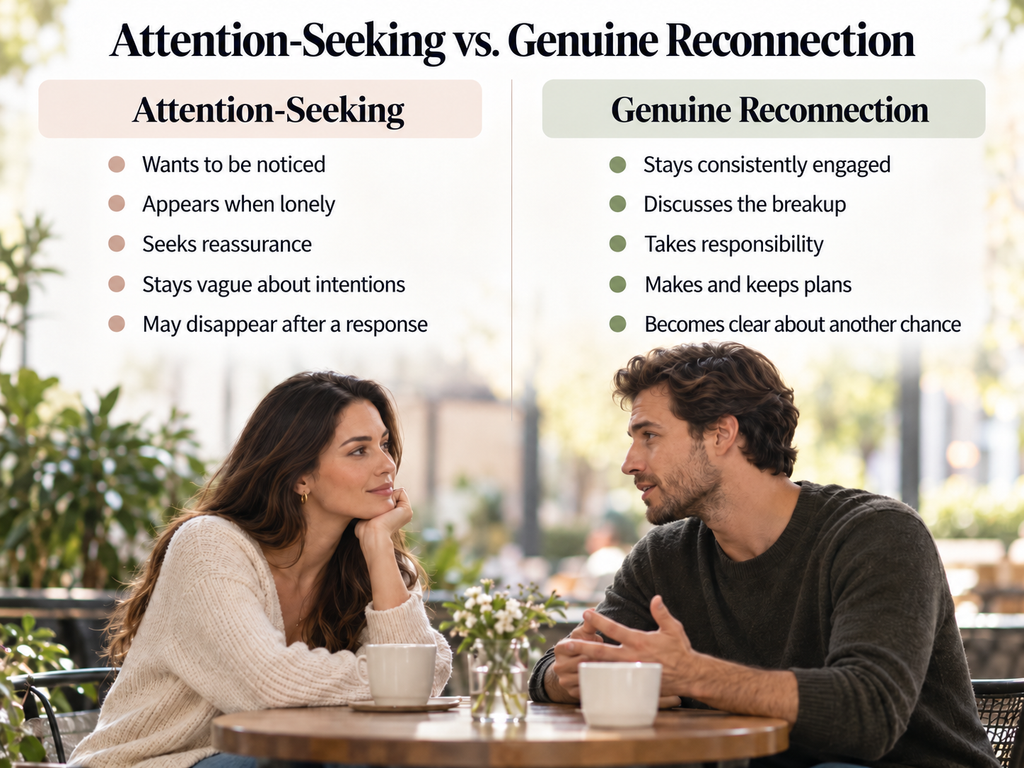
Attention-seeking is mainly about being noticed. Genuine reconnection becomes increasingly focused on what happens between you.
Stronger Reconnection Signs Include:
- They initiate more than once.
- They stay engaged after you respond.
- They ask about your present life.
- They make and keep real plans.
- They discuss why the relationship ended.
- They take responsibility for their contribution.
- They respect your boundaries and pace.
- They become more direct about what they want.
- They discuss what would need to change for another relationship.
A few items from this list do not guarantee reconciliation. The value is in seeing whether the overall pattern becomes clearer and more reciprocal over time.
When Attention From an Ex Becomes Unhealthy
Attention stops being flattering when it ignores your boundaries. Repeated unwanted messages, bypassing a block, monitoring you obsessively, pressuring mutual friends for information, surprise visits after you asked for space, threats, or attempts to control who you date should not be treated as romantic clues.
If you have explicitly asked for no contact, you are allowed to maintain that boundary. If behavior escalates into harassment, stalking, coercion, or threats, prioritize safety and appropriate local support rather than trying to determine whether lingering feelings caused it.
Where The Ex Factor 2.0 May Fit
The current women’s order page lists The Ex Factor 2.0 as a digital package containing a 163-page interactive e-book, a 20-part video course, a three-part bonus video series, How To Read A Man, Why Men Pull Away, and Flawless Fat Loss Guide. The listed price is $47, access is described as immediate, payments are processed through ClickBank, and the seller provides a 60-day money-back guarantee.
The program may appeal to readers who want a structured breakup-and-reconnection framework after attention has become real communication. It cannot tell you with certainty what another person secretly intends, and its stronger promotional claims should not replace your judgment about compatibility, consent, boundaries, or mutual effort.
If you prefer a structured ebook-and-video framework and are comfortable applying that filter, you can consider The Ex Factor 2.0 as optional support rather than a substitute for direct communication, healthy boundaries, or your own judgment.
Signs Your Ex Is Trying to Get Your Attention: The Bottom Line
The strongest signs your ex is trying to get your attention usually form a progression. Your ex repeatedly finds reasons to contact you, becomes more visible, reacts to reduced access, asks about your availability, revives shared memories, creates real opportunities to see you, becomes more direct after you respond, addresses the breakup, and eventually tests whether the door is still open.
That pattern can reveal emotional interest, but it does not automatically tell you what your ex wants to build. Attention can come from loneliness or nostalgia just as easily as reconciliation interest. Let consistent behavior, accountability, respect, and direct communication answer the question that digital hints cannot.
The goal is not to become better at decoding every signal. It is to recognize when the signals are strong enough that you can stop guessing and evaluate the actual relationship being offered.
What are the strongest signs your ex is trying to get your attention?
Repeated casual messages, increased visibility when you pull back, questions about your dating life, attempts to see you, growing directness, and testing whether the door is still open are stronger clues than one social-media interaction.
Does my ex watching my stories mean they want my attention?
It can, but story views alone are weak evidence. Online monitoring can also reflect habit, curiosity, or breakup distress, so look for direct behavior before drawing a conclusion.
Why does my ex seek attention but then disappear?
They may feel lonely, nostalgic, uncertain, or want reassurance that you still care. If the pattern repeatedly stops after you respond warmly, reassurance-seeking may be more likely than stable reconciliation intent.
Why does my ex try to get my attention when I move on?
Your reduced availability may make the breakup feel more final and trigger curiosity, jealousy, regret, or renewed interest. That reaction does not automatically mean your ex wants another relationship.
Should I respond if my ex is trying to get my attention?
Respond only if contact is welcome and no boundary or safety issue prevents it. Direct, respectful communication deserves more weight than indirect likes, posts, or vague attempts to be noticed.
How do I know if attention is turning into reconciliation?
Look for repeated initiation, meaningful conversations, accountability, real plans, respected boundaries, and increasing clarity about what your ex wants and what would be different this time.