

Manifestation scripting for money is a journaling practice where you write about a desired financial future as though you are describing a vivid experience. It can be motivating, but the practice becomes more useful when your script includes realistic goals, obstacles, resources, and actions instead of simply repeating that wealth has already appeared. You can keep the hopeful, imaginative side of manifestation while using the writing to clarify what you want and what you can actually do next.
There is no established scientific evidence that writing a money script causes external financial events or makes wealth appear. The closest relevant research looks at positive future-oriented writing, goal setting, mental contrasting, and implementation intentions. A 2025 systematic review found that positive expressive-writing practices, particularly gratitude and “best possible self” exercises, showed relatively consistent benefits for well-being and positive affect, although the quality of the included research was rated poor or fair overall.
Research on the “best possible self” exercise also examines writing or imagining a positive future after working toward personally meaningful goals. A meta-analysis of 29 studies found benefits across several well-being-related outcomes, giving future-oriented writing a reasonable psychological context without proving manifestation claims.
The goal, then, is not to write the perfect magical paragraph. It is to use scripting to create a clearer bridge between future vision and present behavior.
How to practice manifestation scripting for money in a grounded way
A useful script should answer more than “How much money do I want?” It should help you imagine how greater financial security would affect your ordinary life, how you would behave differently, what obstacles you would need to handle, and which next action is currently within your control. That makes scripting a form of intentional reflection rather than passive wish-making.
The CFPB defines financial well-being through both security and freedom of choice. Its framework includes having control over day-to-day finances, being able to absorb a financial shock, being on track toward financial goals, and having enough financial freedom to make choices that support your life.
Use those ideas when deciding what “abundance” means in your script. A meaningful future could be having a stronger emergency fund, reducing financial stress, improving earning opportunities, managing expenses more confidently, or having more flexibility around work and family.
The following seven steps create a complete scripting routine.
1. Choose One Financial Future to Script About
Do not start by trying to manifest “unlimited wealth.” Pick one outcome that would genuinely improve your life.
For example:
- building an emergency fund;
- paying down a specific debt;
- increasing your earning capacity;
- developing a more consistent savings habit;
- becoming more organized with bills;
- creating greater flexibility around work;
- feeling calmer when reviewing your finances.
Now ask:
“What would this improvement change in my ordinary life?”
Suppose your goal is emergency savings. Instead of writing only, “I have lots of money,” you might focus on the relief of handling an unexpected car repair without immediately panicking about how to pay for it.
If your goal is higher earning potential, your script might focus on having stronger skills, more confidence, and more realistic career options.
Specificity gives your imagination somewhere meaningful to go.
2. Write the Future as a Normal Day, Not a Fantasy Montage
One useful scripting approach is to describe an ordinary day in the future.
Imagine waking up after meaningful progress has happened. What do you notice? How do you make everyday financial decisions? What feels different about your relationship with money?
You might write:
“It’s the beginning of the month, and I know where my main expenses are going. I check my accounts without the same rush of anxiety I used to feel. My emergency savings are gradually becoming stronger, and I feel proud that I have continued the habit even when progress has been slower than I wanted.”
Notice what is missing: sports cars, sudden windfalls, and dramatic claims.
The future feels better because your behavior and financial position are different.
Research on future time perspective has found positive associations with self-regulatory processes such as goal setting, goal monitoring, and goal-directed behavior. That does not mean imagining a future guarantees it, but it gives a grounded reason to make your future scene behaviorally detailed.
3. Add the Behavior Behind the Result
This may be the most important part of manifestation scripting for money.
After describing the future outcome, write about what the future version of you actually does.
If you are scripting about greater savings, perhaps that person:
- reviews finances regularly;
- transfers money after payday;
- pauses before unnecessary purchases;
- adjusts when an unexpected expense occurs;
- continues after imperfect months.
If you are scripting about greater income, perhaps that person:
- keeps developing useful skills;
- finishes important work;
- applies for opportunities;
- communicates professionally;
- asks appropriate questions;
- evaluates offers carefully.
Write these behaviors directly into your scene.
For example:
“I sit down for my weekly money review and understand where my money went. I notice an expense that no longer supports my priorities and adjust it. I make the savings transfer I planned, then move on with my day instead of checking the account repeatedly.”
Your script is now rehearsing a process rather than only celebrating an outcome.

Where The Wealth Signal May Fit
Some people enjoy creating their own scripts, visualization exercises, gratitude prompts, and financial-action plans. Others prefer having a more organized mindset structure because deciding what to focus on each day can make consistency harder.
That is the most appropriate context for The Wealth Signal in this article. The supplied official sales page could not be reliably fetched during research, so current details about its creator, exact format, exercises, audio material, modules, bonuses, pricing, guarantees, or financial results cannot be responsibly verified.
Because those specifics are unavailable, the product is best treated only as optional mindset-oriented support rather than evidence for a particular manifestation mechanism.
If structured abundance-focused guidance would make your mindset routine easier to maintain, consider whether The Wealth Signal fits alongside the practical financial habits you already use.
4. Contrast the Script With Your Current Obstacle
Positive future writing becomes more grounded when you deliberately return to the present.
Ask:
“What is currently making this future difficult?”
Suppose you script:
“I consistently build savings.”
Your current obstacle might be:
“I wait until the end of the month and try to save whatever remains.”
Or perhaps:
“I spend impulsively when I am stressed.”
If your script is about earning more, the obstacle might be:
“I keep researching skills but rarely practice them.”
This is similar to mental contrasting, a self-regulation strategy that pairs a desired future with the obstacle in present reality. A meta-analysis covering 21 studies and 15,907 participants found that mental contrasting combined with implementation intentions had a small-to-moderate positive effect on goal attainment, although the authors also noted possible publication bias and the need for additional research.
Your journal might therefore include:
Desired future:
“I have a consistent emergency-savings habit.”
Current obstacle:
“I often spend first and save only what remains.”
Bridge:
“I need to decide on a manageable amount before payday.”
This keeps your future script connected with your actual circumstances.
5. Add a Grounded Money Affirmation
After identifying the obstacle, choose one statement that supports the behavior you want to practice.
Avoid writing something you cannot emotionally connect with.
Instead of:
“Money comes to me effortlessly from everywhere.”
Try:
“I can become more intentional with the money I manage.”
Instead of:
“I am already completely financially free.”
Try:
“I can make decisions that gradually strengthen my financial position.”
Instead of:
“I never worry about money.”
Try:
“I can feel financial concern without letting fear control my next decision.”
Instead of:
“I attract every opportunity I need.”
Try:
“I can stay open to realistic opportunities and evaluate them carefully.”
The statement should help you move toward the behavior described in your script.
A useful question is:
“What could I do tomorrow that would make this statement slightly more true?”
If your affirmation is “I can become more organized with money,” tomorrow’s evidence might be reviewing your upcoming bills.
If it is “I can develop stronger earning options,” the evidence might be 30 minutes of focused skill development.
The affirmation now has a practical purpose.
6. Include Gratitude for a Resource You Already Have
Many scripting practices use gratitude by writing as though the desired future has already happened. You can also use gratitude in a way that stays connected to your current reality.
Identify something genuinely available today.
It could be:
- a useful professional skill;
- current income you can plan with;
- a supportive relationship;
- knowledge gained from a previous mistake;
- time available for skill development;
- a small amount already saved;
- access to trustworthy financial information.
Write:
“I appreciate that I already have __________, and I am using it by __________.”
For example:
“I appreciate the design skills I have already developed, and I am using them by building stronger portfolio examples this month.”
Or:
“I appreciate the savings habit I have started, even though the amount is currently small. I am continuing it instead of dismissing small progress.”
Positive expressive-writing research has found relatively consistent well-being benefits for gratitude and best-possible-self approaches, although the evidence should not be interpreted as showing that gratitude causes financial wealth.
Gratitude works best here as resource awareness.
7. Finish the Script With an If-Then Action Plan
Do not close the journal immediately after writing the beautiful future.
Create one response you can use in real life.
Use this structure:
If X happens, then I will Y.
For example:
If payday arrives, then I will make the savings transfer I planned before discretionary spending.
If I want an unplanned purchase above my personal limit, then I will wait 24 hours before deciding.
If I feel anxious about my weekly money review, then I will commit to reviewing only the next seven days.
If Tuesday evening arrives, then I will spend 30 minutes developing the skill connected with my income goal.
Implementation intentions are specific if-then plans connecting a situation with a predetermined response. Research has found that this type of planning can support goal attainment across various contexts.
Your complete scripting sequence becomes:
VISION → BEHAVIOR → OBSTACLE → BELIEF → RESOURCE → PLAN → ACTION
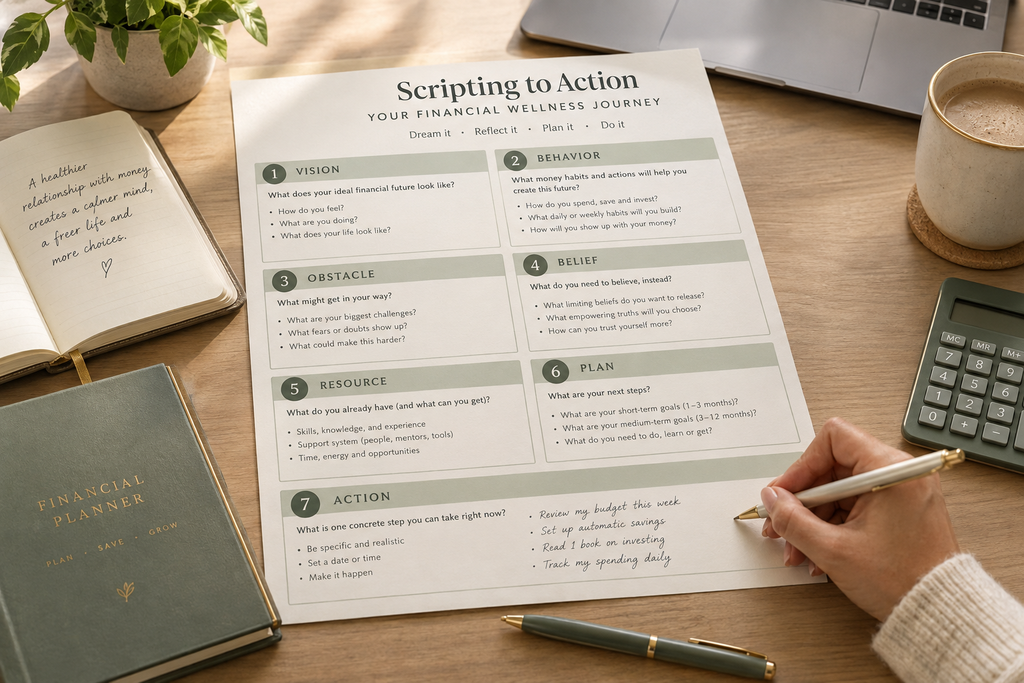
A Complete Manifestation Scripting for Money Example
Here is an example of manifestation scripting for money focused on greater financial stability rather than sudden wealth:
“It’s a Sunday morning, and I sit down with my coffee for my weekly financial review. I no longer avoid checking the numbers because I understand that information helps me make decisions. My emergency savings have become more consistent, and seeing that progress gives me a greater sense of stability.
“I remember when I believed that small savings amounts were pointless. Now I understand that a repeatable habit matters more than waiting for a perfect month. I decide where part of my income will go before unnecessary spending takes over.
“I also feel more confident about my earning options. I have continued developing my professional skills and taking realistic opportunities seriously instead of waiting for one dramatic breakthrough. Progress has not happened perfectly, but I know how to return to my plan when something changes.
“I am grateful for the skills, information, and resources I have available now. I use them intentionally. When payday arrives, I follow the financial plan I made rather than making decisions only from emotion.”
After writing the script, return to today and answer:
What is my current obstacle?
What action would make this future slightly more likely?
That second part is what turns the entry into a practical exercise.
Try the Future–Obstacle–Action Method
If long scripts feel overwhelming, use a shorter three-part structure.
FUTURE
Write three or four sentences describing one financial improvement you want.
Example:
“My finances feel more organized. I understand my upcoming expenses, I am gradually building savings, and I feel more confident making ordinary money decisions.”
OBSTACLE
Write one sentence describing the main issue today.
“I avoid reviewing my finances because I expect the experience to feel stressful.”
ACTION
Write one response.
“If Sunday morning arrives, I will review only the next seven days of expenses for 15 minutes.”
This compact version keeps the imaginative element but prevents scripting from becoming disconnected from behavior.
Write About Financial Security, Not Only a Dollar Number
A large income can be an understandable goal, but money is usually connected with something deeper.
Ask:
Why do I want this amount?
Perhaps you want:
- stability;
- less financial anxiety;
- more options;
- time with family;
- career flexibility;
- the ability to handle emergencies;
- greater independence.
The CFPB’s financial well-being framework emphasizes exactly these kinds of outcomes: day-to-day control, capacity to handle shocks, progress toward goals, and freedom to make meaningful choices.
Try scripting the lived experience behind the number.
Instead of:
“I have $1 million.”
Write:
“I have created enough financial stability that an ordinary unexpected expense no longer throws my entire month into crisis. I understand my priorities, I have a plan, and I can make more choices based on what matters to me.”
That gives the script emotional meaning without requiring fantasy imagery.
Use Present Tense Without Pretending
Manifestation advice often says you must write entirely in the present tense as though your desired outcome already exists.
You can do that if it helps you imagine the scene, but you do not have to convince yourself that a fictional statement is currently factual.
For example:
“I calmly manage my finances and follow my savings plan.”
can simply be a description of the future behavior you are rehearsing.
You can then add:
“Today, the behavior I can practice is reviewing the transfer amount.”
That keeps imagination and reality clearly separated.
You are not weakening the script by acknowledging where you are today. You are giving the future somewhere to connect.
Avoid Scripting Only Passive Outcomes
Compare these two entries.
Passive script:
“Money constantly flows to me. New opportunities appear everywhere. Everything always works out.”
Process script:
“I notice realistic opportunities and evaluate them without rushing. I continue building useful skills, complete important work, ask better questions, and make deliberate financial decisions. When an opportunity fits my goals and circumstances, I respond.”
The second script gives you behaviors to recognize.
Future-oriented imagination may influence affect and self-regulatory thinking, but that does not make external events controllable through imagination alone. A meta-analysis of 63 experimental studies found that imagining future scenarios can meaningfully influence affective responses.
Let scripting influence your orientation toward the future without requiring it to control the future.
Add a Real Financial Goal After Every Script
Once the script is complete, translate it into a measurable priority.
If you wrote:
“I feel financially secure.”
ask:
“What financial condition would support that feeling?”
Perhaps:
- a particular emergency-fund milestone;
- a more manageable debt plan;
- improved monthly cash flow;
- a new professional qualification;
- a consistent savings system.
Goal-setting research across many behavior-change contexts has found a small positive effect of setting goals, although outcomes depend on the situation and how goals are structured.
Your script creates the picture.
Your goal gives the picture a direction.
Your action gives the goal movement.
When Structured Mindset Guidance May Fit
By this point, you already have a complete self-directed scripting process. You can define the financial future, write an ordinary future-day scene, include useful behaviors, identify present obstacles, choose a grounded affirmation, recognize existing resources, and create an if-then plan.
Some readers enjoy creating this material from scratch. Others prefer following a more organized mindset structure because they find consistency easier when the reflection process is already defined.
The current features of The Wealth Signal cannot be described responsibly because its supplied official sales page was not successfully accessible during research.
If you prefer an organized mindset framework rather than creating every scripting exercise yourself, The Wealth Signal may be considered as optional support alongside your financial goals and habits.
Common Scripting Mistakes
One mistake is writing only about a dramatic outcome. If every script jumps immediately from today’s situation to extreme wealth, add the behaviors and intermediate steps that would exist between those points.
Another mistake is treating uncomfortable emotions as evidence that you are “manifesting incorrectly.” A financial concern may contain useful information. Write the fear down, identify what is fact versus prediction, and decide whether the situation requires action.
A third mistake is changing goals constantly. If building emergency savings matters this month, you do not need to script a completely different dream every morning.
A fourth mistake is using manifestation scripting for money instead of reviewing actual information. A journal cannot tell you the balance, terms, risks, fees, tax consequences, or suitability of a financial decision.
The final mistake is treating lack of immediate results as personal failure. The CFPB notes that financial well-being is influenced by multiple factors, including circumstances both within and outside personal control.
Your mindset matters, but it is not the only variable in your financial life.
A 10-Minute Money Scripting Routine
You can complete the entire practice in about 10 minutes.
Minutes 1–2: Choose the future
Write one specific goal and why it matters.
Minutes 3–5: Script the scene
Describe an ordinary day after meaningful progress has happened. Include how you think, decide, and behave.
Minute 6: Name the obstacle
Ask:
“What currently gets in the way?”
Minute 7: Write the grounded belief
Choose one realistic statement supporting the behavior you want.
Minute 8: Identify a resource
What do you already have that can help?
Minute 9: Create the if-then plan
“If __________ happens, then I will __________.”
Minute 10: Schedule the action
Decide when the next financial behavior will occur.
Stop there.
A short script you actually use is more valuable than pages of writing that never influence your decisions.
Review Your Scripts Weekly
Once a week, read your recent entries for patterns rather than “signs from the universe.”
Ask:
Which future keeps appearing?
Which behavior appears in that future?
Which obstacle keeps showing up today?
Which if-then plan worked?
Which action did I avoid?
What useful resource have I overlooked?
Is my financial goal becoming clearer?
A particularly useful question is:
“What has changed outside the journal?”
Perhaps you are checking your finances more consistently. Maybe you followed a savings plan, completed a career task, paused before an impulse purchase, or finally gathered information you had been avoiding.
Those are tangible signals that the writing is connected with behavior.
Try a 30-Day Scripting Experiment
If the method resonates with you, practice it for 30 days without treating that period as a deadline for financial transformation.
Choose one primary financial theme instead of scripting dozens of unrelated goals.
Each day, record:
- the future you are working toward;
- one behavior your future self practices;
- the current obstacle;
- a grounded belief;
- an existing resource;
- an if-then plan;
- the next action.
At the end of 30 days, evaluate the practice through questions such as:
Did my financial goal become more specific?
Did I recognize recurring obstacles sooner?
Did I complete more practical financial actions?
Did I become less avoidant around a particular money task?
Which part of scripting helped most?
Which part felt unnecessary?
Continue only the parts that add real value.
Final Thoughts
Used thoughtfully, manifestation scripting for money can be more than repeatedly writing that you are wealthy. It can help you describe the financial future you genuinely value, identify the behaviors associated with it, notice what is getting in the way, recognize existing resources, and decide how to respond.
Keep the imaginative part. Write the scene vividly if that makes the practice emotionally meaningful. Then return to current reality and create the bridge.
A useful sequence is:
VISION → BEHAVIOR → OBSTACLE → BELIEF → RESOURCE → PLAN → ACTION
Your script can describe the destination and rehearse the mindset.
Your choices still move the plan forward.
If The Wealth Signal matches the structured abundance approach you prefer, decide whether it belongs alongside—not instead of—the practical financial actions supporting your goals.
What is manifestation scripting for money?
It is a journaling practice in which you write about a desired financial future in vivid detail, often as though describing a future experience. A grounded version also includes behaviors, obstacles, resources, and practical financial actions.
Does money scripting actually manifest money?
There is no established scientific evidence that writing a manifestation script directly causes money or financial opportunities to appear. Future-oriented and positive writing have been studied for psychological outcomes such as well-being and affect, not guaranteed financial results.
Should I write manifestation scripts in the present tense?
You can if it helps make the imagined scene vivid, but there is no evidence-based requirement to do so. You can also write about a future scene and then clearly identify what you can practice today.
How often should I script for money?
There is no required frequency. A short practice several times per week or even once weekly may be more useful than forcing yourself to write daily if the routine becomes repetitive.
What should I include in a money manifestation script?
Include the desired future, the behaviors associated with that future, your current obstacle, a grounded belief, an existing resource, an if-then plan, and one next financial action.
Can manifestation scripting replace financial planning?
No. Financial well-being also depends on practical factors such as control over everyday finances, resilience to financial shocks, progress toward goals, financial behavior, skills, opportunities, and circumstances.