

A wealth manifestation meditation can give you a quiet space to think about money differently, especially if financial stress, self-doubt, or vague goals keep pulling your attention in different directions. The practice becomes more useful when meditation is not expected to magically produce money. Instead, it can help you settle your mind, clarify what abundance actually means, notice limiting thoughts, visualize constructive behavior, and choose one realistic financial action to take afterward.
Meditation includes many different practices, and some use breathing, sound, visual imagery, or repeated words as points of focus. The National Center for Complementary and Integrative Health notes that meditation and mindfulness have been studied for areas including stress, anxiety, sleep, and general well-being, although evidence quality varies across practices and studies.
That gives meditation a useful role without requiring exaggerated claims. Scientific research does not establish manifestation meditation as a mechanism that directly attracts wealth, controls financial events, or guarantees financial success. You can still use spiritual intention, visualization, affirmations, and gratitude if they are meaningful to you; the grounded approach is simply to connect those practices with decisions and behaviors you can influence.
How to practice wealth manifestation meditation in a grounded way
A useful wealth manifestation meditation connects inner reflection with an external next step. Rather than sitting down with the pressure to “manifest enough money,” choose one financial area you genuinely want to improve. This might be saving, reducing debt, creating more income opportunities, organizing monthly finances, or simply becoming less avoidant around money decisions.
The CFPB describes financial well-being as having security and freedom of choice. Its framework includes control over everyday finances, the ability to absorb a financial shock, progress toward financial goals, and the freedom to make choices that support your life. That provides a useful way to define abundance without reducing it to luxury imagery or one arbitrary bank-balance number.
The seven steps below combine meditation, reflection, visualization, gratitude, and action. You can complete them in 10–15 minutes, or spend longer when you want a deeper journaling session.
1. Settle Your Attention Before Thinking About Money
Begin with one or two minutes of simple meditation. Sit comfortably, let your breathing remain natural, and place your attention on the sensation of breathing, a calming sound, or another neutral point of focus. When your mind wanders, gently return without turning the exercise into a test of concentration.
This first stage matters because financial thoughts often arrive with urgency. You may immediately start thinking about bills, income, debt, missed opportunities, or everything you believe you should have achieved by now. Giving yourself a short period of quiet attention can create enough distance to observe those thoughts rather than automatically following each one.
You do not need special music, a particular sound frequency, crystals, or any other object to complete this step. Use them only if they personally support your focus. NCCIH notes that meditation can involve attention to breathing, sound, visual images, or repeated phrases, so there is no single required format.
2. Define What Wealth Actually Means to You
Now ask:
“If my financial life became healthier, what would actually change?”
Your answer may have less to do with luxury than you expect. Perhaps you want to handle an unexpected expense without panic, build savings, have greater flexibility around work, pay bills more predictably, support your family, or reduce the amount of mental energy money consumes.
Write one clear intention such as:
- “I want to build a stronger emergency cushion.”
- “I want to become more consistent with saving.”
- “I want to develop skills that improve my earning options.”
- “I want to understand my monthly finances clearly.”
- “I want more freedom to make thoughtful career decisions.”
The more specific the goal, the easier it becomes to visualize useful behavior. “I want unlimited abundance” may feel inspiring, but “I want enough emergency savings to handle an unexpected expense more comfortably” gives your meditation a clearer direction.
3. Notice the Money Thought Behind the Goal
Bring your financial intention to mind and notice the first difficult thought that appears. Do not immediately replace it with positivity. Let yourself identify the belief honestly.
You might notice:
- “I will never get ahead.”
- “I always mess up with money.”
- “I am too far behind.”
- “There is never enough.”
- “Other people can succeed financially, but I cannot.”
- “I need one huge breakthrough.”
Now divide the thought into current reality and prediction. For example, “My savings are currently lower than I want” is a present fact, while “I will never become financially secure” is a prediction about the future.
Try a grounded reframe:
Current thought: “I never make progress.”
What is true: “My progress has been inconsistent.”
Grounded perspective: “Inconsistent progress does not prevent me from building a simpler system from here.”
This approach makes your mindset practice more believable and easier to connect with action.
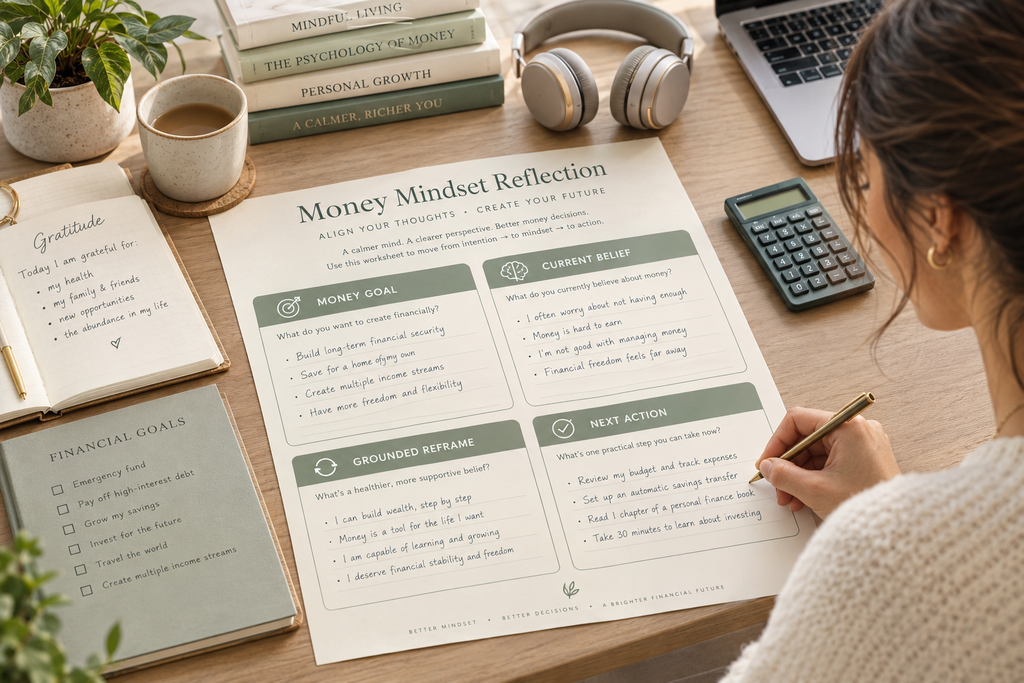
Where The Wealth Signal May Fit
You can complete this meditation with nothing more than a quiet place and a journal. Some people, however, prefer a structured mindset framework because having prompts or an organized routine can make personal-development practices easier to maintain.
That is the appropriate context for The Wealth Signal here. The supplied official sales page could not be reliably accessed, so current details about its creator, exact format, audio content, exercises, modules, bonuses, pricing, guarantee, or specific financial claims cannot be responsibly verified.
Because those details are unavailable, it is best treated as optional mindset-oriented support rather than evidence of a proven wealth-attraction mechanism.
If structured abundance-focused guidance would help you stay consistent with your mindset practice, consider whether The Wealth Signal fits alongside the practical financial habits you already use.
4. Choose One Grounded Money Affirmation
After identifying the thought you want to change, choose an affirmation that feels constructive without requiring you to deny reality. The goal is not to convince yourself that every financial problem has already disappeared. A useful affirmation should help direct your attention toward a healthier response.
Instead of:
“I attract unlimited money effortlessly.”
Try:
“I can make thoughtful choices that gradually strengthen my financial position.”
Instead of:
“I am already completely financially free.”
Try:
“I can build greater financial security through repeated actions.”
Instead of:
“I never worry about money.”
Try:
“I can feel uncertainty without letting fear control every decision.”
Repeat the statement slowly for several breaths. Then ask one important question: “What action would make this affirmation slightly more true?” If your affirmation says you can become more organized, perhaps the evidence is reviewing next week’s expenses. If it says you can expand your options, perhaps the evidence is practicing an income-related skill.
5. Visualize the Process Behind Your Financial Goal
Visualization is often the most recognizable part of manifestation meditation. You can picture the financial future you want, but do not stop at the final result. Mentally rehearse the behaviors that would exist in that future.
If your goal is stronger savings, picture yourself receiving income, completing a planned savings transfer, reviewing progress, and continuing the habit even after an imperfect month. If your goal is higher earning potential, picture yourself practicing a valuable skill, finishing strong work, applying for opportunities, communicating confidently, and evaluating offers carefully.
Then bring your attention back to the present and ask:
“What is the main obstacle between this future and where I am now?”
Perhaps the obstacle is inconsistent saving, avoidance, impulse spending, procrastination, unclear priorities, or expecting progress to happen too quickly. Research on mental contrasting supports the idea of pairing a desired future with the obstacle standing in the way. A 2021 meta-analysis covering 21 studies and 15,907 participants found a small-to-medium positive effect when mental contrasting was combined with implementation intentions for goal attainment, while also noting limitations including possible publication bias.
This gives visualization a practical structure:
Desired Future → Current Obstacle → Planned Response
6. Practice Gratitude as Resource Awareness
Gratitude can fit naturally into meditation, but it does not require pretending that your financial situation is perfect. Instead, identify something useful that already exists in your life.
You might appreciate your current professional experience, access to useful information, an existing income source, a small savings habit, available time, a supportive relationship, or a financial lesson you finally understand. Sit with that resource for a moment and then ask how you can use it more intentionally.
For example, if you are grateful for a skill you already have, your next step might be strengthening your portfolio or looking for realistic ways to apply it. If you appreciate having income you can plan with, your next step might be deciding what portion can realistically support a savings goal.
This keeps gratitude connected with agency. You can acknowledge what is available without claiming gratitude itself will produce money.
7. End With One Specific Financial Action
The meditation should end with something you can do outside the meditation.
Choose one action that can realistically happen within the next 24 hours or at the next relevant opportunity. Examples include reviewing upcoming expenses, making a planned savings transfer, canceling an unused subscription, completing a career-related task, comparing financial options, organizing an account, or scheduling time for financial planning.
Make the action specific:
Instead of:
“I will improve my finances.”
Write:
“Tomorrow at 10 a.m., I will spend 15 minutes reviewing next week’s expenses.”
Instead of:
“I will create more income.”
Write:
“Tomorrow after lunch, I will spend 30 minutes completing the next part of the professional skill I am developing.”
The CFPB notes that financial well-being is influenced by many factors, including some within and some outside personal control. It also notes evidence that positive financial behaviors, skills, and financial self-efficacy may support improved financial outcomes.
Your meditation does not need to control every outcome. It can help clarify the part you can influence next.

A Practical 10-Minute Wealth Manifestation Meditation Routine
You can combine the seven steps into a short routine that is easy to repeat. Begin with two minutes of quiet attention, then spend one minute defining a specific financial intention. Use the next minute to notice the belief that appears, and another minute choosing a grounded affirmation that responds to that belief.
Spend two minutes visualizing the process behind your goal rather than only the reward. Picture what you would actually be doing differently and identify the obstacle currently standing in the way. Then spend one minute recognizing a resource you already have and the final two minutes writing one practical action and deciding when you will complete it.
A simple flow is:
SETTLE → CLARIFY → NOTICE → REFRAME → VISUALIZE → APPRECIATE → ACT
The routine does not need to produce a dramatic emotional state. A session that leaves you calm enough to make one clearer decision can still be useful.
Do You Need Special Music or Frequencies?
No particular sound frequency is required for a wealth manifestation meditation. If relaxing music, nature sounds, or an audio track help you focus, you can include them. The useful question is whether the sound supports the practice, not whether a number on the track promises wealth.
This is especially important with audio labeled as a “money frequency,” “wealth frequency,” or similar phrase. Such terms are common in spiritual content, but meditation research does not establish a particular sound as a scientifically proven method for attracting money. NCCIH’s overview of meditation focuses on outcomes such as stress, anxiety, sleep, pain, and general well-being rather than financial attraction.
Choose the environment that makes reflection easier. Silence is also completely valid.
Use an If-Then Plan After Meditation
You can make your final action more specific by creating an implementation intention.
Use:
“If X happens, then I will Y.”
For example:
If payday arrives, then I will make the savings transfer I already planned.
If I want to make an unplanned purchase above my personal limit, then I will wait 24 hours before deciding.
If Sunday morning arrives, then I will review the next seven days of expenses.
If I begin avoiding an income-related task, then I will work on it for 10 minutes before deciding whether to continue.
Implementation intentions are designed to connect a future situation with a predetermined response. They are also part of the mental-contrasting-with-implementation-intentions approach studied in goal-pursuit research.
This is one of the clearest ways to move from meditation into behavior.
Avoid These Common Wealth Meditation Mistakes
The first mistake is visualizing only the reward. If you picture financial freedom but never mentally rehearse the habits, decisions, learning, and adjustments behind it, the visualization gives you very little practical direction. Add the process.
The second mistake is believing that difficult emotions mean the meditation is failing. If fear or frustration appears when you think about money, use it as information. Ask what the feeling is connected with and whether there is a specific task, belief, or uncertainty that needs attention.
The third mistake is searching constantly for the perfect technique instead of repeating a simple useful one. You do not need a new affirmation, visualization method, audio track, or spiritual ritual every day. Consistency with a basic routine may be more valuable than constantly redesigning it.
The fourth mistake is using meditation instead of financial information. Visualization cannot tell you the terms of a loan, the risks of an investment, your actual expenses, or whether a financial opportunity is suitable. Reflection should support careful decisions, not replace the facts needed to make them.
Turn “Abundance” Into a Measurable Goal
After your meditation, translate abundance into something you can recognize.
Instead of:
“I want to be wealthy.”
Try:
“I want to build an emergency fund.”
Instead of:
“I want unlimited money.”
Try:
“I want to improve my monthly cash flow by reducing unnecessary recurring expenses and increasing my earning options.”
Instead of:
“I want financial freedom.”
Try:
“I want enough financial flexibility to make career decisions without feeling trapped by one month’s expenses.”
The CFPB’s financial-well-being framework is useful here because it does not define success only through income or net worth. It emphasizes control, resilience, progress toward goals, and freedom of choice.
A measurable goal gives your spiritual practice a real-world reference point.
How Structured Mindset Guidance Can Fit
This article already gives you a complete self-directed routine: settle your attention, clarify abundance, notice a money belief, choose a grounded affirmation, visualize useful behavior, practice gratitude, and select an action. You can repeat that process with only a journal and a few quiet minutes.
Some people nevertheless prefer more structure because following an organized mindset framework feels easier than designing every meditation session themselves. Since The Wealth Signal’s supplied official sales page was not reliably accessible, it would be inappropriate to assume that the product currently contains specific meditations, audio programs, exercises, frequencies, or other features.
If an organized mindset framework would make your abundance practice easier to maintain consistently, The Wealth Signal may be worth considering as optional support alongside your financial goals.
Review the Practice Once a Week
Do not judge meditation only by whether you felt peaceful or “abundant” while sitting with your eyes closed. Once a week, look at what happened afterward. Ask which financial thought appeared most often, which goal remained important, which action you completed, and which task you repeatedly postponed.
Also ask whether your meditation is making your financial situation clearer. Are you less avoidant about looking at numbers? Are you becoming more specific about your goals? Are you identifying emotional spending triggers sooner or taking more consistent career-related actions?
If the practice produces inspiration but no useful change outside meditation, adjust it. Spend less time creating elaborate visualization scenes and more time defining one obstacle and one response. The purpose is not to make every session feel profound; it is to help reflection support the life you are actually building.
Try a 30-Day Practice Without a 30-Day Promise
If this approach resonates with you, repeat it for 30 days as an experiment. Do not treat 30 days as a guaranteed deadline for financial transformation.
After each session, record five things:
- the financial intention you focused on;
- the money belief that appeared;
- the grounded perspective you chose;
- the behavior you visualized;
- the financial action you planned.
At the end of the month, review the entries. Look for clearer goals, repeated obstacles, completed actions, improved financial organization, or greater willingness to address a task you previously avoided.
That kind of progress is less dramatic than a promise of overnight wealth, but it gives you useful evidence about whether the routine is helping.
Final Thoughts
A grounded wealth manifestation meditation can combine spirituality with practical self-reflection without asking you to pretend that meditation controls financial outcomes. Use the practice to calm your attention, define what abundance actually means, notice an old money story, choose a healthier perspective, visualize constructive behavior, appreciate existing resources, and identify your next action.
The most useful sequence is simple:
SETTLE → CLARIFY → NOTICE → REFRAME → VISUALIZE → PLAN → ACT
Meditation can hold your intention. Visualization can make the future easier to picture. Your real-world decisions still build the bridge between where you are and where you want to go.
If The Wealth Signal matches the structured abundance approach you prefer, decide whether it belongs alongside—not instead of—the practical financial actions supporting your goals.
What is wealth manifestation meditation?
It is a meditation practice that typically combines financial intentions with visualization, affirmations, gratitude, or abundance-focused reflection. A grounded version also connects those practices with realistic goals and practical action.
Can meditation scientifically attract money?
Current meditation research does not establish meditation as a mechanism that directly attracts money or guarantees financial outcomes. Research has instead examined areas such as stress, anxiety, sleep, attention, pain, and well-being.
How long should a wealth meditation last?
There is no required duration. A focused 10–15 minute practice can be enough to settle your attention, clarify a goal, visualize useful behavior, and choose a practical next step.
Should I visualize money or financial behavior?
You can visualize the desired result, but also include the behaviors behind it. Mental contrasting research supports pairing a desired future with the present obstacle and a plan for responding.
Do I need special frequencies or music?
No. You can use music, ambient sound, guided audio, or silence. There is no scientifically established sound frequency required for financial manifestation.
Can wealth meditation replace financial planning?
No. Financial well-being also depends on real financial circumstances, skills, behavior, goals, and factors both within and outside personal control.