

If you are trying to understand no contact rule male psychology, the first thing to know is that men do not move through one predictable sequence after a breakup. Some feel relief before they feel loss. Some miss the relationship quickly, while others stay distracted, uncertain, or emotionally quiet for much longer. No contact can make absence more noticeable, but it cannot guarantee that a man will miss you, reach out, regret the breakup, or want reconciliation.
The urgent mistake is turning silence into a mind-reading exercise. Story views, likes, new follows, mutual-friend updates, and a rigid “day 30” timeline can keep you focused on his reaction without telling you what he actually wants. A better approach is to understand several realistic psychological patterns, use the space for your own stability, and judge his intentions only when they become visible through voluntary behavior.
Quick Takeaway: No contact changes access, routine, and emotional pressure. It does not give you control over another person’s feelings.
No Contact Rule Male Psychology: What the Phrase Actually Means
The phrase no contact rule male psychology often gets presented online as though men follow a fixed script: first relief, then curiosity, then missing you, then regret, then a return. Real breakup psychology is much less tidy. Men differ in attachment style, emotional support, relationship history, who initiated the breakup, how conflict unfolded, and whether they believe the relationship can realistically improve.
A 2024 interdisciplinary review challenged the stereotype that romantic relationships matter less to men. The authors proposed that, on average, men may derive substantial emotional and health benefits from romantic partnerships and may suffer more from relationship dissolution partly because some men have fewer sources of intimacy and emotional support outside a partner. That is a population-level argument, not a rule for predicting one specific man.
A large survey of more than 5,000 people also found that breakup reactions varied strongly with attachment-related patterns. Attachment anxiety was associated with greater preoccupation with the lost partner, more distress, and more attempts to reestablish the relationship. That is a useful reminder that attachment and coping style can matter as much as gender when you are trying to understand silence.
Decision Rule: Treat “male psychology” as context, not a prediction. His consistent actions will eventually tell you more than a generalized timeline.
What is he thinking during no contact → realistic possibilities behind an ex-boyfriend’s silence
1. He May Feel Relief From Immediate Breakup Pressure
One realistic early response is relief. If the final weeks of the relationship involved repeated arguments, long emotional conversations, pressure for answers, or a pursue-and-withdraw cycle, silence can feel calmer simply because the conflict has stopped. Relief does not automatically mean he never cared or that he is permanently happier without you.
This matters because many people panic when an ex appears fine during the first days or weeks. They assume the absence of visible distress means the relationship meant nothing, then reach out repeatedly to force an emotional response. That can recreate the very pressure the breakup interrupted. If no contact is appropriate, let the emotional temperature fall instead of trying to make him prove that he is hurting.
Common Mistake: Do not interpret calm behavior as a complete emotional verdict. A person can feel relieved that conflict ended and still later miss the bond, routines, affection, or support that came with the relationship.
2. Your Absence May Become More Noticeable as Daily Routines Change
Relationships are built from small repeated experiences: morning messages, shared jokes, weekend plans, physical affection, errands, emotional support, and knowing who you will talk to after a difficult day. When those routines disappear, the absence can become more noticeable than the relationship felt during ordinary life.
For someone studying no contact rule male psychology, this is often the stage they hope will “make him miss you.” He may indeed notice the gap. But noticing your absence is not the same as deciding the relationship should restart. He may miss companionship, intimacy, familiarity, or the role you played while still remembering the problems that led to the breakup.

The useful question is what he eventually does with that awareness. If missing you develops into respectful contact, specific reflection, and willingness to discuss what went wrong, it has more relevance to reconciliation. If it remains private or appears only as vague online behavior, you still do not know what decision he wants to make.
3. He May Process Feelings Privately Before He Talks About Them
Some men talk immediately after a breakup; others distract themselves with work, friends, exercise, gaming, dating, travel, or routine before they fully engage with what they feel. That does not mean every quiet man is secretly devastated. It means visible communication is not a perfect measure of internal emotion.
The 2024 review on men and romantic relationships is relevant here because it argues that some men rely more heavily on a romantic partner for intimacy and emotional support than women do on average. When that relationship ends, the loss may remove an important emotional outlet even if the man does not discuss it openly. Again, this is an average pattern and should not be treated as a personality test for your ex.
This is where no contact rule male psychology becomes easy to misuse. Silence can tempt you to invent hidden suffering because that story feels reassuring. A healthier approach is to allow for private processing without pretending you know its content.
After substantial independent value, some readers want a structured framework for breakup recovery and possible reconnection. The current women’s offer for The Ex Factor 2.0 lists a 163-page interactive e-book, a 20-part video course, a three-part bonus video series, three additional e-books, a $47 price, immediate digital access, and a 60-day money-back guarantee.
If you want a structured breakup-and-reconnection framework to compare with the independent guidance here, you can consider whether The Ex Factor 2.0 fits your situation and boundaries.
4. Positive Memories May Return Without Erasing the Breakup Problems
When a breakup is fresh, the latest argument or disappointment can dominate attention. With distance, emotionally positive memories may become easier to access again. He may remember how you laughed together, the support you gave him, physical affection, trips, routines, or the feeling of being understood.
Nostalgia can matter, but it is not a repair plan. A man can remember the relationship warmly and still believe that incompatibility, mistrust, commitment differences, or repeated conflict make reunion unwise. That is why no contact rule male psychology should never be reduced to “once he remembers the good times, he will come back.”
Practical Example: “I miss our Sunday mornings” is information about attachment and memory. “I have been thinking about why we kept fighting, I understand what I contributed, and I would like to talk about whether we could do this differently” provides much stronger evidence of reconciliation intent.
5. Curiosity About Your Life May Increase, but Curiosity Is Not Commitment
No contact removes easy information. He may wonder how you are doing, whether you are still upset, whether you are dating, or whether your life is moving forward without him. That curiosity can show up as profile checking, asking mutual friends about you, or a casual message.
The danger is treating every small clue as a relationship decision. A story view can reflect habit, curiosity, boredom, unresolved feelings, or a simple tap. A jealous reaction can reflect attachment or loss of access without showing that he is willing to rebuild the relationship. Stronger evidence requires more than passive observation.
If you are constantly checking whether he checked you, no contact has turned into silent monitoring. Mute or unfollow if needed, and stop using digital traces as a substitute for direct information. Your goal is to create enough space that later behavior is easier to read.
Does he miss me during no contact → how to separate longing from real reconciliation readiness
6. His Attachment Style May Shape the Urge to Reconnect More Than Gender Alone
One man may become preoccupied quickly, another may withdraw, and another may move back and forth between wanting contact and wanting distance. Attachment patterns are one reason these reactions differ. In the large breakup survey mentioned earlier, attachment-related anxiety was associated with greater preoccupation, distress, and attempts to reestablish the lost relationship.
This helps correct a common myth in no contact rule male psychology: there is no reliable “male clock” that tells you what he thinks on day 7, day 21, or day 30. A man with strong attachment anxiety may feel intense separation distress early. Someone more avoidant may create distance and resist emotional conversations. Neither pattern by itself tells you whether a healthier relationship is possible.
The sales presentation for The Ex Factor 2.0 describes a seller-created “3R” framework of recovery, rekindling, and reattraction, along with material on post-breakup communication and what to do when contact resumes.
If timing, renewed contact, and knowing how to respond after he reaches out are where you feel most stuck, you can review The Ex Factor 2.0’s structured communication material and keep only guidance that supports clear, voluntary, two-way choices.
7. He May Consider Reconnection—or Gradually Accept the Breakup
The most important reality is that no contact can lead to different outcomes. He may reflect, miss you, recognize his contribution to the breakup, and decide he wants to explore another chance. He may also miss you and still conclude that the relationship should remain over. Or he may gradually detach as his new routine becomes normal.
From the outside, these possibilities can look identical because all three may involve silence. That is why no contact rule male psychology cannot be used to predict a reunion. The answer becomes clearer only when behavior appears: repeated initiation, meaningful conversation, specific plans, accountability, respect for boundaries, and direct discussion of whether trying again makes sense.
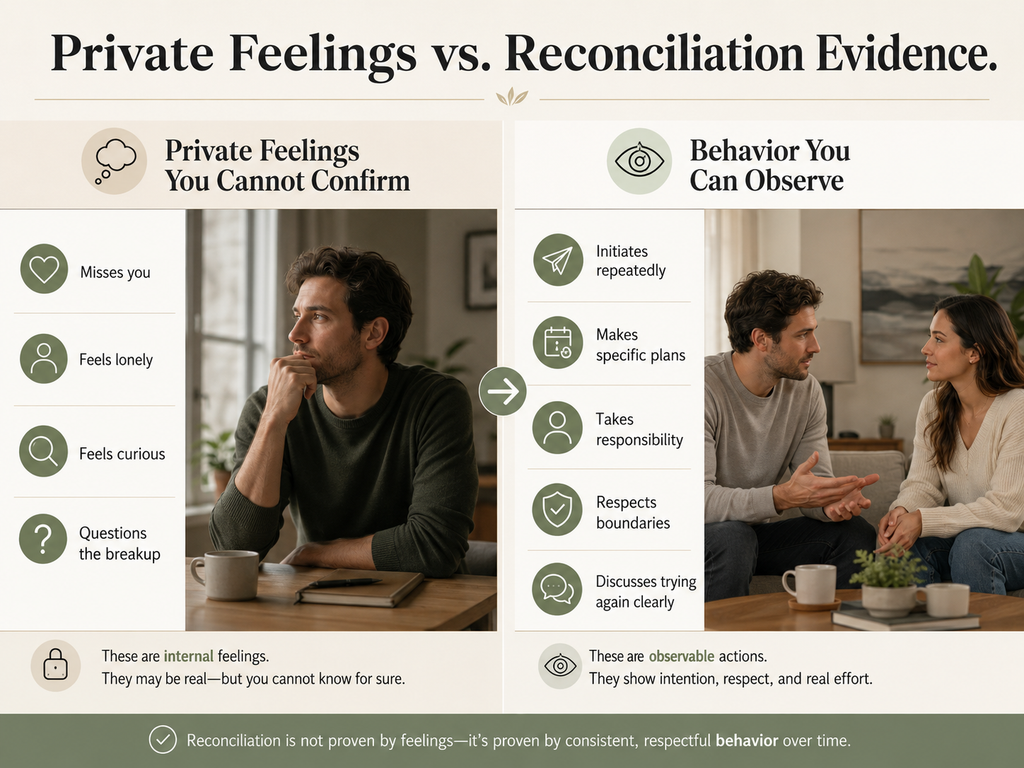
Signs to Watch After Contact Resumes:
- He initiates more than once rather than sending one breadcrumb.
- He asks genuine questions and keeps the conversation going.
- He speaks specifically about what he has been reflecting on.
- He makes concrete plans and follows through.
- He can discuss what went wrong without avoiding responsibility.
- He respects your pace and any boundaries you set.
- He becomes clearer about whether he wants to explore reconciliation.
One emotional message may be sincere. A repeated pattern tells you much more.
What No Contact Does to the Psychology of the Relationship
No contact does not operate only inside his mind. It changes the relationship system by removing immediate access, reassurance, conflict, and habitual communication. That can reduce pressure and reveal whether either person voluntarily moves toward the other once the old chase pattern stops.
For you, the same space can reduce impulsive texting and help you see the breakup more accurately. If your days are still built around his social media, his imagined thoughts, and the exact number of days since the last message, you may be physically silent while psychologically remaining inside the relationship every hour.
A healthy use of no contact rule male psychology therefore includes your own psychology. Use the time to rebuild sleep, work, friendships, exercise, interests, and routines. Ask what you miss, what you do not miss, and what would need to be different before reconciliation became a good decision rather than simply an emotionally relieving one.
How Long Does It Take for a Man to Miss You During No Contact?
There is no scientifically established day count. Claims that men reliably move through identical stages on day 7, 14, 21, or 30 oversimplify individual differences. The length and quality of the relationship, who initiated the breakup, attachment style, conflict, current life circumstances, and access to emotional support can all shape what happens.
If you are using a countdown to manage uncertainty, shift to readiness markers instead. Are you checking less? Can you tolerate the possibility that he may not return? Can you think about contacting him without feeling that one response will determine your worth? Those are more useful signs of progress than completing a magic number of days.
If he explicitly asked for no contact or blocked you, his boundary overrides any timeline you have read online. Do not bypass it through another number, account, friend, or surprise visit.
What If He Reaches Out During No Contact?
Do not treat the first message as proof that the strategy “worked.” One “hey,” “I miss you,” or “how are you?” tells you that he chose to make contact; it does not tell you whether he wants a relationship. Match the level of the message and watch what happens next.
If communication develops, look for reciprocity and increasing clarity. Notice whether he initiates again, makes real plans, can discuss the breakup, takes responsibility, and respects your boundaries. The more serious his intention becomes, the less interpretation you should have to do.
What If He Does Not Reach Out?
Silence is also information, but it is not a complete explanation. He may be respecting the breakup, waiting, avoiding vulnerability, moving on, or believing that contact would reopen conflict. You cannot know which without communication, and repeatedly pursuing him to solve the mystery can undermine the purpose of the space.
If no explicit boundary exists and the no-contact period was your own recovery choice, one respectful message later may be reasonable when you have a clear purpose and can accept any response. If he does not respond or remains consistently distant, do not keep escalating contact to force clarity.
Your emotional recovery should not depend on proving that he secretly misses you. No contact is healthier when it still helps you become steadier even if the relationship does not restart.
Where The Ex Factor 2.0 May Fit
The current women’s order page for The Ex Factor 2.0 lists a 163-page interactive e-book, 20-part video course, three-part bonus video series, How To Read A Man, Why Men Pull Away, and Flawless Fat Loss Guide. The page lists a $47 price, immediate access to the digital program, ClickBank processing, and a 60-day money-back guarantee.
The program may appeal to readers who prefer a structured recovery and reconciliation system. One material limitation is its promotional framing: the sales presentation makes strong claims about controlling or reliably influencing a man’s emotions and promotes tactics such as ignoring an ex and “covert jealousy.” Those are seller marketing claims, not established guarantees about male psychology or a particular relationship, so manipulation-based tactics are better filtered out in favor of consent, boundaries, accountability, honest communication, and voluntary reconciliation.
If you prefer a structured ebook-and-video reconciliation program and are comfortable applying that filter, you can consider The Ex Factor 2.0 as an optional supplement rather than a substitute for compatibility, mutual willingness, boundaries, or your own judgment.
What Male Psychology During No Contact Really Tells You
Ultimately, no contact rule male psychology is useful only when it moves you away from simplistic promises. He may feel relief, notice your absence, process privately, remember the relationship more warmly, become curious, experience attachment-driven distress, reconsider the breakup, or gradually accept it. Several of these can happen together.
The strongest information arrives through behavior, not speculation. If he later offers repeated contact, accountability, consistent effort, respect, and a direct conversation about rebuilding, you have something concrete to evaluate. If he remains silent or unclear, do not turn every digital trace into proof of hidden intent.
The purpose of understanding psychology is not to control him. It is to interpret the breakup more realistically and make your next decision with clearer eyes.
What happens to a man psychologically during no contact?
There is no single sequence. He may initially feel relief, later notice your absence, privately process the breakup, become nostalgic or curious, reconsider the relationship, or gradually accept that it has ended.
When does a man start missing you during no contact?
There is no reliable number of days. Relationship history, attachment style, breakup circumstances, emotional support, and individual coping patterns can all affect when—or whether—missing you becomes prominent.
Do men usually feel relief first during no contact?
Some do, particularly after a high-conflict or emotionally exhausting breakup. Others may feel loss immediately. Initial relief should not be treated as proof that he never cared.
Does checking my stories mean he misses me?
Not necessarily. Story views can reflect habit, curiosity, boredom, or lingering attachment. Direct, consistent behavior gives you stronger information about his intentions.
What does it mean if he contacts me during no contact?
It means he chose to reopen communication. Whether that reflects loneliness, curiosity, lingering feelings, or reconciliation interest becomes clearer through repeated effort and what he does afterward.
Should I contact him if he has not reached out?
If he requested no contact or blocked you, respect that boundary. If no such boundary exists, one respectful message may eventually be reasonable when you have a clear purpose and can accept any response.